Grout vs Concrete: Mix Design, Strength & Application Guide
Compare grout vs concrete mix designs, compressive strengths, and ASTM standards. Learn when to use flowable grout or structural concrete.
Executive Summary: The Core Distinction
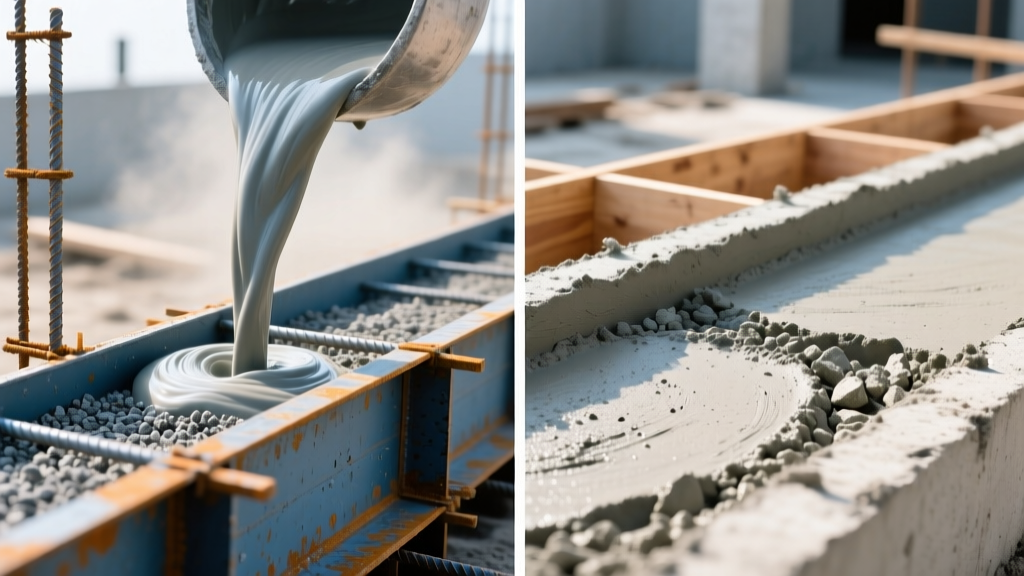
While both materials share a Portland cement base, concrete is a structural composite relying on coarse aggregate for load-bearing capacity and volume stability. Grout is a highly flowable, fine-aggregate mixture designed to fill voids, bond masonry units, and anchor structural steel. Substituting one for the other leads to catastrophic structural failures, excessive shrinkage, or severe honeycombing.
The Fundamental Divide: Aggregate Gradation and Slump
The primary physical difference between grout and concrete lies in aggregate sizing and the resulting workability, measured by the slump test. These physical properties dictate how each material behaves during placement and curing.
Concrete: Coarse Aggregate and Stiffness
Structural concrete utilizes a continuous gradation of both fine aggregate (sand) and coarse aggregate (crushed stone or gravel). The coarse aggregate typically ranges from 3/8-inch to 1.5 inches in diameter, complying with ASTM C33 standards. This coarse matrix provides the bulk of the compressive strength and significantly reduces the overall cement paste volume required, which minimizes shrinkage and heat of hydration.
Standard concrete mixes exhibit a slump between 3 and 5 inches. This relatively stiff consistency allows it to hold its formwork under high hydrostatic pressure and be finished with power trowels for flatwork.
Grout: Fine Aggregate and High Flowability
Grout entirely omits coarse aggregate. It relies exclusively on fine aggregates, typically washed concrete sand where 100% of the particles pass through a No. 4 sieve (4.75 mm) and often a No. 8 sieve (2.36 mm). This fine gradation allows the mixture to flow into narrow, heavily congested spaces, such as masonry block cells, under baseplates, and around tightly spaced rebar.
To achieve this flowability, grout requires a much higher slump, typically ranging from 8 to 12 inches, and sometimes exceeding 14 inches for self-consolidating grouts. Unlike concrete, grout is rarely vibrated; it must be fluid enough to self-consolidate and eliminate entrapped air without mechanical intervention.
Mix Design Anatomy: Proportions and Water-Cement Ratios
The mix design philosophy for these two materials is fundamentally opposed. Concrete optimizes for the lowest possible water content to maximize strength and durability, while grout prioritizes fluidity, requiring chemical or volumetric interventions to maintain structural integrity.
| Parameter | Structural Concrete | Masonry & Non-Shrink Grout |
|---|---|---|
| Water-Cement (w/c) Ratio | 0.40 to 0.50 | 0.55 to 0.80+ |
| Cement Content (per cy) | 450 to 600 lbs (4 to 5 bags) | 600 to 850 lbs (5.5 to 7.5 bags) |
| Aggregate Type | Fine + Coarse (up to 1.5 in.) | Fine only (passes No. 4 sieve) |
| Target Slump | 3 to 5 inches | 8 to 12+ inches |
| Consolidation Method | Internal vibration | Self-consolidating / Puddling |
The High Water Paradox in Grout
A fundamental rule of cementitious chemistry is that higher water content leads to lower compressive strength and higher permeability. Since grout requires a high w/c ratio (often exceeding 0.60) to achieve an 11-inch slump, it should theoretically be weak. However, grout mix designs compensate for this by drastically increasing the cement content. By utilizing 6 to 7.5 bags of Portland cement per cubic yard, the sheer volume of cementitious material ensures that even with excess water, the resulting 28-day compressive strength easily meets the 2,000 to 4,000 psi requirements specified by the Masonry Society and ASTM C476.
Modern non-shrink grouts (ASTM C1107) bypass the high-water issue entirely by utilizing High-Range Water-Reducing Admixtures (HRWRA), specifically polycarboxylate ether (PCE) superplasticizers. These allow for a low w/c ratio (0.35 to 0.45) while maintaining a highly fluid 10-inch slump, resulting in compressive strengths exceeding 8,000 psi at 28 days.
Compressive Strength and ASTM Standards
Specifying the correct material requires adherence to distinct testing and performance standards. Concrete and grout are governed by entirely different ASTM frameworks.
- Concrete (ASTM C94 / ACI 318): Ready-mix concrete is batched to precise volumetric proportions. Standard structural flatwork and foundations typically specify 3,000 to 5,000 psi at 28 days. High-rise columns may specify 10,000+ psi. Testing is performed via cast cylinders cured in a lab environment.
- Masonry Grout (ASTM C476): Governed by proportion specifications or property specifications. The minimum compressive strength is typically 2,000 psi, though engineered shear walls often require 3,000 to 4,000 psi. Testing involves casting grout into paper cone molds or directly into masonry prisms to account for the moisture absorption of the surrounding clay or concrete blocks.
- Non-Shrink Structural Grout (ASTM C1107): Used for baseplates, column bearings, and heavy machinery anchoring. These pre-packaged, dry-shake or flowable grouts must exhibit zero to slight volume expansion (0.0% to 3.0%) to ensure 100% bearing contact under steel plates. Strengths routinely exceed 7,000 psi at 28 days, with 1-day strengths often reaching 3,500 psi for rapid-return-to-service applications.
Real-World Applications: Decision Framework
Selecting the wrong material for a specific structural node is a frequent cause of construction litigation. Use this decision framework to specify the correct material on site.
Specify Structural Concrete When:
- Pouring continuous footings, grade beams, or mat foundations.
- Casting suspended slabs, tilt-up panels, or elevated decks.
- Forming retaining walls or shear cores where coarse aggregate interlock provides necessary shear friction.
- The volume exceeds 2 cubic yards and the formwork can withstand high hydrostatic pressure.
Specify Flowable Grout When:
- Filling the vertical cells of reinforced concrete masonry units (CMU) or clay brick walls.
- Pouring beneath structural steel baseplates, column bearing plates, or bridge pedestals where a 100% bearing seal is critical.
- Encasing anchor bolts in deep, narrow concrete pockets or dowel holes.
- Stabilizing soil or filling abandoned utility voids (using specialized cellular or flowable fill grouts).
Cost and Yield Analysis (2026 Pricing)
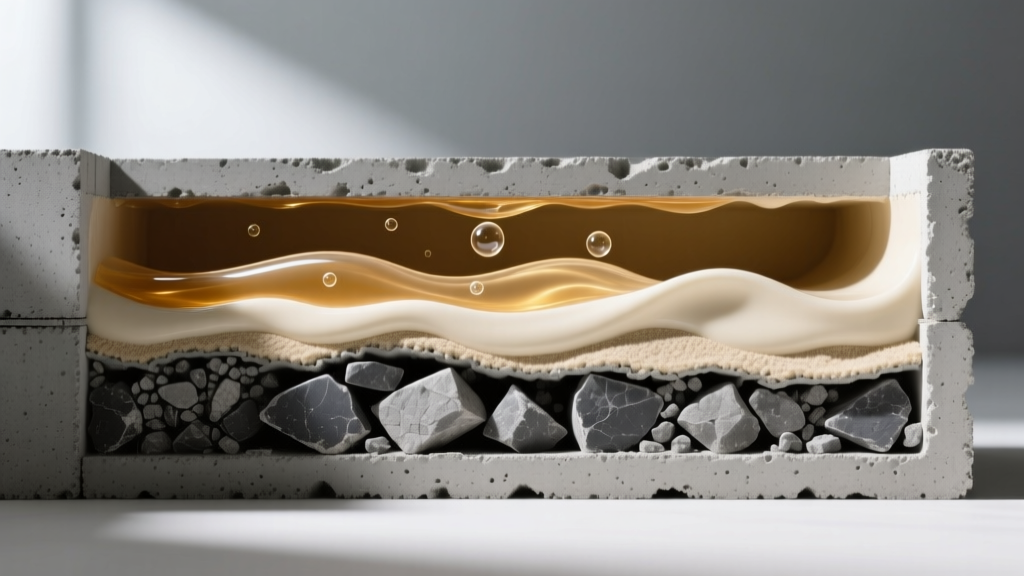
The economics of grout versus concrete differ drastically due to batching methods, cement concentrations, and delivery logistics.
Ready-Mix Concrete: In 2026, standard 4,000 psi ready-mix concrete averages $145 to $175 per cubic yard delivered. Because it relies heavily on inexpensive coarse aggregate and fly ash/slag supplementary cementitious materials (SCMs), the cost per unit of volume remains relatively low. Minimum load fees apply for orders under 4 cubic yards.
Bulk Masonry Grout: Ready-mix masonry grout (delivered via specialized mixers with higher drum speeds) typically costs $190 to $240 per cubic yard. The higher cost reflects the increased cement content and the absence of cheap coarse stone.
Pre-Packaged Non-Shrink Grout: For precision baseplate work, contractors use 50-lb bags of product like SikaGrout or Quikrete Non-Shrink. At $28 to $45 per bag, and yielding approximately 0.45 cubic feet per bag, the in-place cost translates to a staggering $1,800 to $2,800 per cubic yard. This extreme premium is justified by the microscopic tolerances and zero-shrinkage requirements of heavy industrial and structural steel connections.
Common Specification Errors and Failure Modes
Understanding how these materials fail when misapplied is critical for quality assurance and site superintendents.
Error 1: Pumping Concrete into CMU Cells
The Mistake: Attempting to fill masonry block cells with standard 3/4-inch aggregate concrete to save money or avoid ordering a separate grout truck.
The Failure Mode: The coarse aggregate bridges across the narrow 5-inch block cells, creating massive honeycombs and voids. The rebar remains unencapsulated, completely nullifying the engineered shear and moment capacity of the wall.
The Fix: Always specify fine-aggregate masonry grout with an 11-inch slump, poured in 5-foot lifts and mechanically puddled to ensure complete encapsulation.
Error 2: Using Grout for Structural Flatwork
The Mistake: Using high-strength, flowable non-shrink grout to cast a small exterior patio or structural slab because it is 'stronger' than standard concrete.
The Failure Mode: Grout lacks the coarse aggregate skeleton that provides dimensional stability and flexural toughness. Without coarse stone, the high cement paste volume results in severe plastic shrinkage cracking, curling at the edges, and a brittle failure mode under dynamic loads.
The Fix: Restrict grout strictly to void-filling, bonding, and encapsulation. Use air-entrained concrete with a 0.45 w/c ratio for any exposed flatwork subject to freeze-thaw cycles.
Error 3: Ignoring Bleed Water in Deep Grout Lifts
The Mistake: Pouring high-slump masonry grout into 10-foot tall CMU shear walls in a single continuous lift.
The Failure Mode: The high water content separates from the cement paste under hydrostatic pressure. Bleed water accumulates at horizontal cold joints and around dowels, creating weak, porous fault lines that fail during seismic shear events.
The Fix: Adhere to industry grouting guidelines by limiting pours to 5-foot maximum lifts. Allow 30 to 45 minutes for initial settlement and bleed water evaporation before placing the next lift, or utilize low-slump, self-consolidating grout admixtures designed for high-lift pours.
Written by
Elena RodriguezElena Rodriguez is a civil engineer and technical writer specializing in concrete technology, masonry systems, and ASTM/ACI compliance. She earned her B.S. in Civil Engineering from Texas A&M University and spent a decade at a materials testing laboratory, performing over 2,000 concrete compressive strength tests and masonry prism evaluations. Elena is an ACI-certified Field Testing Technician (Grade I) and a member of ASTM Committee C12 on Natural Building Stone. She currently consults on forensic engineering cases involving concrete failures and moisture intrusion. Based in San Antonio, TX, Elena is a proud member of the Society of Women Engineers (SWE) and coaches her daughter's FIRST Robotics team.
More from Elena Rodriguez
View all
Walls & Panels
Cost Analysis: Light Gauge Steel Framing Advantages and Disadvantages
Evaluate light gauge steel framing advantages and disadvantages through a strict cost analysis lens, comparing material, labor, and lifecycle expenses.
Aug 4, 2026

Walls & Panels
Gypsum Board Types: Exact Specifications, Thickness & Dimensions
Compare standard, Type X, and moisture-resistant gypsum board types. Get exact specifications, thicknesses, dimensions, and ASTM standards for your project.
Aug 4, 2026

Fire Resistance
Best Fire-Resistant Outdoor Decking Materials: 2026 Buyer Guide
Discover the best fire-resistant outdoor decking materials for 2026. Compare Class A PVC, aluminum, and hardwood options for WUI compliance and safety.
Aug 4, 2026