Comparing Types of Concrete Finish for Driveways and Patio Slabs
Compare types of concrete finish for driveways and patios. Explore costs, slip resistance data, execution steps, and climate-specific decision frameworks.

The Physics of Surface Texture: Slip Resistance and Traction
When selecting from the various types of concrete finish for exterior applications, aesthetics often overshadow functional physics. However, the surface texture directly dictates the Static Coefficient of Friction (SCOF), a critical metric for pedestrian safety and vehicular traction. According to OSHA Walking-Working Surfaces standards, flat walking surfaces should maintain a minimum SCOF of 0.50, while ramps require 0.60 or higher. A standard hard steel-troweled finish yields an SCOF of roughly 0.35 when wet, making it hazardous for exterior patios or pool decks. Conversely, a coarse broom finish achieves an SCOF between 0.75 and 0.85. Understanding these friction baselines is the first step in matching the correct finish to the anticipated foot traffic and environmental moisture of your specific site.
Comprehensive Matrix: 6 Primary Types of Concrete Finish
The following matrix breaks down the 2026 market rates, functional metrics, and ideal use cases for the most common exterior concrete finishes. Labor rates reflect national averages for specialized finishing crews.
| Finish Type | Material Cost (per sq ft) | Total Installed Cost (2026) | Wet SCOF Rating | Ideal Application |
|---|---|---|---|---|
| Broom Finish | $0.10 - $0.25 | $7.00 - $11.00 | 0.75 - 0.85 | Driveways, public sidewalks, pool decks |
| Exposed Aggregate | $0.40 - $0.80 | $11.00 - $17.00 | 0.80 - 0.90 | High-traffic walkways, steep driveway inclines |
| Stamped / Textured | $2.50 - $4.00 | $16.00 - $26.00 | 0.55 - 0.65 | Patios, courtyards, decorative aprons |
| Salt Finish | $0.15 - $0.30 | $8.00 - $12.00 | 0.65 - 0.75 | Pool decks, coastal properties |
| Polished (Exterior Grit) | $1.50 - $3.00 | $12.00 - $19.00 | 0.50 - 0.60 | Covered patios, modern architectural entries |
| Acid Stained / Sealed | $1.00 - $2.50 | $9.00 - $15.00 | 0.45 - 0.55 | Low-moisture covered porches, interior-exterior transitions |
Execution Protocols and Common Failure Modes
The National Ready Mixed Concrete Association (NRMCA) emphasizes that the timing of finishing operations is just as critical as the technique itself. Premature finishing traps bleed water beneath the surface crust, leading to catastrophic scaling, spalling, and dusting within the first freeze-thaw cycle.
Broom and Float Finishes: The Utility Standard
A broom finish is executed by dragging a specialized concrete broom across the surface after the bleed water has completely evaporated and the concrete has stiffened enough to support the weight of the tool without gouging. The rule of thumb: when you press your thumb into the slab, it should leave an indentation of exactly 1/4 inch.
Never use a hard steel trowel on an exterior slab before brooming. Steel troweling pushes the coarse aggregate down and brings a weak layer of cement paste (laitance) to the top. When broomed over, this weak layer will peel off under UV exposure and deicing salts. Stick to magnesium or aluminum bullfloats for exterior leveling.
Bristle Selection: Use a polypropylene bristle broom for a fine, ADA-compliant texture that is comfortable for bare feet around pools. Use a coarse horsehair or stiff synthetic broom for steep driveways where maximum tire traction is required.
Exposed Aggregate: Chemical Retardation
Exposed aggregate finishes reveal the natural stone within the concrete mix. This is achieved by applying a chemical surface retarder (such as Sika Rugasol or Euclid Chemical EUCO CLEAR) immediately after the final screeding and floating. The retarder penetrates the top 1/4 inch of the slab, preventing the cement paste from hydrating.
The Washout Window: Timing the washout is highly temperature-dependent. At 70°F (21°C), washing typically begins 12 to 24 hours after placement. If you wash too early, the aggregate will pop out entirely, leaving deep, unstable voids. If you wash too late, the retarder is neutralized, and the paste will not scrub off. The target exposure depth is exactly 1/3 the diameter of the top-sized aggregate in your mix design (e.g., if using 3/4-inch pea gravel, expose 1/4 inch of the stone).
Stamped and Textured Overlays
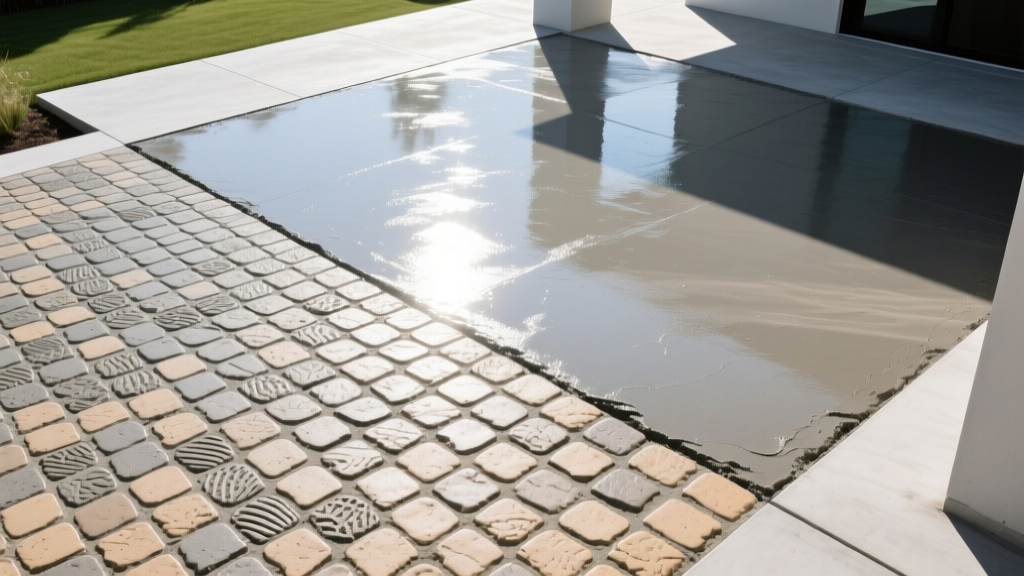
Stamped concrete mimics brick, slate, or natural stone. It requires a robust base slab: a minimum 4-inch thickness with a compressive strength of 3,000 psi and a 4-inch slump. The coloring process involves broadcasting a dry-shake color hardener (typically 60 lbs per 100 square feet) during the floating stage, followed by an antiquing release agent to prevent the polyurethane stamping mats from sticking to the wet concrete.
Failure to thoroughly power-wash the secondary release agent before sealing will result in a cloudy, opaque sealer coat that traps white powder beneath the surface. Wait 24 to 48 hours after stamping, then use a pressure washer with a surface cleaner attachment to remove the release agent until the water runs clear.
Climate-Specific Decision Framework
Choosing the right types of concrete finish requires analyzing the local macro-climate. The American Concrete Institute (ACI) provides stringent guidelines for concrete durability in extreme weather, which directly impacts finish selection.
- Freeze-Thaw Zones (USDA Zones 3-6): Avoid hard steel troweling and polished finishes for exterior flatwork. The dense surface traps microscopic air bubbles, preventing the concrete from expanding safely during freezing. Specify air-entrained concrete (5% to 7% air content by volume) paired with a coarse broom or exposed aggregate finish to allow for surface drainage and micro-expansion.
- High-Heat and Arid Zones (Zones 8-10): In environments where the evaporation rate exceeds the bleed rate (common in the US Southwest), stamped and exposed aggregate finishes are at high risk for plastic shrinkage cracking. Apply a monomolecular evaporation retardant film (like E-Con) immediately after screeding to trap moisture in the top 1/8 inch of the slab while the finishing crew works the texture.
- Coastal and High-Salinity Environments: Salt finishes and exposed aggregates perform best here. Stamped concrete requires film-forming acrylic sealers that degrade rapidly under intense UV and salt spray, requiring expensive biannual maintenance. Exposed aggregate relies on the physical stone, requiring only a penetrating silane/siloxane sealer that does not form a surface film and is immune to UV degradation.
Long-Term Maintenance and Resealing Economics
The lifecycle cost of a concrete finish is heavily dictated by the sealer required to maintain it. Film-forming sealers provide high gloss and color enhancement but wear away under foot traffic. Penetrating sealers offer zero aesthetic enhancement but provide a decade of invisible protection.
| Sealer Type | Compatible Finishes | Lifespan | Resealing Cost (per sq ft) |
|---|---|---|---|
| Solvent-Based Acrylic | Stamped, Stained | 1 - 2 Years | $1.50 - $2.50 |
| Water-Based Acrylic | Stamped (Low VOC areas) | 1 - 2 Years | $1.25 - $2.00 |
| Penetrating Silane/Siloxane | Broom, Exposed Aggregate, Salt | 5 - 10 Years | $0.40 - $0.80 |
| Aliphatic Polyurethane | High-Traffic Stamped, Polished | 3 - 5 Years | $2.50 - $4.00 |
Final Specification Checklist for Contractors and Homeowners
Before pouring an exterior slab, verify these critical specifications to ensure the chosen finish performs as intended over the next 20 years:
- Mix Design Verification: Confirm the batch ticket shows a minimum 3,000 psi compressive strength and a water-to-cement (w/c) ratio of 0.45 or lower. High w/c ratios guarantee surface dusting regardless of the finish type.
- Subgrade Compaction: Ensure the base gravel is compacted to 95% Proctor density. Uneven settling will cause rigid finishes like stamped or exposed aggregate to crack along the score lines.
- Jointing Plan: Control joints must be cut to a depth of 1/4 the slab thickness within 12 hours of placement. For stamped concrete, joints must be integrated into the stamp pattern (e.g., hidden in the grout lines of a cobblestone mat) to avoid ruining the visual continuity.
- Curing Protocol: Do not use polyethylene sheeting to cure stamped or colored concrete, as it traps moisture unevenly and causes permanent dark blotching. Use a liquid membrane curing compound or continuous fine misting with soaker hoses for the first 72 hours.
Written by
Priya KapoorPriya Kapoor is a real estate market analyst and construction economics researcher with expertise in housing affordability, development feasibility, and infrastructure investment. She holds a Master of Regional Planning from Cornell University and previously worked as a senior analyst at CBRE's Investment Properties group, where she modeled returns for $4B in mixed-use development pipelines. Priya now runs an independent research practice advising developers, municipalities, and REITs on construction cost forecasting and market timing. She publishes the quarterly "BuildMat Market Pulse" report tracking material price indices across 12 commodity categories. Based in Austin, TX, Priya serves on the board of Habitat for Humanity Austin and is a marathon runner.
More from Priya Kapoor
View all
Construction Cost
Cost to Build a 1600 Sq Ft Home in 2026: Full Breakdown
Accurate 2026 cost to build a 1600 sq ft home—material, labor, and regional pricing breakdowns included. Plan your budget with real-time estimates.
Aug 11, 2026

Wood & Lumber
Name the Types of Wood for Pressure Treatment and Preservation
Learn how to name the types of wood best suited for pressure treatment. Compare species treatability, chemical retention levels, and 2026 preservation costs.
Aug 4, 2026

Stone & Masonry
Stone Veneer Suppliers Lindenhurst: 2026 Cost Analysis
Analyze 2026 stone veneer costs in Lindenhurst, NY. Compare local supplier pricing, delivery fees, and Suffolk County installation labor rates.
Aug 4, 2026