Concrete Block Foundation Repair Cost & Troubleshooting Guide 2026
Discover the true concrete block foundation repair cost in 2026. Diagnose CMU wall cracks, bowing, and water intrusion with expert fix strategies.

The Anatomy of CMU Foundation Failures
Concrete Masonry Unit (CMU) foundations—commonly known as concrete block walls—behave fundamentally differently than monolithic poured concrete. While poured walls rely on the tensile strength of steel rebar and the cohesive mass of the concrete itself, CMU walls are an assembly of individual 8x8x16-inch blocks bound by mortar joints. According to the Portland Cement Association, these mortar joints represent the weakest link in the structural chain. When lateral earth pressure or hydrostatic water pressure exceeds the shear capacity of the mortar, the wall articulates at the joints, leading to predictable but severe failure modes.
Understanding the specific concrete block foundation repair cost requires first identifying the exact mechanical failure occurring in your basement or crawlspace. A misdiagnosed crack can lead to thousands of dollars in wasted waterproofing treatments that fail to address underlying structural deflection.
Diagnostic Matrix: Symptom, Cause, and Repair
Before requesting contractor bids, map your wall's symptoms to this diagnostic matrix. The International Association of Certified Home Inspectors (InterNACHI) categorizes CMU defects by their visual geometry, which directly dictates the repair methodology.
| Crack Geometry | Primary Cause | Required Repair Method |
|---|---|---|
| Stair-Step (following mortar joints) | Differential settlement or localized lateral pressure | Helical piers (if settling) or Carbon Fiber/Anchors (if lateral) |
| Horizontal (mid-wall, usually 3rd-5th course) | Hydrostatic pressure exceeding lateral shear capacity | Wall anchors, Steel I-Beams, or Carbon Fiber straps |
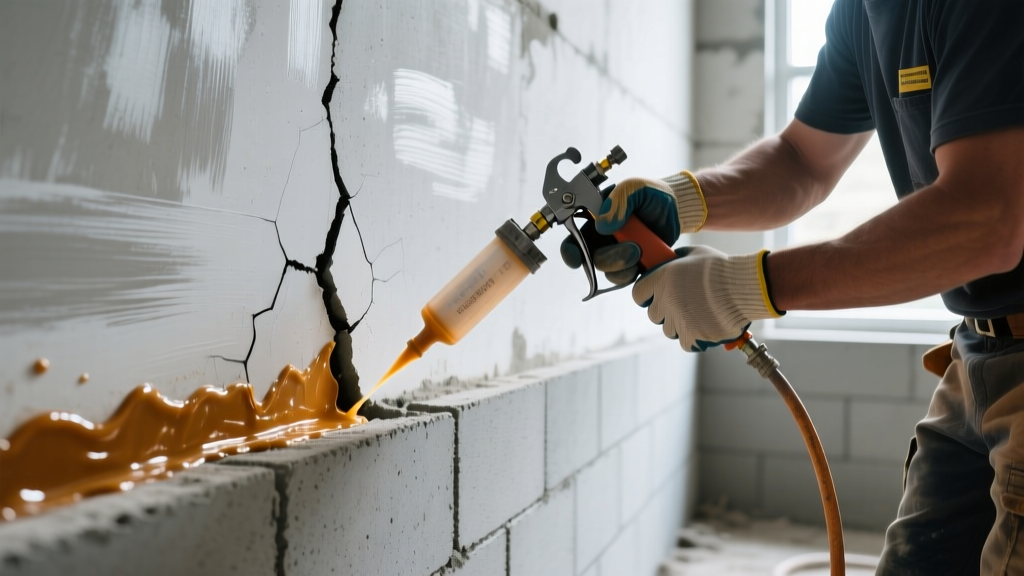
| Vertical (splitting blocks or straight down joints) | Thermal shrinkage, minor uniform settlement, or frost heave | Epoxy injection or Polyurethane foam sealing |
| Cobweb/Map (surface level) | Concrete carbonation or rapid surface drying during curing | Surface patching or elastomeric waterproof coating |
2026 Concrete Block Foundation Repair Cost Breakdown
Pricing for foundation stabilization has shifted in 2026 due to supply chain adjustments in carbon fiber manufacturing and the rising cost of deep-foundation steel. Below is the current national average cost matrix for professional CMU repairs. Note that these figures assume standard 8-foot basement walls and do not include exterior excavation.
| Repair Method | Unit of Measure | 2026 Cost Range (Low - High) | Best Application |
|---|---|---|---|
| Polyurethane Crack Injection | Per Crack (up to 8ft) | $450 - $850 | Active water leaks in non-structural vertical cracks |
| Structural Epoxy Injection | Per Linear Foot | $75 - $125 | Welding dormant stair-step or vertical cracks |
| Carbon Fiber Straps | Per Strap (48" on center) | $550 - $800 | Walls bowing inward less than 2 inches |
| Steel I-Beam Bracing (e.g., PowerBrace) | Per Beam | $850 - $1,200 | Severe bowing, allowing for incremental wall straightening |
| Exterior Wall Anchors (e.g., Geo-Lock) | Per Anchor | $900 - $1,400 | Stabilizing horizontal shear cracks where interior space is limited |
| Helical Piers | Per Pier (driven 20-30ft) | $2,200 - $3,100 | Lifting and stabilizing settling footings beneath stair-step cracks |
| Exterior Excavation & Waterproofing | Per Linear Foot | $180 - $280 | Comprehensive hydrostatic pressure relief and membrane application |
Material Deep Dive: Selecting the Right Structural Fix
When contractors propose solutions, they will often default to the system they are franchised to install. As an informed property owner, you must understand the material science behind these systems to ensure the correct application for your specific CMU failure.
Polyurethane vs. Epoxy for Crack Sealing
Not all injections are created equal. If water is actively seeping through a vertical CMU joint, the contractor must use a hydrophobic polyurethane foam, such as Sika Injection-201 CE. This material expands upon contact with water, filling the hollow cores of the concrete block and the surrounding soil void. Conversely, if the crack is dry and the goal is to restore the structural tensile strength of the mortar joint, a high-modulus epoxy like SikaDur 35 Hi-Mod is required. Epoxy effectively welds the masonry back together, boasting a tensile strength that exceeds the concrete itself.
Carbon Fiber vs. Steel I-Beams for Bowing Walls
Carbon fiber systems (like CarbonArmor or Fortress Stabilization) utilize aerospace-grade composite straps bonded to the CMU surface with structural epoxy. They are incredibly strong in tension (up to 10 times stronger than steel) and lie flush against the wall, allowing you to finish the basement directly over them. However, carbon fiber cannot straighten a bowed wall; it only locks it in its current position. If your wall has deflected more than 2 inches, or if you require the wall to be jacked back to plumb over time, adjustable steel I-beams (e.g., Supportworks PowerBrace) anchored to the floor joists and concrete slab are the mandatory choice.
Deep Foundation Support: Helical Piers
If your stair-step cracking is accompanied by a sloping floor above, the issue is footing settlement, not lateral wall pressure. In this scenario, wall anchors will not help. You need Chance Helical Piles or equivalent helical piers. These steel shafts are hydraulically torqued through the unstable soil beneath your footing until they reach load-bearing strata (often 20 to 40 feet deep). The footing is then bracketed and lifted. The cost is high, but it permanently halts differential settlement.
"The most common mistake homeowners make with CMU foundations is treating a structural deflection problem as a simple waterproofing issue. Painting over a horizontal shear crack with Drylok does nothing to counteract the 60+ pounds per square foot of lateral hydrostatic pressure pushing against the exterior of the wall."
— Structural Engineering Field Note
Hidden Variables That Inflate Your Invoice
The base concrete block foundation repair cost rarely tells the whole financial story. When budgeting for your project, factor in these ancillary expenses that frequently arise during the repair process:
- Structural Engineering Report ($500 - $1,200): Never rely solely on a contractor's free inspection for severe bowing or settlement. Hire an independent, licensed Structural Engineer (PE) to draft a repair specification. This ensures contractors bid on the exact same scope of work and prevents over-engineering.
- Interior French Drain Integration ($85 - $125 per linear foot): If you are installing wall anchors or steel beams, the bottom flange will interfere with standard interior perimeter drains. You may need to trench and install a specialized drainage channel like WaterGuard that routes water beneath the stabilization hardware.
- Hollow Core Reinforcement ($40 - $60 per block): For carbon fiber installations on highly degraded CMU walls, contractors may need to drill into the hollow cores of the blocks and fill them with high-strength grout and vertical rebar to provide a solid substrate for the epoxy bonding.
- Radon Mitigation Adaptations ($1,500 - $2,500): Sealing CMU cracks alters the pressure dynamics of your basement. If you live in a high-radon zone (EPA Zones 1 or 2), sealing the foundation without upgrading your sub-slab depressurization system can cause radon gas to pool indoors.
Actionable Decision Framework: DIY vs. Professional Intervention
Use this framework to determine your next step based on the physical evidence on your foundation walls:
- Scenario A: Hairline vertical cracks (< 1/16") with no moisture.
Action: DIY. Clean the crack with a wire brush and apply a high-quality elastomeric polyurethane sealant (e.g., SikaFlex). Monitor with a glass crack gauge over 6 months. - Scenario B: Vertical or stair-step cracks (1/16" to 1/4") with active water seepage.
Action: Professional. Requires high-pressure polyurethane injection to fill the block cores and exterior soil voids. DIY surface sealants will simply force the water to find a new exit point. - Scenario C: Horizontal cracking with inward bowing (< 2 inches).
Action: Professional Structural Repair. Carbon fiber straps are the most cost-effective and least invasive solution here. Ensure exterior grading and downspout extensions are corrected simultaneously to relieve hydrostatic pressure. - Scenario D: Horizontal cracking with bowing (> 2 inches) or severe settlement.
Action: Independent Structural Engineer followed by Professional Repair. Steel I-beams or helical piers are mandatory. Do not accept bids from contractors who suggest carbon fiber for walls deflected beyond 2 inches.
By accurately diagnosing the geometry of your CMU failures and understanding the material limitations of modern repair systems, you can navigate the 2026 concrete block foundation repair cost landscape with confidence, ensuring your home's structural integrity is permanently restored.
Written by
Priya KapoorPriya Kapoor is a real estate market analyst and construction economics researcher with expertise in housing affordability, development feasibility, and infrastructure investment. She holds a Master of Regional Planning from Cornell University and previously worked as a senior analyst at CBRE's Investment Properties group, where she modeled returns for $4B in mixed-use development pipelines. Priya now runs an independent research practice advising developers, municipalities, and REITs on construction cost forecasting and market timing. She publishes the quarterly "BuildMat Market Pulse" report tracking material price indices across 12 commodity categories. Based in Austin, TX, Priya serves on the board of Habitat for Humanity Austin and is a marathon runner.
More from Priya Kapoor
View all
Construction Cost
Cost to Build a 1600 Sq Ft Home in 2026: Full Breakdown
Accurate 2026 cost to build a 1600 sq ft home—material, labor, and regional pricing breakdowns included. Plan your budget with real-time estimates.
Aug 11, 2026

Wood & Lumber
Name the Types of Wood for Pressure Treatment and Preservation
Learn how to name the types of wood best suited for pressure treatment. Compare species treatability, chemical retention levels, and 2026 preservation costs.
Aug 4, 2026

Stone & Masonry
Stone Veneer Suppliers Lindenhurst: 2026 Cost Analysis
Analyze 2026 stone veneer costs in Lindenhurst, NY. Compare local supplier pricing, delivery fees, and Suffolk County installation labor rates.
Aug 4, 2026