How Many Bags of Concrete Do I Need? Project Scenario Guide
Calculate exactly how many bags of concrete you need for DIY projects. Match scenarios, bag sizes, and mix types to avoid waste and cold joints.
The Yield Math: Translating Cubic Feet to Bags
Miscalculating concrete volume results in two equally frustrating outcomes: wasted money on cured, unusable bags, or a mid-pour shortage that forces a structurally compromising cold joint. To determine exactly how many bags of concrete you need, you must first convert your project dimensions into cubic feet, then apply the specific yield of the bag size you intend to buy.
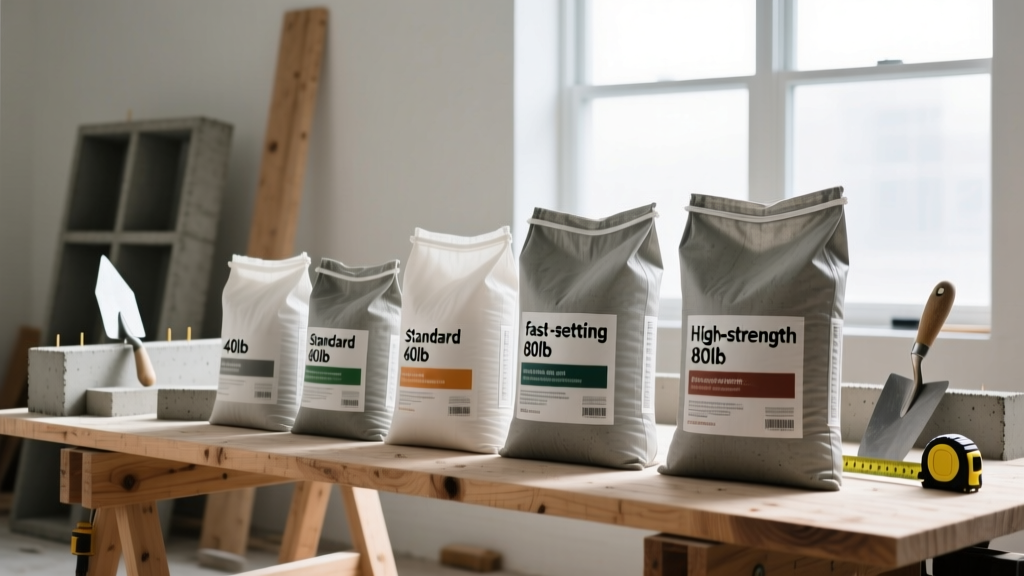
According to standard industry formulations documented by the Portland Cement Association, pre-mixed concrete bags are sold by dry weight, but their volume is measured in wet yield. The baseline yields for standard density mixes are:
- 80 lb bag: Yields 0.60 cubic feet
- 60 lb bag: Yields 0.45 cubic feet
- 50 lb bag: Yields 0.375 cubic feet (common for fast-setting mixes)
- 40 lb bag: Yields 0.30 cubic feet
The foundational formula for any slab or footer is: Length (ft) × Width (ft) × Depth (ft) = Total Cubic Feet. For cylindrical applications like post holes, the formula is: 3.14 × Radius² (ft) × Depth (ft) = Total Cubic Feet. Once you have the total cubic footage, divide by the bag yield, then add a mandatory 10% overage factor to account for trench over-excavation, spillage, and formwork bowing.
Application-Fit Scenarios: Exact Counts for Common Projects
Generic calculators often fail to account for the displacement of physical objects inside the pour zone or the specific bag sizes optimized for the task. Below are exact calculations for three common DIY scenarios.
Scenario 1: Setting a 4x4 Mailbox Post
The Setup: A 12-inch diameter hole dug 24 inches deep, accommodating a 4x4 wooden post that extends to the bottom of the hole.
- Gross Hole Volume: 3.14 × (0.5 ft)² × 2 ft = 1.57 cubic feet.
- Post Displacement: A 4x4 post is actually 3.5" × 3.5". Volume displaced = (0.29 ft × 0.29 ft) × 2 ft = 0.17 cubic feet.
- Net Concrete Volume: 1.57 - 0.17 = 1.40 cubic feet.
The Match: For vertical post-setting, standard 80lb bags are heavy to maneuver in tight holes, and standard mix takes 24-48 hours to set, requiring extensive bracing. The optimal application-fit is a 50lb Fast-Setting Concrete Mix (yield: 0.375 cu ft).
Calculation: 1.40 ÷ 0.375 = 3.73 bags. You need exactly 4 bags of 50lb fast-setting mix per mailbox post. This mix achieves 400 PSI in just two hours, eliminating the need for overnight bracing.
Scenario 2: Pouring a 10x10 Shed Slab (4 Inches Thick)
The Setup: A standard 100 square foot pad for a prefabricated shed, poured at a standard 4-inch depth.
- Gross Volume: 10 ft × 10 ft × 0.333 ft = 33.3 cubic feet.
- 10% Overage: 33.3 × 1.10 = 36.63 cubic feet.
The Match: Slabs require high compressive strength to prevent cracking under point loads (like shed corners). Use an 80lb High-Strength 5000+ PSI Mix.
Calculation: 36.63 ÷ 0.60 = 61.05 bags. You need 62 bags of 80lb high-strength mix. Note: Mixing 62 bags manually is a logistical bottleneck. This scenario pushes the absolute upper limit of DIY bag-pouring before professional delivery becomes necessary (see Break-Even section below).
Scenario 3: Setting 15 Fence Posts (6-inch Diameter Holes)
The Setup: 15 holes, each 6 inches in diameter and 24 inches deep, for a standard 6-foot privacy fence.
- Volume Per Hole: 3.14 × (0.25 ft)² × 2 ft = 0.39 cubic feet.
- Net Volume (minus post): ~0.35 cubic feet per hole.
- Total Net Volume: 0.35 × 15 holes = 5.25 cubic feet.
The Match: Fence lines require speed and consistency. 60lb Standard Concrete Mix offers the best balance of weight and yield for repetitive lifting.
Calculation: 5.25 ÷ 0.45 = 11.66 bags. You need 12 bags of 60lb standard mix.
Mix Selection Matrix: Matching the Bag to the Job
Selecting the correct bag goes beyond mere volume; the chemical composition of the mix must align with the structural and environmental demands of the project. The Concrete Network emphasizes that using the wrong mix design is a primary cause of premature surface spalling and structural failure.
| Mix Type | Target Application | Compressive Strength (28-Day) | Set Time | Water Requirement (per 80lb) |
|---|---|---|---|---|
| Standard Concrete Mix | General slabs, sidewalks, footings | 4,000 PSI | 24-48 hours | ~3 quarts |
| High-Strength (5000+) | Driveways, heavy-load shed pads, winter pours | 5,000+ PSI | 24 hours | ~2.5 quarts |
| Fast-Setting | Post-setting, anchoring, emergency repairs | 4,000 PSI (in 28 days) | 20-40 minutes | ~2.75 quarts |
| Crack-Resistant (Fiber) | Overlays, thin patios, high-wind areas | 4,000 PSI | 24-48 hours | ~3 quarts |
| Sand Topping Mix | Under 2-inch thick repairs, setting pavers | 5,000 PSI | 24 hours | ~2 quarts |
Mixing Logistics: Wheelbarrow vs. Portable Mixer
Knowing how many bags you need is only half the battle; calculating your mixing throughput dictates whether your pour will succeed or result in cold joints. A cold joint occurs when a new batch of concrete is poured against a batch that has already begun its initial set, creating a permanent structural weak point.
- Wheelbarrow & Hoe: A standard 6-cubic-foot wheelbarrow can comfortably mix one 80lb bag at a time. Mixing, moving, and placing one bag takes an experienced DIYer about 8-10 minutes. At this rate, you can place roughly 6 bags per hour. This method is only viable for projects requiring 10 bags or fewer.
- Portable Drum Mixer: A standard 3.5-cubic-foot electric mixer (such as the Kushlan Products 350DD) can safely process two 80lb bags simultaneously. Cycle time drops to 4-5 minutes per batch, allowing you to place up to 15-20 bags per hour. For projects requiring 20 to 50 bags, renting a portable mixer is non-negotiable.
The Break-Even Point: Bags vs. Ready-Mix Delivery
There is a hard mathematical ceiling where buying bags becomes more expensive and labor-intensive than ordering a ready-mix truck. In 2026, the average retail price for an 80lb bag of standard mix hovers between $6.50 and $7.50, depending on regional supply chain variances.
Cost Comparison: 10x10 Slab (approx. 1.25 Cubic Yards)
Option A: Bagged Concrete
62 bags × $7.00 = $434.00
Plus tool rental (mixer/trowels): ~$75.00
Total: ~$509.00 (Requires 6-8 hours of intense physical labor)
Option B: Ready-Mix Truck
1.5 cubic yards (minimum order) × $180/yard = $270.00
Short-load fee (under 3 yards): ~$150.00
Total: ~$420.00 (Placed in 45 minutes via chute)
The Verdict: The financial and physical break-even point occurs at approximately 1.25 to 1.5 cubic yards (roughly 60 to 70 80lb bags). If your project requires more than 60 bags, abandon the bagged approach and order ready-mix. If your site lacks truck access (e.g., a backyard shed pad behind a narrow gate), consider hiring a concrete pump truck or utilizing a motorized buggy, but do not attempt to hand-mix 80+ bags in a single day.
Pro-Tips for Minimizing Waste and Cold Joints
- Stage Your Water: Never add all the water at once. Pour 75% of the required water into the mixer or wheelbarrow first, add the dry mix, and then slowly introduce the remaining 25%. This prevents the mix from becoming "soupy," which drastically reduces the final PSI and causes surface scaling.
- The "Wet Edge" Rule: When pouring a slab in multiple batches, never let the edge of the previous batch dry out. If you are working in hot weather (above 80°F), the initial set time accelerates. Keep a spray bottle of water handy to lightly mist the edge of the previous pour just before the new batch meets it, ensuring a chemical bond rather than a mechanical one.
- Pallet Storage: Concrete bags draw moisture directly from the earth and ambient humidity. If you are buying your bags a week before the project, store them on a wooden pallet elevated off the ground, and wrap the stack tightly in a polyethylene tarp. A single humid night can turn the bottom row of bags into solid, unusable bricks.