Colored Concrete vs Stained Concrete: Repair & Troubleshooting
Diagnose and fix fading, blotchiness, and peeling. Compare repair methods for colored concrete vs stained concrete with expert product picks and costs.

The Diagnostic Divide: Integral Pigment vs. Topical Reaction
Troubleshooting decorative concrete failures requires an immediate understanding of how the color was originally introduced. The debate of colored concrete vs stained concrete is fundamentally a comparison between integral chemistry and topical reactions. Integral colored concrete relies on synthetic iron oxide pigments mixed directly into the batch truck, coloring the entire slab matrix. Stained concrete—whether acid-based or water-based—relies on surface-level chemical reactions or topical pigment suspension. When failures occur, applying a stained concrete repair protocol to an integral colored slab (or vice versa) will result in catastrophic aesthetic failure. Below is the definitive diagnostic matrix and repair framework for both systems.
Symptom-to-Root-Cause Diagnostic Matrix
| Visual Symptom | System Type | Root Cause Analysis | Primary Repair Vector |
|---|---|---|---|
| White, powdery haze masking color | Integral Colored | Efflorescence (calcium carbonate migration) | Chemical dissolution & sealing |
| Surface fading from UV or traffic | Integral Colored | Cement paste erosion exposing unhydrated aggregate | Tinted micro-topping application |
| Patchwork or mismatched repair zones | Integral Colored | Hydration variance and water-cement ratio differences | Pigmented polymer-modified overlay |
| Blotchy, uneven dark spots | Acid Stained | Over-troweling (burned surface) or residual curing compounds | Mechanical profiling & re-staining |
| Peeling, flaking, or white bubbles | Water-Based Stained | Sealer delamination due to trapped moisture vapor | Chemical stripping & breathable resealing |
Troubleshooting Integral Colored Concrete
Defeating Efflorescence Without Etching the Pigment
Efflorescence is the most common complaint with integral colored concrete. As moisture moves through the slab, it carries water-soluble calcium hydroxide to the surface, where it reacts with atmospheric carbon dioxide to form a white calcium carbonate crust. On standard gray concrete, contractors often use aggressive muriatic acid washes to remove this crust. Never use raw muriatic acid on integral colored concrete. The acid will etch the cement paste, expose the underlying sand and aggregate, and permanently alter the slab's color profile.
The Repair Protocol:
- Apply a specialized, non-acidic efflorescence remover such as PROSOCO Sure Klean or a diluted solution of white vinegar and water (1:4 ratio).
- Agitate with a stiff nylon brush (avoid wire brushes, which leave rust-inducing metallic particles).
- Rinse thoroughly with a pressure washer set to a maximum of 1,500 PSI, maintaining a 12-inch standoff distance to prevent paste erosion.
- Once fully cured (minimum 48 hours), apply a penetrating silane/siloxane sealer to prevent future moisture migration.
Fixing Faded and Eroded Colored Slabs
When heavy foot traffic or UV degradation wears away the top 1/16th of an inch of the slab, the color appears faded because the uncolored aggregate is becoming exposed. You cannot 're-stain' integral concrete to fix this. According to guidelines from the International Concrete Repair Institute (ICRI), the surface must be properly profiled before applying an overlay.
The Repair Protocol:
- Shot-blast or scarify the surface to a CSP-2 (Concrete Surface Profile) standard.
- Apply a tinted micro-topping system. Products like Ardex SD-M mixed with Ardex Concrete Color allow you to match the original integral pigment exactly.
- Trowel the micro-topping to a feather-edge thickness of 1/16 inch. This restores the colored cement paste matrix without altering the slab's structural elevation or drainage slopes.
Troubleshooting Stained Concrete Systems
Acid Stain Blotchiness: The Calcium Hydroxide Deficit
Acid stains (like Kemiko Stone Tone or Scofield Lithochrome) do not contain pigment. They contain metallic salts suspended in a mild acid solution. The acid opens the pores, and the metallic salts react with the calcium hydroxide (lime) in the concrete to form permanent, insoluble color compounds. If an acid stain results in blotchy, pale, or entirely non-reactive patches, the surface lacks accessible calcium hydroxide. This occurs when finishers over-trowel the slab (burning it and trapping lime deep inside) or when acrylic curing compounds were not fully stripped prior to staining.
The Repair Protocol:
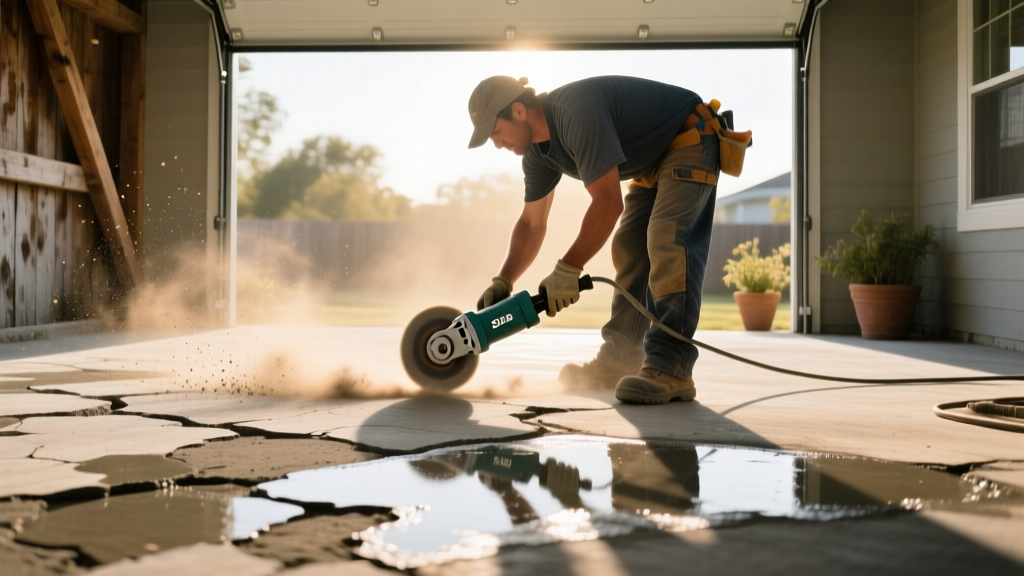
- Rent a walk-behind planetary grinder equipped with 50-grit metal-bond diamond segments.
- Grind the blotchy areas to remove the top 1/32nd of an inch of the burned or sealed surface.
- Vacuum the dust completely. Do not use water to clean the slab, as it will close the pores.
- Re-apply the acid stain. The freshly exposed lime will react aggressively, yielding deep, rich tones.
- Neutralize the surface with an ammonia-water solution (1 cup ammonia to 1 gallon water) to halt the acid reaction before sealing.
Water-Based Stain Peeling: Moisture Vapor Traps
Water-based stains are essentially topical acrylic pigments. They sit inside the pores but rely entirely on the protective sealer to prevent wear and UV fading. When a water-based stained floor begins peeling or developing white, cloudy blisters, the failure is almost always sealer delamination caused by hydrostatic pressure. If the concrete's Moisture Vapor Transmission Rate (MVTR) exceeds the sealer's breathability threshold, vapor pushes the acrylic film off the slab.
The Repair Protocol:
- Apply a soy-based chemical stripper (e.g., Franmar Soy Gel) to emulsify the failing acrylic or polyurethane sealer. Avoid caustic strippers, which can alter the pH and ruin the underlying water-based stain.
- Scrape the emulsified sealer and rinse with hot water.
- Test the slab's MVTR using a calcium chloride test kit (ASTM F1869). If emissions exceed 3 lbs/1,000 sq ft/24 hours, you cannot use a standard film-forming acrylic.
- Re-seal using a moisture-vapor-permeable penetrating sealer, such as a lithium silicate densifier paired with a breathable matte polyaspartic topcoat.
Repair Cost & Longevity Comparison
Budgeting for decorative concrete repairs requires understanding the labor intensity of the chosen vector. Below is the 2026 national average pricing for professional remediation.
| Repair Method | Target System | Avg. Cost (per sq. ft.) | Expected Longevity |
|---|---|---|---|
| Chemical Efflorescence Removal | Integral Colored | $0.75 - $1.25 | 3 - 5 years (depends on sealer) |
| Tinted Micro-Topping Overlay | Integral Colored | $5.50 - $8.50 | 10 - 15 years |
| Mechanical Profiling & Re-Stain | Acid Stained | $3.00 - $5.00 | Permanent (color) / 3-5 years (sealer) |
| Chemical Strip & Breathable Reseal | Water-Based Stained | $2.50 - $4.00 | 4 - 7 years |
The Golden Rule: Why Cross-System Repairs Fail
'Attempting to acid-stain an integral colored concrete slab to refresh its fading color is a guaranteed failure. The synthetic iron oxide pigments used in integral coloring consume the available calcium hydroxide during the initial hydration process. There is simply no lime left at the surface for the acid stain to react with.' — American Society of Concrete Contractors (ASCC) Position Guidelines on Decorative Concrete.
If an integral colored slab is severely damaged beyond what a micro-topping can fix, and the client demands a stained look, the contractor must aggressively shot-blast the slab to a CSP-4 profile, removing the colored paste entirely, before attempting to apply a topical water-based stain or dye. Acid stains will remain entirely ineffective on heavily pigmented integral slabs.
Sealer Selection Post-Repair
The final step in any colored or stained concrete repair is selecting the correct sacrificial wear layer. For exterior integral colored concrete, always use a penetrating silane/siloxane sealer. These sealers do not form a surface film, meaning they will never peel, yellow, or trap moisture, and they enhance the natural color without adding an artificial gloss. For interior acid-stained floors, a high-solids, solvent-based acrylic or a two-part polyaspartic provides the necessary scuff resistance and depth of color enhancement required for commercial or residential foot traffic. Always verify the manufacturer's technical data sheet for recoat windows and UV stability ratings before final application.
Written by
James ThorntonJames Thornton is a construction industry veteran with 25 years of hands-on experience in wood framing, lumber grading, and residential building codes. He started as a framing carpenter in rural Oregon, earned his ICC Residential Building Inspector certification, and eventually became a senior plan reviewer for the City of Portland Bureau of Development Services. James holds a B.S. in Wood Science & Technology from Oregon State University and is a certified lumber grader through the West Coast Lumber Inspection Bureau (WCLIB). He has inspected over 3,000 residential construction sites and authored the city's internal guide on advanced framing techniques (2x6 at 24" O.C.). James lives in Bend, OR, where he builds custom timber-frame cabins and competes in lumberjack sports.
More from James Thornton
View all
Insulation
Best Home Insulation Materials: Complete 2026 Guide
Compare top home insulation materials for 2026. Find R-values, installed costs per square foot, and best uses for fiberglass, spray foam, and mineral wool.
Aug 4, 2026

Sustainable Building
Certify Your Green Building Material for LEED and WELL
Step-by-step guide to certifying a green building material for LEED v5 and WELL v2. Master EPDs, HPDs, and VOC limits for 2026 project specifications.
Aug 4, 2026

Stone & Masonry
Veneer Stacked Stone Panels: Interior Design & Style Showcase
Discover how veneer stacked stone panels transform interiors. Explore modern design profiles, material pairings, and technical installation specs.
Aug 4, 2026