Concrete Block vs Cement Block: Key Differences and Uses
Discover the real differences in the concrete block vs cement block debate. Compare CMU strength, costs, and applications for your 2026 masonry projects.

The Semantic Divide: Binder vs. Composite Material
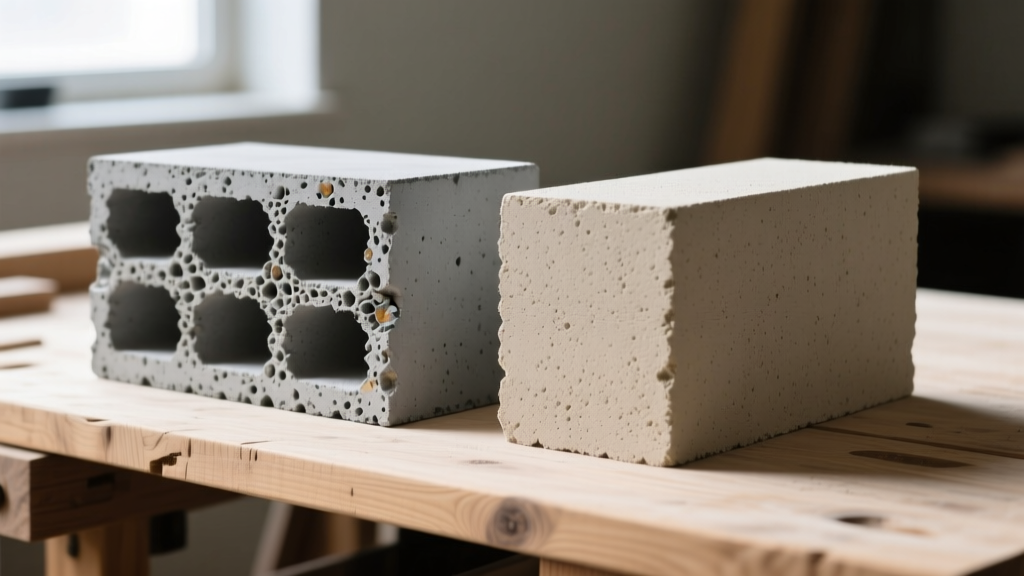
The debate surrounding a concrete block vs cement block typically stems from a fundamental misunderstanding of masonry terminology. In the construction industry, cement and concrete are not interchangeable synonyms; they represent entirely different material classifications. According to the Portland Cement Association, cement is an ingredient of concrete. Specifically, Portland cement is the fine gray powder that acts as the binder. Concrete, conversely, is the composite material created when cement is mixed with water and aggregates (sand, gravel, or crushed stone).
Therefore, a true 'cement block'—manufactured using only cement, fine sand, and water without coarse aggregate—is a niche, brittle product rarely used in modern structural masonry. When contractors, architects, and DIY builders refer to 'cement blocks,' they are almost universally referring to Concrete Masonry Units (CMUs). Understanding this distinction is critical for material procurement, structural engineering, and avoiding catastrophic failures related to shrinkage and compressive overloading.
The 'Cinder Block' Confusion
Adding to the terminology overlap is the colloquial use of the term 'cinder block.' Historically, cinder blocks were manufactured using coal cinders or volcanic pumice as the aggregate instead of crushed stone. While they are technically a type of concrete block, their physical properties differ vastly from modern normal-weight CMUs. Coal cinder blocks are largely obsolete in 2026 due to environmental regulations and the depletion of accessible coal ash, though reclaimed cinder blocks are still utilized in non-structural landscaping. Modern lightweight CMUs use expanded shale, clay, or slate aggregates to achieve reduced density without sacrificing the compressive strength required by building codes.
Material Specifications and Performance Matrix
To make informed procurement decisions, you must compare standard CMUs against the theoretical 'cement-sand' block and alternative masonry units like Autoclaved Aerated Concrete (AAC). The table below outlines the critical engineering metrics for each material type.
| Material Type | Aggregate Composition | Compressive Strength (psi) | Density (pcf) | R-Value (Uninsulated) | 2026 Avg. Cost (8x8x16) |
|---|---|---|---|---|---|
| Normal-Weight CMU | Crushed stone, sand, gravel | 1,900 - 3,750+ | 125 - 145 | 1.11 | $2.25 - $2.85 |
| Lightweight CMU | Expanded shale, pumice | 1,900 - 2,800 | 85 - 105 | 2.00 - 2.50 | $2.60 - $3.40 |
| Pure Cement-Sand Block | Fine silica sand only | 1,200 - 1,800 | 110 - 130 | 0.80 | $3.50+ (Specialty) |
| AAC Block | Aerated cement slurry (no aggregate) | 300 - 870 | 25 - 50 | 1.25 per inch | $3.80 - $4.90 |
Structural Integrity and ASTM C90 Compliance
For any load-bearing application, standard concrete blocks must comply with ASTM C90 (Standard Specification for Loadbearing Concrete Masonry Units). This standard mandates a minimum net compressive strength of 1,900 psi. However, in regions with high seismic activity or for multi-story commercial construction, engineers routinely specify 2,800 psi or 3,750 psi mixes.
Shrinkage and Crack Propagation
The primary failure mode in masonry is drying shrinkage. The National Concrete Masonry Association notes that proper aggregate grading in standard CMUs limits drying shrinkage to a maximum of 0.065%. Pure cement-sand blocks, lacking the rigid skeletal structure of coarse aggregate, experience significantly higher shrinkage rates. When these blocks lose moisture during the curing process, the tensile stresses exceed the block's capacity, resulting in micro-cracking that compromises the wall's waterproofing and structural integrity.
Mortar Compatibility and Reinforcement Protocols
Selecting the correct block is only half the battle; pairing it with the appropriate mortar and reinforcement is where many projects fail. A fundamental rule of masonry is that the mortar must be weaker (lower compressive strength) than the block it binds. This ensures that if the wall experiences thermal expansion, settlement, or seismic lateral loads, the cracking occurs in the mortar joints—which can be easily repointed—rather than fracturing the concrete blocks themselves.
- Type N Mortar (750 psi): The standard choice for above-grade, load-bearing CMU walls. It provides adequate flexibility and bonds well with standard 1,900 psi concrete blocks.
- Type S Mortar (1,800 psi): Required for below-grade foundations, retaining walls, and masonry subjected to high lateral soil pressure. Never use Type S on lightweight or low-strength blocks, as the rigid mortar will cause the blocks to spall under stress.
- Reinforcement Grout: When vertical reinforcement is required, #4 or #5 Grade 60 rebar is placed in the block cores. The cores must be filled with high-slump (8 to 11 inches) fine grout conforming to ASTM C476. This high-slump mixture ensures the grout consolidates entirely around the steel and fills all voids without requiring mechanical vibration inside the narrow 8-inch CMU cells.
Moisture Dynamics and Efflorescence
Concrete blocks are inherently porous. Normal-weight CMUs can absorb significant amounts of water, which leads to two major issues: freeze-thaw degradation and efflorescence. Efflorescence is the white, powdery deposit of water-soluble salts left on the surface of the masonry after water evaporates.
While true 'cement blocks' with high cement content might appear denser, they actually trap more unhydrated cement particles that can react with groundwater sulfates, leading to expansive sulfate attack. Standard CMUs formulated with low-alkali cements and properly applied silane/siloxane water repellents offer vastly superior long-term moisture management.
To mitigate moisture ingress in exterior CMU walls, specify blocks with an integral water repellent admixture (such as a stearate or oleate added at the batch plant) and pair them with a compatible water-repellent mortar. This creates a continuous hydrophobic barrier throughout the wall assembly.
2026 Cost Analysis: Material and Labor
When budgeting for a masonry project, the raw cost of the block is only a fraction of the total installed price. In 2026, a standard 8x8x16 normal-weight CMU averages $2.25 to $2.85 at regional supply yards. Architectural face blocks with split-face or ground-face finishes command $4.50 to $7.50 per unit.
However, labor dominates the budget. A skilled masonry crew can lay between 90 and 150 standard CMUs per day. Because pure cement-sand blocks are heavier relative to their structural yield and require more careful handling to prevent edge-chipping, labor costs increase by approximately 15% to 20%. Furthermore, lightweight CMUs, while slightly more expensive to purchase, reduce mason fatigue, often resulting in a 10% faster installation rate and lower overall labor costs for large-scale commercial projects.
Decision Framework: Selecting the Right Unit
Use the following operational framework to specify the correct masonry unit for your project parameters:
- Below-Grade Foundations & Retaining Walls: Specify Normal-Weight CMU (minimum 2,800 psi) with Type S mortar and integral water repellents. Do not use lightweight blocks or AAC, as they lack the necessary mass to resist lateral soil loads and hydrostatic pressure.
- Above-Grade Exterior Load-Bearing Walls: Standard Normal-Weight or Lightweight CMU (1,900 psi) with Type N mortar. Lightweight blocks are preferred here to reduce the dead load on the foundation and provide marginally better thermal resistance.
- Interior Non-Load-Bearing Partitions: Lightweight CMUs or AAC blocks. The reduced weight makes overhead handling easier, and AAC can be cut with standard woodworking saws for rapid electrical and plumbing rough-ins.
- Landscaping & Garden Walls: Reclaimed cinder blocks or standard utility-grade CMUs are sufficient. Avoid pure cement-sand blocks, as their high porosity and lack of coarse aggregate make them prone to rapid degradation when exposed to constant soil moisture and freeze-thaw cycles.
Ultimately, the 'concrete block vs cement block' debate is resolved by adhering to modern material science. By specifying ASTM-compliant Concrete Masonry Units with the correct aggregate profile, mortar pairing, and reinforcement strategy, you ensure a masonry assembly that is structurally resilient, thermally efficient, and economically viable.
Written by
Priya KapoorPriya Kapoor is a real estate market analyst and construction economics researcher with expertise in housing affordability, development feasibility, and infrastructure investment. She holds a Master of Regional Planning from Cornell University and previously worked as a senior analyst at CBRE's Investment Properties group, where she modeled returns for $4B in mixed-use development pipelines. Priya now runs an independent research practice advising developers, municipalities, and REITs on construction cost forecasting and market timing. She publishes the quarterly "BuildMat Market Pulse" report tracking material price indices across 12 commodity categories. Based in Austin, TX, Priya serves on the board of Habitat for Humanity Austin and is a marathon runner.
More from Priya Kapoor
View all
Construction Cost
Cost to Build a 1600 Sq Ft Home in 2026: Full Breakdown
Accurate 2026 cost to build a 1600 sq ft home—material, labor, and regional pricing breakdowns included. Plan your budget with real-time estimates.
Aug 11, 2026

Wood & Lumber
Name the Types of Wood for Pressure Treatment and Preservation
Learn how to name the types of wood best suited for pressure treatment. Compare species treatability, chemical retention levels, and 2026 preservation costs.
Aug 4, 2026

Stone & Masonry
Stone Veneer Suppliers Lindenhurst: 2026 Cost Analysis
Analyze 2026 stone veneer costs in Lindenhurst, NY. Compare local supplier pricing, delivery fees, and Suffolk County installation labor rates.
Aug 4, 2026