Mold vs Mildew on Concrete: How to Identify and Remove Both
Master the mold vs mildew on concrete debate. Learn exact identification tests, deep-pore removal chemicals, and siloxane sealing methods.

The Biology of Concrete Colonization
Concrete is often mistakenly viewed as an impermeable, sterile surface. In reality, standard unsealed concrete is a highly porous network of capillary channels and microscopic voids left behind after the water in the cement paste evaporates during curing. When ambient relative humidity exceeds 60%, these capillaries draw in moisture via vapor drive, creating an ideal microclimate for fungal growth. Understanding the biological distinction between mold and mildew on concrete is the critical first step in remediation, as their root structures dictate entirely different chemical treatment protocols.
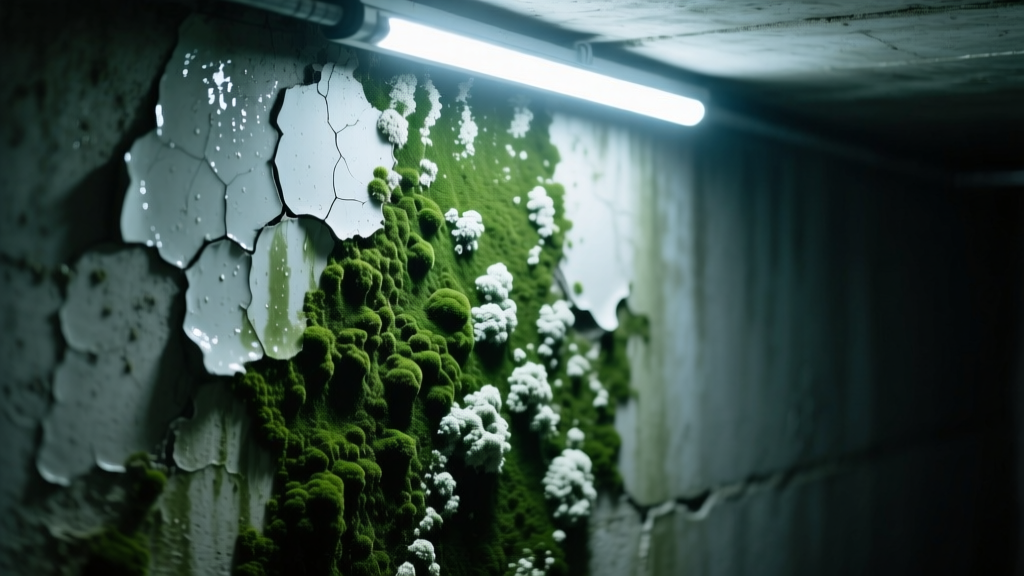
Diagnostic Matrix: Mold vs Mildew on Concrete
Homeowners frequently use the terms interchangeably, but from a remediation standpoint, they represent different threat levels. Mildew is a surface-level fungus, while mold possesses hyphae (root-like structures) that penetrate deep into the concrete matrix.
| Characteristic | Mildew | Mold |
|---|---|---|
| Visual Profile | Powdery, flat, white, gray, or pale yellow | Fuzzy, slimy, or velvety; black, dark green, or brown |
| Depth of Penetration | Surface-level only (epidermal) | Penetrates up to 1/8 inch into concrete pores |
| Odor | Mild, musty, akin to damp leaves | Sharp, pungent, earthy, or rotting wood scent |
| Bleach Reaction Test | Lightens or disappears within 2 minutes | Surface lightens, but dark core remains unchanged |
| Health Risk Level | Low (primarily an aesthetic and allergy trigger) | High (releases mycotoxins and volatile organic compounds) |
The Efflorescence False Positive
Before treating for mildew, you must rule out efflorescence. Efflorescence is a crystalline deposit of water-soluble salts (primarily calcium carbonate and sodium sulfate) that migrate to the concrete surface as moisture evaporates. It looks exactly like white, powdery mildew.
The Acid Diagnostic Test: Apply a single drop of muriatic acid (hydrochloric acid) diluted at a 10:1 water-to-acid ratio onto the white patch. If it fizzes and dissolves instantly, it is efflorescence, not mildew. Fungal growth will not react to the acid. Treating efflorescence with fungicides is a waste of resources; it requires moisture mitigation and a mild acid wash instead.
The Bleach Fallacy in Porous Substrates
The most common error in DIY concrete remediation is the application of household chlorine bleach (sodium hypochlorite). While bleach is highly effective on non-porous surfaces like glass or tile, it is counterproductive on concrete.
Chlorine bleach has a high surface tension and a large molecular structure, preventing it from penetrating the microscopic concrete pores. It kills the surface mold but leaves the deep hyphae intact. Worse, bleach solutions are typically 90% water. Once the chlorine gas evaporates, the remaining water soaks into the concrete, effectively watering the surviving mold roots and triggering a rapid regrowth cycle. According to the EPA's Brief Guide to Mold, Moisture, and Your Home, biocides that only address surface growth without resolving the underlying moisture or root structure will result in inevitable recurrence.
Professional Eradication Protocol
To properly resolve the mold vs mildew on concrete issue, you must use chemicals with low surface tension and high oxidative capacity that can penetrate the capillary network.
Step 1: Dry Agitation and HEPA Extraction
Do not wet the surface initially. Use a stiff nylon bristle brush to agitate the dry surface, immediately capturing the dislodged spores with a HEPA-filtered vacuum. Wetting the surface first turns spores into a paste, driving them deeper into the pores. The CDC emphasizes that minimizing airborne spore release during the initial cleaning phase is vital for indoor air quality and respiratory safety.
Step 2: Hydrogen Peroxide Penetration (For Mold)
For deep-penetrating mold, use a 3% to 10% concentration of hydrogen peroxide (H2O2). Unlike bleach, H2O2 has a lower surface tension and effervesces upon contact with organic matter. This bubbling action physically lifts the hyphae out of the concrete pores while oxidizing the cellular walls of the fungus.
Application: Saturate the concrete heavily. Allow it to dwell for 15 to 20 minutes. Scrub with a stiff brush, then extract the liquid using a wet vac. Repeat if dark spots persist.
Step 3: Quaternary Ammonium Treatment (For Mildew & Residual Spores)
Once the deep mold is eradicated, or if you are treating surface-level mildew, apply a Quaternary Ammonium Compound (Quat). Products containing alkyl dimethyl benzyl ammonium chloride (commonly found in commercial mold control solutions like Concrobium) do not rely on oxidation. Instead, they physically crush the spore walls as they dry and leave behind a microscopic, crush-proof polymer barrier that inhibits regrowth for up to 12 months.
Permanent Prevention: Silane/Siloxane Chemistry
Eradication is temporary if the concrete remains a moisture sponge. To permanently alter the concrete's susceptibility to fungal growth, you must change its capillary action without trapping vapor.
- Avoid Film-Forming Sealers: Acrylics, epoxies, and urethanes create a surface film. If hydrostatic pressure builds up beneath the slab (a common issue in below-grade basements), these films will blister, peel, and trap moisture against the concrete, accelerating spalling and hidden mold growth.
- Use Penetrating Silane/Siloxane Sealers: These reactive sealers penetrate up to 1/4 inch into the concrete. They undergo a chemical reaction with the free lime and alkalis in the cement paste to form a hydrophobic silicone resin matrix within the pores. This reduces water absorption by up to 95% while maintaining 100% vapor permeability. By starving the capillary network of liquid water, you eliminate the biological requirement for both mold and mildew to survive.
When evaluating products, look for a silane/siloxane blend with a minimum 40% active solids content. Water-based formulations are suitable for interior basement walls, while solvent-based formulations offer deeper penetration for exterior driveways and patios exposed to heavy rain and freeze-thaw cycles.
Written by
David NakamuraDavid Nakamura is a licensed architect (AIA) and construction technology writer focused on sustainable building methods, mass timber engineering, and high-performance building envelopes. He holds a Master of Architecture from the University of Washington and is a certified Passive House Consultant (CPHC). David spent eight years at the Seattle firm Mithun, where he led the design of three LEED Platinum projects, before founding his own practice specializing in net-zero residential design. He serves on the editorial advisory board of GreenBuilder Magazine and has authored peer-reviewed papers on cross-laminated timber (CLT) connections for the Journal of Structural Engineering. In his spare time, David teaches woodworking at Pratt Fine Arts Center and kayaks the Puget Sound.
More from David Nakamura
View all
Construction Cost
Labor Cost to Build a Deck Per Sq Ft: 2026 Installation Guide
Discover the exact labor cost to build a deck per sq ft in 2026. This installation guide breaks down contractor rates, complexity factors, and hidden fees.
Aug 4, 2026

Construction Cost
How Much Does It Cost to Build a 3 Bedroom House? Financing Guide
Learn exactly how much it costs to build a 3 bedroom house and explore 2026 financing options, construction loan types, and budget frameworks for your build.
Aug 4, 2026

Construction Cost
Cost to Build a Tennis Court: 2026 Guide
How much does it cost to build a tennis court in 2026? Breakdowns for asphalt, concrete, and synthetic surfaces plus fencing and lighting.
Jul 30, 2026