Concrete vs Shake Freddy's: Roofing Application Showcase
Compare concrete roof tiles and Shake Freddy's synthetic shakes. Explore structural needs, costs, and real-world application showcases for modern builds.

Application Showcase: Selecting the Right Roofing Profile
When specifying roofing materials for high-performance residential and light commercial builds, architects and contractors frequently debate traditional masonry profiles against advanced synthetic alternatives. The decision between concrete roof tiles and Shake Freddy's premium synthetic polymer shakes hinges on structural load capacities, regional climate demands, and lifecycle budgeting. This application showcase breaks down the exact engineering parameters, installation requirements, and real-world performance metrics of both systems to guide your material specification.
Quick Specification Matrix
- Concrete Tiles: 900–1,100 lbs per square (100 sq ft); Class A fire rating; 50+ year lifespan; requires heavy timber or engineered truss framing.
- Shake Freddy's Synthetic: 300–340 lbs per square; Class A fire rating; UL 2218 Class 4 impact resistance; 50-year limited warranty; installs on standard framing.
Material Deep-Dive: Engineering and Composition
Concrete Roof Tiles: The Masonry Standard
Modern concrete tiles are manufactured using a dense mixture of Portland cement, sand, and water, extruded under high pressure and cured in controlled environments. According to the Tile Roofing Institute (TRI), contemporary concrete tiles are significantly more refined than their mid-century predecessors, featuring integrated interlocking side-laps and advanced acrylic or slurry color coatings that resist UV degradation.
The primary advantage of concrete is its thermal mass and wind uplift resistance when properly mechanically fastened. In high-wind regions, concrete tiles utilize a combination of adhesive foam and corrosion-resistant stainless steel or copper clips. However, the material's inherent porosity requires strict adherence to ASTM C1492 standards to prevent freeze-thaw spalling in northern climates. Contractors must specify high-density, low-absorption tiles (under 3% water absorption by weight) for projects in regions with frequent freezing cycles.
Shake Freddy's Synthetic Shakes: The Polymer Contender
Shake Freddy's represents the upper echelon of synthetic roofing, utilizing an engineered blend of post-industrial polymers, recycled rubber, and specialized UV-inhibiting resins. Unlike early-generation plastic shingles that suffered from thermal expansion and brittleness, Shake Freddy's proprietary formulation mimics the exact shadow lines and texture variations of hand-split cedar while delivering superior structural integrity.
From an installation perspective, Shake Freddy's shakes are designed to be fastened directly to the deck using standard roofing nails or stainless steel ring-shank fasteners. The National Roofing Contractors Association (NRCA) notes that synthetic polymer shakes generally require less specialized labor than masonry tiles, as they can be cut with standard carbide-tipped saw blades and do not require the precise headlap calculations necessary for curved concrete profiles. Furthermore, their UL 2218 Class 4 impact rating ensures they will not fracture under severe hail (2-inch steel ball impact), a common failure point for standard concrete tiles.
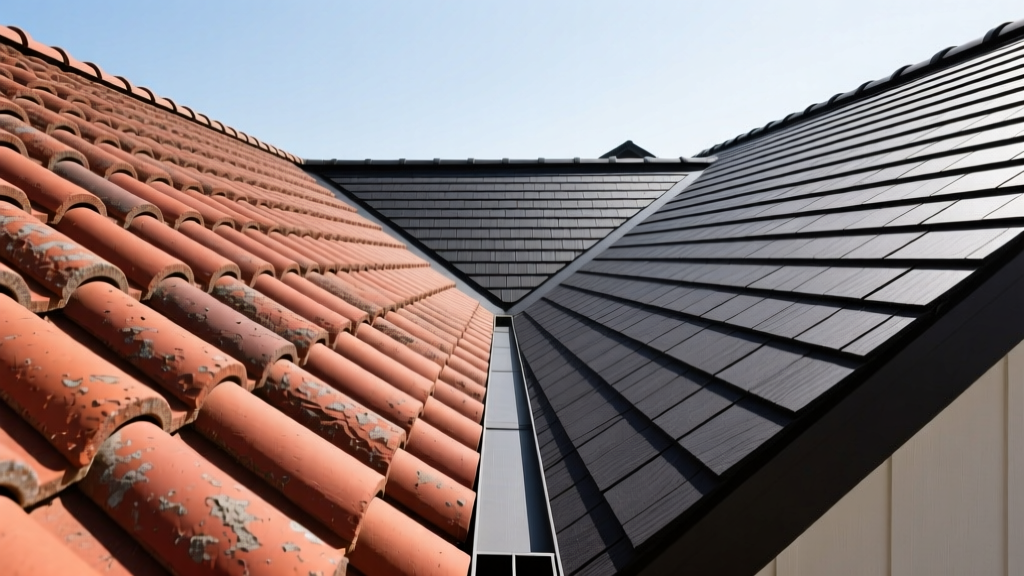
Real-World Application Scenarios
Choosing between these two materials requires matching the product to the specific environmental and architectural demands of the project site. Below is a decision framework based on common application showcases.
| Application Scenario | Concrete Tiles | Shake Freddy's Synthetic | Recommended Choice |
|---|---|---|---|
| Coastal High-Wind (130+ mph) | Excellent, if foam-adhered and clipped per code. | Excellent, high pull-through resistance with ring-shank nails. | Shake Freddy's (lower risk of projectile damage to adjacent properties) |
| Heavy Snow Load / Alpine | Risk of ice damming and freeze-thaw spalling if absorption is high. | Impervious to moisture absorption; sheds snow efficiently. | Shake Freddy's |
| Mediterranean / Spanish Revival | Authentic aesthetic; unmatched architectural accuracy. | Cannot replicate curved barrel profiles; limited to flat shake profiles. | Concrete Tiles |
| Wildfire Urban Interface (WUI) | Class A rated; non-combustible masonry. | Class A rated; will not ignite from wind-blown embers. | Tie (Both meet strict WUI codes) |
| Historic Retrofit / Older Framing | Requires expensive structural reinforcement of existing trusses. | Lightweight; installs over existing 2x4 framing without reinforcement. | Shake Freddy's |
Structural Requirements and Framing Costs
The most critical differentiator in the concrete vs Shake Freddy's debate is the dead load imposed on the building's structural skeleton. This directly impacts both new construction framing budgets and the feasibility of re-roofing existing structures.
Concrete tiles impose a dead load of approximately 9.5 to 11.5 pounds per square foot (psf). For a standard 2,500-square-foot roof, this translates to over 23,000 pounds of sheer roofing material. To support this, structural engineers typically specify 2x6 or 2x8 top chords on roof trusses, spaced at a maximum of 24 inches on center (O.C.), with additional lateral bracing. In seismic zones, the high center of gravity created by a concrete roof can also necessitate heavier shear walls and reinforced concrete foundations to resist lateral racking forces.
Engineering Insight: When retrofitting an existing home built with standard 2x4 trusses at 24" O.C. from asphalt shingles to concrete tiles, expect structural reinforcement costs to range from $4,500 to $9,000. This involves sistering trusses, adding purlins, or installing supplemental load-bearing walls. Shake Freddy's synthetic shakes, weighing just 3.2 psf, eliminate this structural upgrade cost entirely.
Underlayment and Flashing Specifications
Both systems demand rigorous attention to the secondary water barrier (underlayment), but the specifications differ due to material weight and thermal properties.
- For Concrete Tiles: Because concrete is highly alkaline and can retain moisture, standard felt paper will degrade prematurely. Specify a minimum 40-pound organic felt or, preferably, a self-adhering polymer-modified bitumen membrane (ice and water shield) over the entire deck in climates with driving rain. Furthermore, concrete requires a counter-batten system (vertical battens over horizontal battens) to create an air channel that allows moisture to drain and ventilate beneath the heavy tiles.
- For Shake Freddy's Synthetic: The Insurance Institute for Business & Home Safety (IBHS) recommends high-temperature synthetic underlayments for polymer roofs. Because synthetic shakes can experience higher thermal expansion and retain heat differently than masonry, a high-temp rated synthetic underlayment (rated to at least 240°F) prevents the membrane from melting or adhering to the back of the shingles during peak summer temperatures. A counter-batten system is generally not required, reducing installation time and material costs.
Lifecycle Cost and ROI Breakdown
While initial material costs are a primary consideration, the true cost of ownership includes structural prep, installation labor, and long-term maintenance.
Estimated Cost per Square Foot (Installed)
- Concrete Tiles: $14.00 – $19.00 / sq ft (Includes material, specialized labor, and standard underlayment. Excludes structural reinforcement).
- Shake Freddy's Synthetic: $17.00 – $22.00 / sq ft (Includes premium material and standard installation labor).
- Maintenance (50-Year Horizon): Concrete requires periodic pressure washing to remove efflorescence and moss, plus replacement of broken tiles from foot traffic (approx. $1,500 over 50 years). Shake Freddy's requires virtually zero maintenance beyond standard gutter clearing.
Although Shake Freddy's carries a higher upfront material cost per square, the elimination of structural reinforcement on retrofits, the removal of the counter-batten system, and the faster installation timeline (synthetic shakes install roughly 30% faster than interlocking concrete tiles) often result in a lower total project cost for residential applications.
Final Verdict: Matching Material to Project Scope
The choice between concrete and Shake Freddy's synthetic shakes is rarely about which material is universally "better," but rather which is structurally and architecturally appropriate for the specific build.
Specify concrete tiles for new construction in Mediterranean, Spanish, or Mission-style architectural themes where the authentic curved profile is non-negotiable, and where the structural framing can be engineered from the ground up to handle the 10+ psf dead load without incurring retrofit penalties. Concrete remains the undisputed champion for thermal mass in hot, arid climates.
Specify Shake Freddy's synthetic shakes for Tudor, Craftsman, Cape Cod, and modern farmhouse aesthetics. It is the mandatory choice for historic retrofits, lightweight timber-frame structures, and projects in severe hail or heavy snow regions where impact resistance and moisture impermeability are paramount. By leveraging the lightweight nature of polymers, contractors can deliver a premium, 50-year roofing system without the structural overhead of masonry.
Written by
Elena RodriguezElena Rodriguez is a civil engineer and technical writer specializing in concrete technology, masonry systems, and ASTM/ACI compliance. She earned her B.S. in Civil Engineering from Texas A&M University and spent a decade at a materials testing laboratory, performing over 2,000 concrete compressive strength tests and masonry prism evaluations. Elena is an ACI-certified Field Testing Technician (Grade I) and a member of ASTM Committee C12 on Natural Building Stone. She currently consults on forensic engineering cases involving concrete failures and moisture intrusion. Based in San Antonio, TX, Elena is a proud member of the Society of Women Engineers (SWE) and coaches her daughter's FIRST Robotics team.
More from Elena Rodriguez
View all
Walls & Panels
Cost Analysis: Light Gauge Steel Framing Advantages and Disadvantages
Evaluate light gauge steel framing advantages and disadvantages through a strict cost analysis lens, comparing material, labor, and lifecycle expenses.
Aug 4, 2026

Walls & Panels
Gypsum Board Types: Exact Specifications, Thickness & Dimensions
Compare standard, Type X, and moisture-resistant gypsum board types. Get exact specifications, thicknesses, dimensions, and ASTM standards for your project.
Aug 4, 2026

Fire Resistance
Best Fire-Resistant Outdoor Decking Materials: 2026 Buyer Guide
Discover the best fire-resistant outdoor decking materials for 2026. Compare Class A PVC, aluminum, and hardwood options for WUI compliance and safety.
Aug 4, 2026