Concrete Densifier vs Sealer: A Comprehensive Chemistry and Cost Guide
Compare concrete densifier vs sealer chemistry, costs, and applications. Learn when to use lithium silicates, acrylics, or both for maximum durability.

The Fundamental Difference: Subsurface Reaction vs. Surface Barrier
A pervasive misconception in commercial and residential flooring is that concrete densifiers and sealers are interchangeable protective treatments. They are not. When evaluating concrete densifier vs sealer options, the distinction lies in their chemical mechanisms and primary objectives. According to the American Concrete Institute's Guide to Durable Concrete (ACI 201.2R), protecting a slab requires addressing both internal structural integrity and external environmental exposure.
A concrete densifier is a reactive chemical hardener. It penetrates the capillary pores of the cementitious matrix and reacts with free lime (calcium hydroxide) to form additional calcium silicate hydrate (C-S-H) gel. This permanently increases surface density, reduces dusting, and improves abrasion resistance. It does not repel water or stains.
A concrete sealer, conversely, is a protective barrier. Whether penetrating (hydrophobic) or film-forming (topical), its primary function is to block the ingress of water, chlorides, oils, and UV radiation. It does not structurally harden the concrete matrix. For high-traffic industrial floors or exterior flatwork exposed to freeze-thaw cycles, understanding this dichotomy is critical for specifying the correct material—or combining both.
Concrete Densifiers: The Chemistry of Subsurface Hardening
Densifiers are categorized by their active alkali metal silicate base. The choice between sodium, potassium, and lithium silicates dictates the application method, reaction speed, and final surface profile.
Sodium and Potassium Silicates
Products like the Ashford Formula (sodium) rely on a slower, moisture-dependent reaction. They require the concrete to be kept wet for up to 24 hours post-application to facilitate the pozzolanic reaction. While highly cost-effective, sodium silicates carry a high risk of efflorescence (white, powdery residue) if over-applied or if the slab has high moisture vapor transmission (MVT). They are best suited for broom-finished exterior flatwork where aesthetic haze is less critical.
Lithium Silicates
Lithium-based densifiers, such as PROSOCO Consolideck LS, represent the modern standard for polished and burnished concrete. Lithium molecules are smaller and more stable, allowing for deeper penetration without the need to keep the slab wet. They react almost immediately, eliminating the risk of caustic efflorescence. Lithium densifiers typically increase surface abrasion resistance by 30% to 40% as measured by ASTM C779 testing protocols, and they significantly enhance the light reflectance value (LRV) when mechanically polished.
Concrete Sealers: Moisture, Stain, and UV Defense
Sealers are divided into two distinct categories based on how they interact with the concrete surface. The Portland Cement Association emphasizes that selecting the wrong sealer type for a specific environment is the leading cause of premature coating failure.
Penetrating Sealers (Silanes and Siloxanes)
Penetrating sealers do not alter the surface appearance or traction. Siloxanes, such as Ghostshield Siloxa-Tek 8500, react with the silica in the concrete to form a hydrophobic resin within the pores. They are ideal for exterior driveways, pool decks, and bridge decks where freeze-thaw scaling and chloride intrusion (from de-icing salts) are primary concerns. The Federal Highway Administration frequently specifies silane/siloxane treatments for concrete bridge decks due to their ability to reduce chloride permeability by over 90% without creating a slippery film.
Film-Forming Sealers (Acrylics, Epoxies, Polyurethanes)
These sealers create a physical wear layer on top of the concrete.
- Acrylics: Fast-drying and UV-stable. Used for stamped concrete and interior decorative floors. Requires reapplication every 1 to 3 years.
- Epoxies: Provide extreme chemical and abrasion resistance but will amber (yellow) under UV exposure. Strictly for interior industrial use.
- Polyurethanes: Often applied as a topcoat over epoxy to provide UV stability and superior scratch resistance.
Comparison Matrix: Densifier vs. Sealer
| Criteria | Concrete Densifier | Penetrating Sealer | Film-Forming Sealer |
|---|---|---|---|
| Primary Mechanism | Subsurface chemical reaction (C-S-H formation) | Pore-lining hydrophobic resin | Surface physical barrier |
| Hardens Concrete? | Yes (up to 40% increase) | No | No (adds sacrificial wear layer) |
| Water/Oil Repellency | None | High (Waterborne) | High (Water and Oil) |
| Changes Appearance? | No (unless polished) | No | Yes (Adds gloss/satin sheen) |
| Lifespan | Permanent (Life of slab) | 5 to 10 years | 1 to 5 years (Traffic dependent) |
| UV Stability | N/A | Excellent | Varies (Epoxies yellow) |
| Application Time | 1 to 2 hours | 2 to 4 hours | 2 to 6 hours (+ cure time) |
The Synergy Protocol: When to Use Both
In high-performance environments—such as automotive showrooms, warehouse aisles, and high-end residential garages—relying on just one treatment is insufficient. The industry best practice is a dual-application synergy protocol: densify first to harden the substrate, then seal to protect against stains.
Never apply a topical acrylic or epoxy sealer over a sodium silicate densifier unless the slab has been thoroughly neutralized and profiled. Unreacted sodium salts will migrate to the surface, causing severe efflorescence that breaks the adhesive bond of the film-forming sealer, leading to catastrophic peeling. If combining treatments, always use a lithium silicate densifier.
Step-by-Step Dual Application Flow
- Surface Preparation: Grind the slab to a minimum Concrete Surface Profile (CSP) of 1 or 2 using 100-grit to 200-grit metal-bond diamonds. Remove all residual slurry.
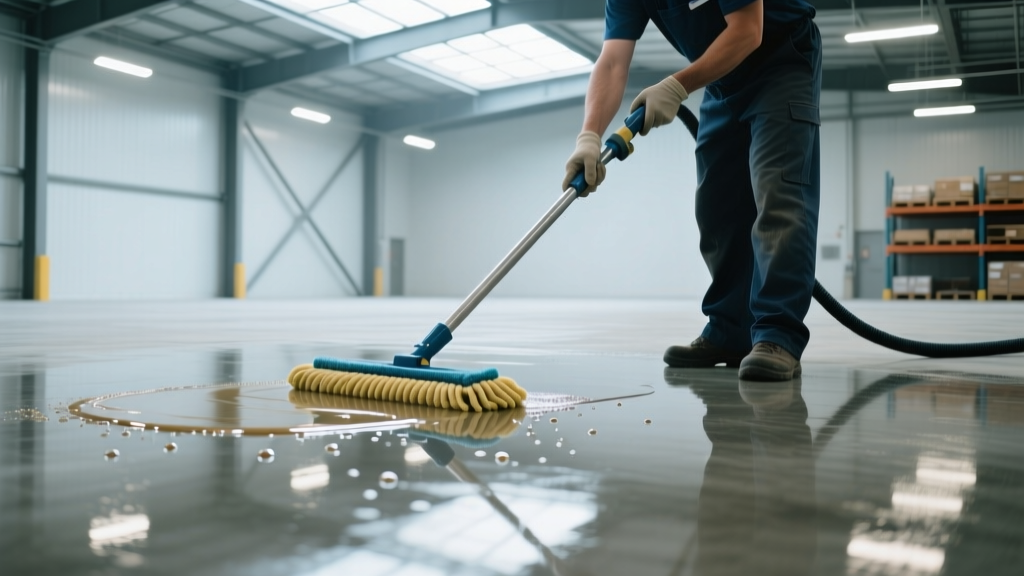
- Densification: Flood the slab with a lithium silicate densifier (e.g., PROSOCO LS). Agitate with an auto-scrubber or microfiber mop for 20 minutes. Allow to dry completely (typically 2 to 4 hours).
- Polishing (Optional): If a polished finish is desired, proceed with resin-bond diamonds from 400-grit up to 3000-grit.
- Sealing: Apply a breathable, penetrating guard (like a stain-blocking siloxane) or a high-solids polyurethane topcoat. For interior polished concrete, a stain-guard product like PROSOCO LS Guard is applied and buffed with a high-speed burnisher (1500+ RPM) to achieve a high-gloss, stain-resistant finish.
2026 Cost Breakdown and Coverage Rates
Budgeting for concrete treatments requires calculating both material costs and labor. Below are the current market averages for commercial applications.
Sodium densifiers are cheaper per gallon but require heavier application rates (200-300 sq ft/gal). Lithium densifiers cost more per gallon but cover 500-800 sq ft/gal, often making the cost per square foot nearly identical, with lithium offering vastly superior performance and lower labor costs.
| Treatment Type | Material Cost (Per Sq Ft) | Installed Cost (Per Sq Ft) | Typical Coverage Rate |
|---|---|---|---|
| Sodium/Potassium Densifier | $0.08 - $0.12 | $0.25 - $0.40 | 200 - 350 sq ft / gallon |
| Lithium Silicate Densifier | $0.12 - $0.18 | $0.30 - $0.55 | 500 - 800 sq ft / gallon |
| Penetrating Siloxane Sealer | $0.15 - $0.25 | $0.45 - $0.80 | 150 - 250 sq ft / gallon |
| Acrylic Film-Forming Sealer | $0.20 - $0.35 | $0.75 - $1.25 | 300 - 400 sq ft / gallon |
| Industrial Polyurethane Topcoat | $0.60 - $1.10 | $2.50 - $4.50 | 250 - 350 sq ft / gallon |
Troubleshooting Common Application Failures
Even with premium materials, improper execution leads to costly remediation. Here are the most frequent failure modes and their solutions:
Failure Mode 1: White Haze or Chalking on Densified Concrete
Cause: Over-application of sodium or potassium silicate densifier, or failure to agitate and remove excess material before it dried. The unreacted alkali salts crystallize on the surface.
Fix: Scrub the floor with hot water and a mild acidic cleaner (like PROSOCO DailyKlean diluted heavily) using an auto-scrubber. For severe cases, light mechanical grinding with a 400-grit resin pad is required to cut through the crystalline layer.
Failure Mode 2: Film-Forming Sealer Peeling in Sheets
Cause: High Moisture Vapor Transmission (MVT) pushing hydrostatic pressure from beneath the slab, or applying a non-breathable sealer (like epoxy) to an exterior slab or a slab lacking a vapor barrier.
Fix: Remove the failing sealer via shot blasting or chemical stripping. Conduct a calcium chloride test (ASTM F1869) or relative humidity probe test (ASTM F2170) to measure MVT. If MVT exceeds 5 lbs/1000 sq ft/24 hours, you must switch to a breathable penetrating sealer or install a moisture-mitigation epoxy primer before re-topcoating.
Failure Mode 3: Water Still Beading Poorly on Penetrating Sealer
Cause: The concrete substrate was too porous, absorbing the siloxane too deeply to form a continuous hydrophobic layer near the surface, or the sealer was applied to a damp slab.
Fix: Ensure the slab is bone-dry (minimum 24 hours after rain or washing) before application. Apply a second 'wet-on-wet' flood coat within 5 minutes of the first coat to ensure adequate resin concentration in the top 1/4 inch of the pore structure.
Written by
Marcus ChenMarcus Chen is a licensed structural engineer (PE) and building materials analyst with over 12 years of experience across residential, commercial, and industrial construction. He holds a Master of Science in Civil Engineering from UC Berkeley and spent six years at Thornton Tomasetti before transitioning to independent consulting and technical writing. Marcus specializes in material selection for seismic-prone regions, concrete reinforcement strategies, and lifecycle cost analysis. His work has been cited by the American Concrete Institute (ACI) and the Structural Engineers Association of California (SEAOC). When he is not on a job site or at his desk, you will find him hiking the Sierra Nevada or restoring a 1920s craftsman bungalow in Oakland, CA.
More from Marcus Chen
View all
Construction Cost
How Much Did the Eiffel Tower Cost to Build?
How much did the Eiffel Tower cost to build in 1889? We adjust for inflation and compare its budget to modern skyscraper construction.
Aug 4, 2026

Fire Resistance
What Is a Fire Resistant Material? Testing & Certification Guide
Discover what is a fire resistant material through ASTM and UL testing. Learn how fire ratings, certifications, and assemblies work in construction.
Aug 4, 2026

Construction Cost
How Much Did the Burj Khalifa Cost to Build?
How much did the Burj Khalifa cost to build? We break down the $1.5B project and extract 5 money-saving strategies for your next build.
Jul 30, 2026