Concrete Pavers vs Concrete: Mix Design and PSI Compared
Compare concrete pavers vs concrete slabs through mix design, water-cement ratios, PSI strength, and aggregate sizing for driveways and patios.
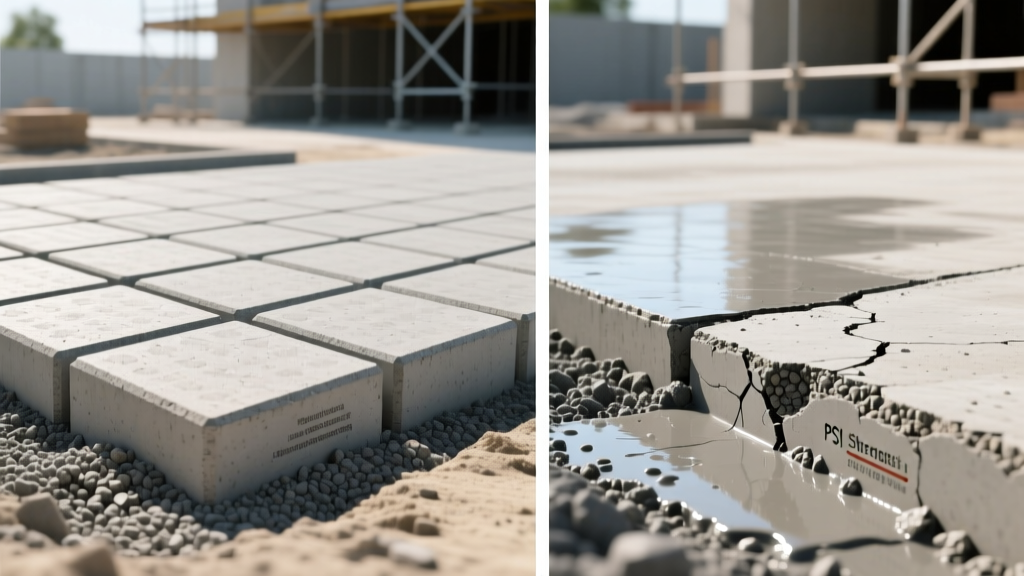
The Material Science: Precast Dry-Cast vs. Cast-in-Place
The comparison of concrete pavers vs concrete slabs is fundamentally an analysis of material states: precast, zero-slump dry-cast concrete versus cast-in-place, high-slump plastic concrete. While both rely on Portland cement, water, and aggregates, their mix designs diverge drastically to accommodate different placement and compaction methods. Understanding these metallurgical and chemical differences is critical for specifying the right hardscape for heavy vehicular loads, freeze-thaw climates, or complex architectural geometries.
Water-Cement Ratio & Slump: The Defining Variables
In concrete technology, the water-cement (w/c) ratio is the single most important factor governing compressive strength and permeability. According to American Concrete Institute (ACI) guidelines, excess water creates capillary pores as it evaporates, weakening the cementitious matrix and providing pathways for chloride and water intrusion.
Zero-Slump Precast Pavers
Concrete pavers are manufactured using a "zero-slump" or "dry-cast" mix. The w/c ratio is aggressively restricted to 0.30–0.35. At this ratio, the mixture resembles damp soil rather than a liquid. Because it cannot flow, the mix is placed into steel molds and subjected to intense high-frequency vibration and hydraulic tampering (up to 1,500 psi of compaction force). This mechanical energy forces the cement paste to coat the aggregates and expels entrapped air, resulting in an ultra-dense matrix with immediate dimensional stability. Pavers can be demolded instantly without sagging.
High-Slump Poured Concrete
Cast-in-place driveway and patio slabs require a plastic, workable state to be screeded, floated, and troweled. Standard ready-mix concrete is batched to a 4-inch to 5-inch slump, necessitating a w/c ratio of 0.45 to 0.50. To maintain structural integrity without adding excess water, modern 2026 ready-mix designs utilize Polycarboxylate Ether (PCE) superplasticizers (High-Range Water Reducers). These chemical admixtures disperse cement particles electrostatically, allowing the mix to flow like a liquid at a lower w/c ratio than was historically possible, though it still cannot match the extreme density of a mechanically compacted paver.
Aggregate Grading and Sizing
Aggregate selection dictates the surface finish, structural mass, and compaction potential of the concrete.
- Paver Aggregates: Pavers utilize uniformly graded, fine aggregates with a maximum top size of 3/8-inch (9.5mm) or smaller. This fine gradation ensures a smooth, architectural face finish and allows the mix to flow into the intricate corners of steel molds under vibration. The high sand-to-gravel ratio requires precise moisture control to prevent balling or segregation during the batching process.
- Poured Slab Aggregates: Cast-in-place concrete relies on a continuous gradation curve up to 3/4-inch (19mm) or 1-inch (25mm) crushed stone. Larger aggregates reduce the total surface area requiring cement paste, lowering the overall cost and minimizing volumetric shrinkage as the slab cures. However, these larger stones preclude the tight, smooth finishes achievable with paver mixes.
Compressive Strength (PSI) and Curing Protocols
The divergence in mix design directly impacts the compressive strength, measured in pounds per square inch (PSI), and the curing timeline required to reach design maturity.
| Metric | Precast Concrete Pavers (ASTM C936) | Cast-in-Place Slabs (ASTM C94) |
|---|---|---|
| Design Compressive Strength | 8,000 – 10,000+ PSI | 3,500 – 4,500 PSI |
| Water-Cement (w/c) Ratio | 0.30 – 0.35 | 0.40 – 0.50 |
| Slump | Zero (Dry-Cast) | 4 – 5 inches |
| Max Aggregate Size | 3/8" (9.5 mm) | 3/4" (19 mm) |
| Curing Method | Steam / Kiln (24 hours to 80% strength) | Moist curing / Membrane (28 days to design strength) |
| Air Entrainment | Low (Density provides freeze-thaw resistance) | 5% – 8% (Required in freeze-thaw climates) |
Poured concrete requires a 28-day moist curing period to achieve its target 4,000 PSI. If moisture evaporates too quickly during the first 48 hours, plastic shrinkage cracking occurs. Conversely, the National Concrete Masonry Association (NCMA) notes that precast pavers are typically steam-cured or kiln-cured in controlled factory environments. This accelerated thermal curing allows the low w/c ratio mix to achieve 8,000+ PSI within 24 hours, rendering the units virtually impervious to weather damage before they even reach the job site.
Freeze-Thaw Durability and Joint Mechanics
When evaluating concrete pavers vs concrete for driveways in northern climates, freeze-thaw survivability is a primary engineering concern. Water expands by 9% when it freezes. If concrete is saturated and the temperature drops, the internal hydraulic pressure will spall and fracture the surface.
The Micro-Void Principle: Poured concrete requires microscopic air bubbles (air entrainment) to act as pressure relief valves for freezing water. Pavers, due to their extreme mechanical compaction and low permeability, resist water absorption inherently. When water does freeze, the segmented nature of a paver field allows for micro-movements that dissipate stress, preventing the catastrophic cracking seen in monolithic slabs.
Furthermore, a poured slab is a continuous, monolithic mass. As it cures and undergoes thermal contraction, it will crack. Contractors mitigate this by saw-cutting control joints to a depth of 25% of the slab thickness, forcing the concrete to crack in a straight, hidden line. Over time, these joints spall, collect debris, and allow weed growth. Pavers eliminate this failure mode entirely; the joints are filled with angular polymeric sand or crushed aggregate, which locks the units together while accommodating thermal expansion, soil settlement, and hydrostatic pressure without structural failure.
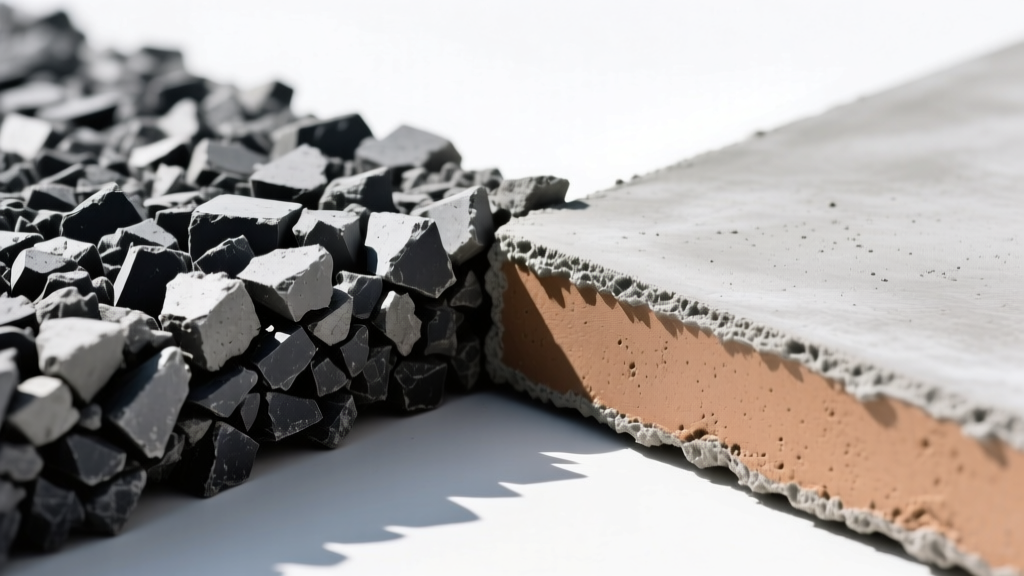
Admixtures: Color, Efflorescence, and Flow
The chemical admixture packages for pavers and poured concrete serve entirely different purposes.
Paver Admixtures
Because pavers do not require flow, manufacturers focus on aesthetic and durability additives. Integral liquid iron-oxide pigments are batched directly into the mixer for consistent, UV-stable color. To combat efflorescence (the white, powdery calcium carbonate deposits that migrate to the surface), modern paver mixes include stearate-based water repellents or specialized pozzolans (like metakaolin) that consume the free lime (calcium hydroxide) generated during cement hydration, effectively starving the efflorescence reaction at the molecular level.
Poured Concrete Admixtures
Ready-mix designs prioritize placement speed and finishability. Beyond PCE superplasticizers, poured concrete often incorporates set-retarders (to delay the initial set during hot summer pours), accelerators like calcium nitrate (for cold-weather pouring), and fibers (macro-synthetic or steel) to provide secondary reinforcement against plastic shrinkage and impact loading. The National Ready Mixed Concrete Association (NRMCA) emphasizes that precise batching of these admixtures is critical, as overdosing superplasticizers can cause severe segregation and bleeding in high-slump mixes.
2026 Cost Analysis and Decision Framework
Material science dictates performance, but project economics dictate specification. As of 2026, the installed cost gap between the two systems remains significant, driven primarily by labor and base preparation rather than raw cement costs.
Pricing Breakdown (Installed)
- Poured Concrete (Broom or basic stamped finish): $8.00 – $14.00 per square foot. Material costs (ready-mix) average $135–$160 per cubic yard, but forming, pouring, and finishing labor are highly optimized.
- Concrete Pavers (Standard driveway/patio): $16.00 – $26.00+ per square foot. While the pavers themselves cost $2.50–$5.50 per square foot, the requirement for a meticulously compacted open-graded crushed stone base (ASTM No. 57 stone) and precise screeding of the bedding sand layer drastically increases labor hours.
Decision Matrix: When to Specify Which
Specify Poured Concrete When:
- Budget constraints are the primary driver.
- The design requires continuous, monolithic surfaces (e.g., ADA-compliant ramps, basketball courts, or large industrial aprons).
- Subgrade soil is highly stable and well-draining, minimizing the risk of differential settlement.
Specify Concrete Pavers When:
- The site is prone to soil settlement, expansive clays, or heavy tree-root intrusion (pavers can be lifted, base repaired, and reinstalled).
- The project is in a severe freeze-thaw climate where monolithic slab heaving and cracking are guaranteed.
- Architectural requirements demand intricate geometric patterns, permeable drainage systems, or zero-cure-time immediate traffic access.
Ultimately, the choice between concrete pavers vs concrete slabs is not merely aesthetic. It is a structural decision regarding how water, thermal stress, and subgrade movement will be managed over a 30-to-50-year service life. Poured concrete offers economic efficiency and monolithic continuity, while precast pavers deliver superior compressive density, segmented flexibility, and long-term maintainability.
Written by
Marcus ChenMarcus Chen is a licensed structural engineer (PE) and building materials analyst with over 12 years of experience across residential, commercial, and industrial construction. He holds a Master of Science in Civil Engineering from UC Berkeley and spent six years at Thornton Tomasetti before transitioning to independent consulting and technical writing. Marcus specializes in material selection for seismic-prone regions, concrete reinforcement strategies, and lifecycle cost analysis. His work has been cited by the American Concrete Institute (ACI) and the Structural Engineers Association of California (SEAOC). When he is not on a job site or at his desk, you will find him hiking the Sierra Nevada or restoring a 1920s craftsman bungalow in Oakland, CA.
More from Marcus Chen
View all
Construction Cost
How Much Did the Eiffel Tower Cost to Build?
How much did the Eiffel Tower cost to build in 1889? We adjust for inflation and compare its budget to modern skyscraper construction.
Aug 4, 2026

Fire Resistance
What Is a Fire Resistant Material? Testing & Certification Guide
Discover what is a fire resistant material through ASTM and UL testing. Learn how fire ratings, certifications, and assemblies work in construction.
Aug 4, 2026

Construction Cost
How Much Did the Burj Khalifa Cost to Build?
How much did the Burj Khalifa cost to build? We break down the $1.5B project and extract 5 money-saving strategies for your next build.
Jul 30, 2026