Stained Concrete vs Tile: Best Flooring Applications & Costs
Compare stained concrete vs tile for flooring projects. Explore room-by-room applications, installed costs, failure modes, and expert design frameworks.

The Core Conflict: Monolithic vs. Modular Flooring
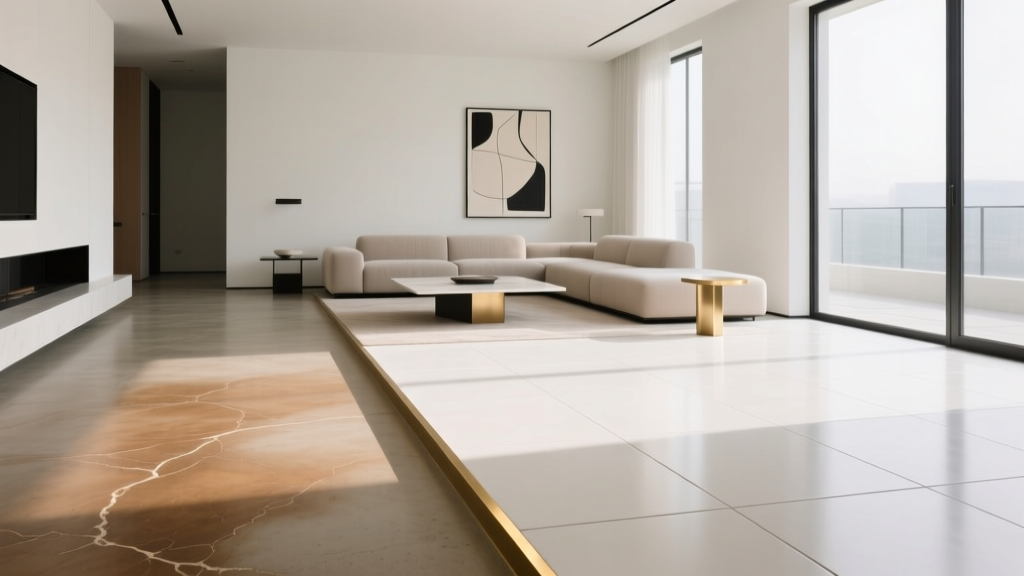
Choosing between stained concrete and ceramic or porcelain tile is not merely an aesthetic decision; it is a fundamental choice between a monolithic, chemically treated substrate and a modular, mechanically bonded assembly. Stained concrete leverages the structural slab itself, utilizing metallic salts or water-based acrylics to create variegated, translucent color, followed by a protective wear layer. Tile, conversely, relies on a multi-layer build-up—subfloor, uncoupling membrane, mortar bed, and grout—to achieve its geometric precision and surface durability.
As large-format porcelain tiles (LFT) exceeding 24x48 inches dominate 2026 design trends, and advanced polyaspartic sealers extend the lifespan of decorative concrete, the performance gap between these two materials has narrowed. However, their failure modes, installation prerequisites, and lifecycle costs remain vastly different. This application showcase dissects where each material excels, backed by structural tolerances and real-world pricing.
Room-by-Room Application Showcase
The suitability of stained concrete versus tile shifts dramatically depending on the room's moisture profile, traffic load, and substrate conditions. Below is a technical matrix evaluating both materials across primary residential and light-commercial zones.
| Application Zone | Stained Concrete Verdict | Tile Verdict | Primary Technical Constraint |
|---|---|---|---|
| Open-Plan Living Areas | Superior | Excellent | Concrete offers seamless flow; tile requires matching grout lines and expansion joints every 20-25 feet per TCNA guidelines. |
| Kitchens | Good (with caveats) | Superior | Acidic spills (lemon, vinegar) can etch poorly sealed concrete. Tile glaze is impervious to household acids. |
| Bathrooms | Poor | Superior | Concrete is inherently porous; prolonged water exposure risks sealer delamination and sub-slab moisture migration. |
| Basements | High Risk | Excellent | Below-grade concrete is prone to Moisture Vapor Emission (MVER). Tile systems with waterproof membranes (e.g., Schluter-DITRA) mitigate this. |
| Outdoor Patios | Excellent | Good | Freeze-thaw cycles can cause tile delamination if water infiltrates grout lines. Integral colored concrete withstands thermal shock better. |
2026 Installed Cost & Lifecycle Breakdown
While bare concrete seems inherently cheaper, achieving a high-end, durable stained finish requires extensive surface preparation and premium sealers. Conversely, tile costs are heavily weighted toward labor and substrate remediation. Based on current national averages for professional installation, here is the financial reality.
Average Installed Cost Per Square Foot (2026)
- Basic Acid-Stained Concrete: $5.00 - $8.00 / sq. ft. (Includes diamond grinding, single-color acid stain, and acrylic sealer).
- High-End Decorative Concrete: $9.00 - $15.00 / sq. ft. (Includes shot-blasting, multiple stain layers, faux finishing, and UV-stable polyaspartic topcoat).
- Standard Ceramic/Porcelain Tile: $8.50 - $14.00 / sq. ft. (Includes cement backer board, standard thin-set, and standard format tile).
- Large-Format Porcelain (LFT): $14.00 - $24.00+ / sq. ft. (Requires medium-bed mortar, uncoupling membrane, and specialized lippage-free installation tools).
Sources: Industry pricing data aggregated via HomeGuide Concrete Cost Index and HomeGuide Tile Flooring Cost Index.
Lifecycle ROI: Stained concrete wins on longevity if maintained. A high-quality polyaspartic or polyurethane sealer will last 5 to 10 years before requiring a recoat (approximately $1.50 - $2.50 per sq. ft.). Tile grout, however, requires annual sealing and may need complete regrouting every 10 to 15 years in high-traffic areas, which is labor-intensive and costly.
Critical Installation Realities & Failure Modes
Both materials punish improper installation, but they fail in entirely different ways. Understanding these edge cases is critical for architects, contractors, and homeowners.
Stained Concrete: The Moisture Vapor Trap
The most catastrophic failure in stained concrete occurs when installers ignore the Moisture Vapor Emission Rate (MVER). Before applying any stain or sealer, the slab must be tested via the calcium chloride test (ASTM F1869). If the MVER exceeds 3 lbs per 1,000 square feet per 24 hours, applying an impermeable sealer like epoxy or polyaspartic will trap hydrostatic pressure. This results in blistering, peeling, and white, powdery efflorescence beneath the coating.
Tile: Subfloor Deflection and Lippage
Tile assemblies are rigid; they do not bend. The Tile Council of North America (TCNA) mandates that subfloors supporting natural stone or large-format porcelain must meet a strict deflection limit of L/360. If a floor joist system flexes beyond this threshold under load, the resulting shear stress will transfer through the mortar bed and snap the tiles or fracture the grout lines.
Furthermore, the rise of large-format tiles (any tile with one edge longer than 15 inches) has introduced the scourge of lippage—where one edge of a tile sits higher than the adjacent piece. Because LFTs are often slightly bowed from the kiln-firing process, installers must use a medium-bed mortar (such as LATICRETE 4-XLT or Custom MegaLite) and mechanical lippage control systems (wedges and clips) to maintain the ANSI A108.02 tolerance of 1/32 inch.
The Final Decision Framework
Use this synthesis to make a definitive material choice based on your specific project parameters.
"Choose stained concrete when you have an existing, above-grade slab in good condition, desire a seamless industrial or organic aesthetic, and want to minimize long-term joint maintenance. Choose large-format porcelain tile when building on a wood-framed subfloor, designing wet areas like bathrooms, or requiring absolute resistance to chemical etching and heavy point-loads."
Choose Stained Concrete If:
- You are renovating a slab-on-grade home: Removing existing flooring to expose the structural slab saves thousands in demolition and subfloor build-up costs.
- You have radiant floor heating: Concrete is an exceptional thermal mass. Staining it directly (without the insulating air gaps of tile mortar and backer board) yields highly efficient heat transfer.
- You want to eliminate grout maintenance: The monolithic nature of sealed concrete means no grout lines to harbor bacteria, stain from pet accidents, or require annual resealing.
Choose Tile If:
- The substrate is wood-framed: While you can pour a gypsum or lightweight concrete underlayment over wood, it adds immense dead load and height. Tile over an uncoupling membrane is the standard, code-compliant solution for upper floors.
- The space is a wet zone: Bathrooms, mudrooms, and commercial kitchens demand the impervious surface of glazed porcelain and the slope-to-drain capabilities of tiled shower pans.
- You require modular replaceability: If a heavy cast-iron pot drops and cracks a tile, a skilled technician can cut out and replace the single module. A dropped object on stained concrete will chip the surface, requiring a complex, visible patch-and-re-stain repair.
For further technical specifications on decorative concrete chemical reactions and substrate prep, consult the Concrete Network's comprehensive staining guidelines. Ultimately, the success of either application hinges not on the material itself, but on the rigorous preparation of the substrate beneath it.
Written by
David NakamuraDavid Nakamura is a licensed architect (AIA) and construction technology writer focused on sustainable building methods, mass timber engineering, and high-performance building envelopes. He holds a Master of Architecture from the University of Washington and is a certified Passive House Consultant (CPHC). David spent eight years at the Seattle firm Mithun, where he led the design of three LEED Platinum projects, before founding his own practice specializing in net-zero residential design. He serves on the editorial advisory board of GreenBuilder Magazine and has authored peer-reviewed papers on cross-laminated timber (CLT) connections for the Journal of Structural Engineering. In his spare time, David teaches woodworking at Pratt Fine Arts Center and kayaks the Puget Sound.
More from David Nakamura
View all
Construction Cost
Labor Cost to Build a Deck Per Sq Ft: 2026 Installation Guide
Discover the exact labor cost to build a deck per sq ft in 2026. This installation guide breaks down contractor rates, complexity factors, and hidden fees.
Aug 4, 2026

Construction Cost
How Much Does It Cost to Build a 3 Bedroom House? Financing Guide
Learn exactly how much it costs to build a 3 bedroom house and explore 2026 financing options, construction loan types, and budget frameworks for your build.
Aug 4, 2026

Construction Cost
Cost to Build a Tennis Court: 2026 Guide
How much does it cost to build a tennis court in 2026? Breakdowns for asphalt, concrete, and synthetic surfaces plus fencing and lighting.
Jul 30, 2026