Concrete vs Limestone: Mix Design, Type IL Blends, and Aggregates
Compare concrete vs limestone in mix design. Explore Type IL Portland limestone cement, crushed limestone aggregates, ITZ bonding, and 2026 costs.

The Core Distinction: Natural Stone vs. Engineered Matrix
When specifiers and contractors evaluate concrete vs limestone, the comparison usually falls into two distinct categories: natural limestone block/paver performance versus cast-in-place concrete, and the integration of limestone derivatives (calcium carbonate) directly into modern concrete mix designs. From a mix design perspective, limestone is not merely a competing material; it is a foundational chemical and physical component of contemporary concrete. Understanding how limestone functions as a cementitious replacement (Portland Limestone Cement, or Type IL) and as a coarse aggregate is critical for optimizing structural integrity, workability, and embodied carbon.
| Property | Natural Limestone (Indiana/Bedford Grade) | Engineered Structural Concrete (4,000 psi Mix) |
|---|---|---|
| Compressive Strength | 4,500 – 8,000 psi | 4,000 – 10,000+ psi (designable) |
| Density | 150 – 165 lbs/ft³ | 145 – 150 lbs/ft³ (normal weight) |
| Porosity / Absorption | 3% – 7% (highly variable) | 1% – 3% (with proper w/cm ratio) |
| Tensile Strength | ~400 psi (unreinforced) | Infinite (with steel rebar/post-tensioning) |
| Embodied Carbon (per ft³) | Low (quarrying and cutting only) | High (clinker calcination), reducible via SCMs |
Portland Limestone Cement (Type IL) in Modern Mix Design
The most significant shift in cementitious mix design over the last decade is the transition from Ordinary Portland Cement (Type I) to Portland Limestone Cement (Type IL), governed by ASTM C595 and AASHTO M 240. Type IL contains between 5% and 15% finely ground limestone by mass. This is not an inert filler; the limestone is ground to a finer particle size than the clinker, which fundamentally alters the hydration kinetics of the mix.
Particle Packing and the Nucleation Effect
In a Type IL blend, the micro-fine limestone particles act as nucleation sites for calcium silicate hydrate (C-S-H) gel formation. This accelerates early-age hydration, often resulting in 1-day and 3-day compressive strengths that match or slightly exceed traditional Type I mixes, despite the lower clinker factor. However, the increased surface area of the limestone fines increases the overall water demand of the mix.
Crushed Limestone vs. Siliceous Gravel Aggregates
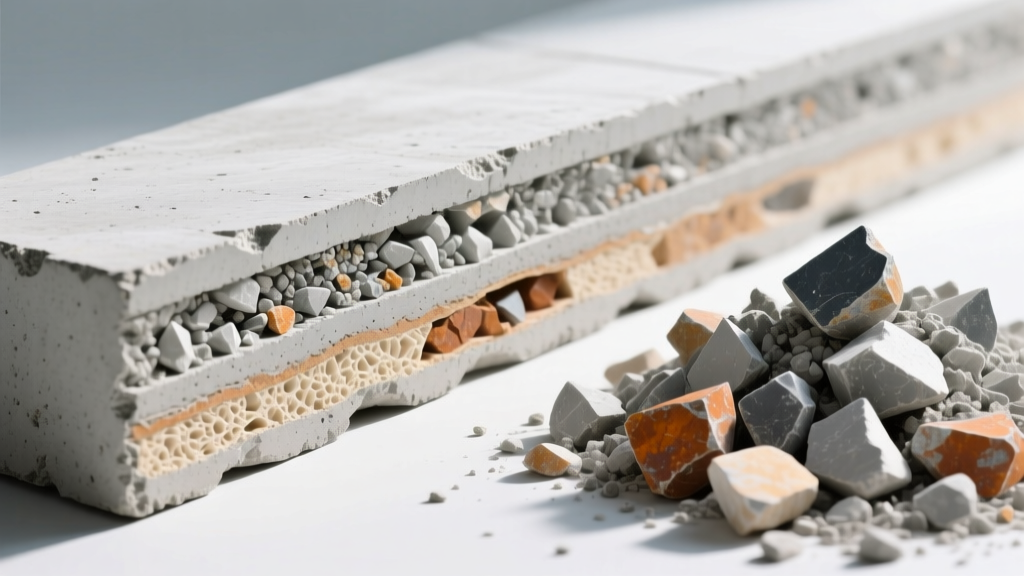
Beyond the cement powder, limestone plays a massive role as a coarse aggregate. In regions where siliceous river gravel is scarce, crushed limestone is the default coarse aggregate. The interaction between the cement paste and the aggregate surface—known as the Interfacial Transition Zone (ITZ)—is where concrete mix designs succeed or fail.
- Chemical Affinity: Unlike inert siliceous gravels, the calcium carbonate (CaCO3) in crushed limestone reacts chemically with the tricalcium aluminate (C3A) in the hydrating cement. This reaction forms monocarboaluminate, which densifies the ITZ, reduces localized porosity, and creates a stronger mechanical bond between the paste and the rock.
- Crushing Mechanics: Crushed limestone provides angular, cubical particles with high surface roughness, enhancing mechanical interlock. However, this angularity increases the paste requirement by 10-15 lbs/yd³ compared to smooth, rounded gravel to achieve identical workability.
- Thermal Compatibility: Limestone has a lower coefficient of thermal expansion (CTE) (~3.5 x 10⁻⁶/°F) compared to siliceous gravel (~7.0 x 10⁻⁶/°F). Concrete pavements and mass structures utilizing limestone aggregate exhibit significantly reduced thermal cracking and curling stresses.
2026 Cost and Embodied Carbon Breakdown
With the construction industry heavily focused on decarbonization, the concrete vs limestone debate often centers on environmental impact. By substituting up to 15% of energy-intensive clinker with ground limestone, Type IL mixes offer immediate carbon reductions without sacrificing structural performance. Below is a comparative breakdown for a standard 4,000 psi structural mix design in the US market.
| Metric | Type I (Ordinary Portland) | Type IL (Portland Limestone) |
|---|---|---|
| Material Cost (per cubic yard) | $142 - $158 | $134 - $148 |
| Clinker Factor | ~95% | 85% - 90% |
| Embodied Carbon (kg CO2e / yd³) | 385 - 410 | 330 - 355 |
| 28-Day Compressive Strength | 4,200 psi | 4,150 psi |
According to the Portland Cement Association, the widespread adoption of PLC (Type IL) is one of the most effective immediate strategies for reducing the carbon footprint of the built environment, eliminating millions of metric tons of CO2 annually without requiring new infrastructure or unproven technologies.
Troubleshooting Sulfate and Chloride Exposure
While limestone integration offers immense benefits, it introduces specific vulnerability profiles in aggressive environments. Specifiers must account for these edge cases during the mix design phase.
In cold, wet environments with high soil sulfate concentrations, the calcium carbonate in Type IL cement and limestone aggregates can react with sulfates to form thaumasite. Unlike traditional ettringite sulfate attack, which attacks the aluminate phases, thaumasite attack destroys the C-S-H gel itself, turning concrete into a soft, mushy pulp. Never specify Type IL or limestone aggregates for foundations in severe sulfate exposures (ASTM C150 Type V or specialized slag/fly ash blends are required).
For chloride exposure (marine environments or de-icing salts), Type IL performs identically to Type I, provided the w/cm ratio is kept at or below 0.40 and supplementary cementitious materials (SCMs) like fly ash or slag are incorporated to refine the pore structure. The National Ready Mixed Concrete Association emphasizes that durability is dictated by the permeability of the matrix, not just the clinker content.
Summary Framework for Specifiers
Choosing between natural limestone masonry and engineered concrete, or deciding how heavily to integrate limestone derivatives into a mix, requires a structured decision framework:
- For Architectural Facades: Natural limestone offers superior weathering aesthetics and lower embodied carbon for low-rise cladding, but engineered precast concrete (using limestone aggregates) provides higher tensile capacity for complex, heavily fenestrated panels.
- For Sustainable Flatwork & Foundations: Default to Type IL (Portland Limestone Cement). It provides a 10% carbon reduction and slight cost savings while maintaining 28-day strength parity with Type I.
- For Mass Concrete & Pavements: Specify crushed limestone coarse aggregate over siliceous gravel to lower the thermal expansion coefficient and reduce the risk of thermal cracking during the hydration heat cycle.
- For Sulfate-Rich Soils: Exclude limestone from the mix design entirely. Utilize Type V cement and non-reactive granitic or basaltic aggregates to prevent thaumasite formation.
Written by
James ThorntonJames Thornton is a construction industry veteran with 25 years of hands-on experience in wood framing, lumber grading, and residential building codes. He started as a framing carpenter in rural Oregon, earned his ICC Residential Building Inspector certification, and eventually became a senior plan reviewer for the City of Portland Bureau of Development Services. James holds a B.S. in Wood Science & Technology from Oregon State University and is a certified lumber grader through the West Coast Lumber Inspection Bureau (WCLIB). He has inspected over 3,000 residential construction sites and authored the city's internal guide on advanced framing techniques (2x6 at 24" O.C.). James lives in Bend, OR, where he builds custom timber-frame cabins and competes in lumberjack sports.
More from James Thornton
View all
Insulation
Best Home Insulation Materials: Complete 2026 Guide
Compare top home insulation materials for 2026. Find R-values, installed costs per square foot, and best uses for fiberglass, spray foam, and mineral wool.
Aug 4, 2026

Sustainable Building
Certify Your Green Building Material for LEED and WELL
Step-by-step guide to certifying a green building material for LEED v5 and WELL v2. Master EPDs, HPDs, and VOC limits for 2026 project specifications.
Aug 4, 2026

Stone & Masonry
Veneer Stacked Stone Panels: Interior Design & Style Showcase
Discover how veneer stacked stone panels transform interiors. Explore modern design profiles, material pairings, and technical installation specs.
Aug 4, 2026