Best Type of Drill Bit for Concrete vs. Masonry and Diamond Bits
Discover the best type of drill bit for concrete. We compare SDS carbide, standard masonry, and diamond core bits for cost, lifespan, and performance.

The Core Contenders: Concrete vs. Masonry vs. Diamond Bits
Selecting the correct type of drill bit for concrete is a matter of metallurgy, shank mechanics, and structural engineering. Modern structural concrete routinely exceeds 4,000 PSI in compressive strength and contains hard quartzite aggregate and steel reinforcement. Using an under-specified bit results in burnt tips, shattered carbide, and damaged rotary hammers. To determine the optimal tooling, we must compare the three primary categories: SDS carbide bits, standard masonry bits, and diamond core bits.
| Bit Category | Shank Type | Max Diameter | Primary Mechanism | Avg. Cost (2026) |
|---|---|---|---|---|
| SDS Carbide (4-Cutter) | SDS-Plus / SDS-Max | 1-1/4' (Plus) / 2' (Max) | Hammer + Rotation | $18 - $45 |
| Standard Masonry | Straight / Hex (3-Jaw) | 1/2' | Percussion + Rotation | $4 - $12 |
| Diamond Core | Threaded / Quick-Release | 6' to 14' | Rotary Grinding (Wet/Dry) | $90 - $250+ |
The Heavyweights: SDS Carbide vs. Standard Masonry Bits
The most common point of failure on job sites is the substitution of standard masonry bits for dedicated concrete tooling. While both feature carbide tips, their shank designs and tip geometries dictate entirely different performance ceilings.
Standard Masonry Bits: The Light-Duty Alternative
Standard masonry bits feature a straight or hex shank designed for a traditional 3-jaw drill chuck. They rely on the drill's mechanical clutch to provide a percussive 'hammer' action. This mechanism is sufficient for soft brick, cinder block, and mortar joints. However, when introduced to cured, 4,000 PSI concrete, the straight shank slips in the chuck under high torque, and the shallow flute design fails to evacuate dense silica dust. The bit overheats, the carbide tip brazing fails, and the bit seizes. For structural concrete, masonry bits are a false economy.
SDS Carbide Bits: The Concrete Standard
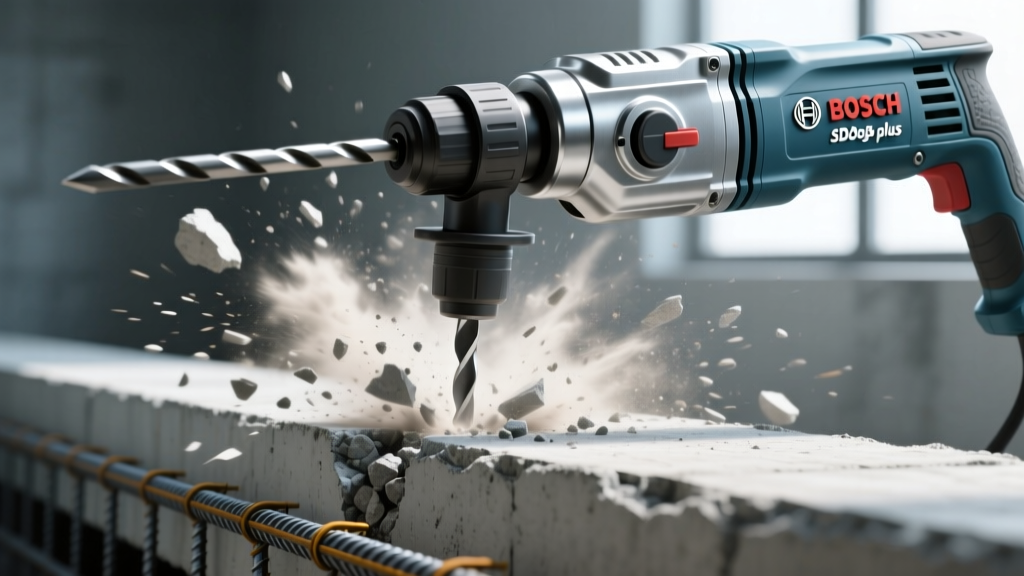
The Slotted Drive System (SDS) shank allows the bit to slide back and forth within the chuck without slipping, transferring the pneumatic hammer energy of a rotary hammer directly to the concrete. When evaluating SDS bits, the cutter head geometry is the critical differentiator.
Standard 2-cutter SDS bits feature a spade-like carbide tip. If this tip strikes a #4 (1/2') or #5 (5/8') rebar at an angle, the spade catches the steel, causing immediate rotational binding. This can snap the bit shank or violently twist the rotary hammer, risking severe wrist injuries. Always specify 4-cutter (full carbide head) bits, such as the Bosch HCFC2000 series or Hilti TE-CX, for any concrete slab or foundation where rebar placement is unverified. The symmetrical 4-cutter head grinds through steel reinforcement without binding.
Diamond Core Bits: The Alternative for Large Penetrations
When hole diameters exceed 1-1/4 inches, carbide bits become inefficient and structurally risky. For HVAC ducting, plumbing stacks, and electrical conduit penetrations, diamond core bits are the mandatory alternative. Unlike carbide bits that pulverize material via impact, diamond cores use a rotational grinding action, embedding industrial diamonds into a steel matrix to sheer away the concrete.
Wet vs. Dry Diamond Drilling and Silica Compliance
Diamond core drilling generates massive volumes of respirable crystalline silica (RCS). The choice between wet and dry diamond bits is no longer just about bit lifespan; it is a strict regulatory compliance issue.
- Wet Diamond Cores: Water is fed through the center of the bit, cooling the diamond segments and encapsulating silica dust in a slurry. This is the preferred method for indoor structural penetrations, preserving the diamond matrix and eliminating airborne RCS. It requires a GFCI-protected power supply and a wet/dry vacuum for slurry extraction.
- Dry Diamond Cores: Designed with specialized laser-welded segments and wider air gaps to dissipate heat. Dry bits require the operator to periodically pull the bit from the hole to clear dust and cool the segments. According to the OSHA Respirable Crystalline Silica Standard for Construction (1926.1153), dry drilling concrete without an integrated HEPA dust extraction system attached to the shroud violates Table 1 exposure limits, exposing contractors to severe citations.
For comprehensive health guidelines on silica exposure during concrete drilling, the CDC NIOSH Silica Safety Resources provide critical frameworks for PPE and ventilation requirements.
Cost, Lifespan, and ROI Breakdown
Evaluating the cost per hole reveals why professional contractors abandon cheaper alternatives in favor of specialized concrete tooling.
Pricing & Yield Matrix (Based on 4,000 PSI Concrete with Aggregate)
- Standard 1/2' Masonry Bit ($6): Yields 3 to 5 holes before the tip dulls or shatters. Cost per hole: $1.20 - $2.00 (plus high failure risk).
- SDS-Plus 2-Cutter Bit ($12): Yields 40 to 60 holes in plain concrete. Drops to 15 holes if rebar is encountered. Cost per hole: $0.20 - $0.30.
- SDS-Plus 4-Cutter Full Carbide ($24): Yields 100+ holes, including incidental rebar strikes. Cost per hole: $0.24 (but zero downtime for bit changes or broken tools).
- 4' Dry Diamond Core Bit ($130): Yields 15 to 25 deep penetrations (6' thick) before segment wear. Cost per hole: $5.20 - $8.60.
Decision Framework: Which Bit for Which Job?
Use this diagnostic flow to select the exact tooling required for your specific application.
- Are you drilling into brick, CMU block, or mortar?
Action: Use a standard straight-shank masonry bit with a hammer drill. Keep RPMs below 1,500 to prevent burning the tip. - Are you drilling 1/4' to 3/4' holes for wedge anchors or Tapcons in a poured foundation?
Action: Use an SDS-Plus rotary hammer with a 4-cutter full carbide bit. Set the tool to 'Hammer + Rotation' mode. Apply 15-20 lbs of forward pressure; let the pneumatic hammer do the work. - Are you drilling 1' to 2' holes for plumbing or large lag shields?
Action: Step up to an SDS-Max rotary hammer and an SDS-Max 4-cutter bit. Ensure your tool has Active Torque Control (ATC) to prevent body rotation if the bit binds in deep aggregate. - Is the hole diameter larger than 2'?
Action: Abandon carbide. Use a dedicated diamond core rig (e.g., Husqvarna DM 220) with a wet-feed diamond core bit. Anchor the rig securely to the concrete using wedge anchors to prevent the rig from spinning under high torque.
Expert Edge Case: When drilling deep holes (over 10 inches) for epoxy anchor systems, dust accumulation at the bottom of the hole compresses and creates a 'cushion' that prevents the bit from advancing, while simultaneously ruining the bond strength of the epoxy. You must use an SDS bit with an aggressive, wide-open flute design and pull the bit out of the hole every 2 inches to clear the dust, followed by a compressed air and wire brush cleaning protocol per the epoxy manufacturer's ICC-ES evaluation report.
Matching the type of drill bit for concrete to the specific compressive strength, reinforcement profile, and hole diameter of your project is non-negotiable. While standard masonry bits and dry-core alternatives have niche applications, the 4-cutter SDS carbide system remains the undisputed baseline for structural concrete fastening in modern construction.
Written by
Marcus ChenMarcus Chen is a licensed structural engineer (PE) and building materials analyst with over 12 years of experience across residential, commercial, and industrial construction. He holds a Master of Science in Civil Engineering from UC Berkeley and spent six years at Thornton Tomasetti before transitioning to independent consulting and technical writing. Marcus specializes in material selection for seismic-prone regions, concrete reinforcement strategies, and lifecycle cost analysis. His work has been cited by the American Concrete Institute (ACI) and the Structural Engineers Association of California (SEAOC). When he is not on a job site or at his desk, you will find him hiking the Sierra Nevada or restoring a 1920s craftsman bungalow in Oakland, CA.
More from Marcus Chen
View all
Construction Cost
How Much Did the Eiffel Tower Cost to Build?
How much did the Eiffel Tower cost to build in 1889? We adjust for inflation and compare its budget to modern skyscraper construction.
Aug 4, 2026

Fire Resistance
What Is a Fire Resistant Material? Testing & Certification Guide
Discover what is a fire resistant material through ASTM and UL testing. Learn how fire ratings, certifications, and assemblies work in construction.
Aug 4, 2026

Construction Cost
How Much Did the Burj Khalifa Cost to Build?
How much did the Burj Khalifa cost to build? We break down the $1.5B project and extract 5 money-saving strategies for your next build.
Jul 30, 2026