Concrete Floor Coating Options: Cost Breakdown Guide
Compare the costs of top concrete floor coating options. Detailed price breakdowns for epoxy, polyurea, acrylic, and polyaspartic systems.
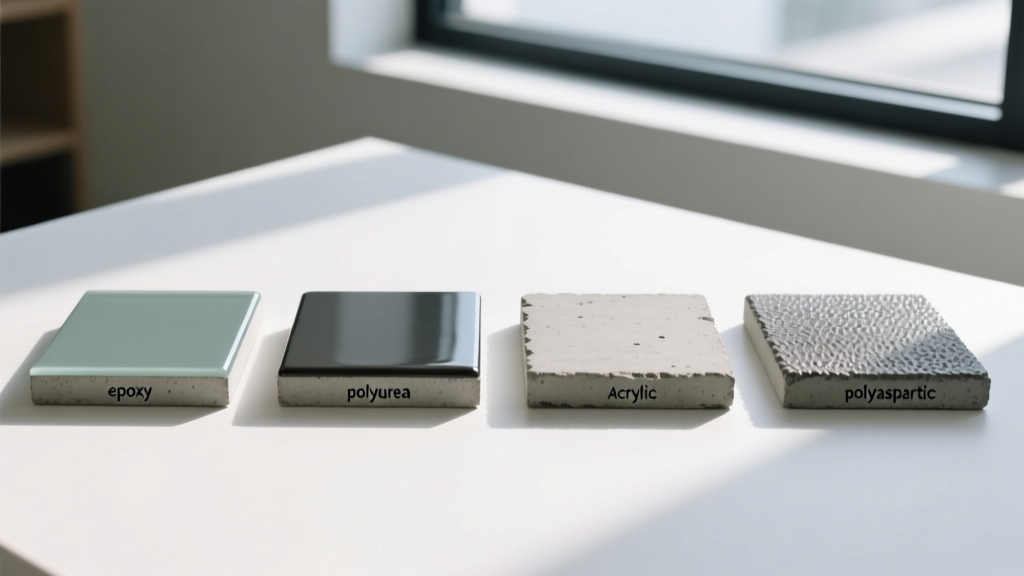
The Financial Reality of Concrete Floor Coatings
When evaluating concrete floor coating options, contractors and facility managers frequently make the mistake of comparing only the per-gallon material cost. This approach inevitably leads to budget overruns and premature coating failures. The true cost of a concrete coating system is a composite of substrate preparation, moisture mitigation, material chemistry, and long-term maintenance. A budget-friendly water-based acrylic might cost $1.50 per square foot initially, but when factoring in biennial reapplications, its 10-year cost eclipses that of a premium 100% solids epoxy system.
This analysis deconstructs the pricing structures of the four primary concrete floor coating chemistries available in 2026, providing exact installed cost ranges, failure modes, and lifecycle financial modeling.
⚠️ The Hidden Cost Warning: Moisture Vapor Transmission (MVT)
Before finalizing any coating budget, you must test for MVT using the ASTM F2170 in-situ relative humidity probe method or the ASTM F1869 calcium chloride test. If your slab emits moisture vapor exceeding 5 lbs/1,000 sq ft/24 hours, standard epoxies will blister and delaminate within months. Mitigating high MVT requires a specialized moisture vapor barrier (such as TRU PC MVB or Master Builders MasterSeal), which adds $2.00 to $3.50 per square foot to your baseline preparation costs. Never skip this diagnostic step to save money.
Material & Labor Cost Matrix
The following matrix outlines the baseline installed costs for standard commercial and residential applications. These figures assume a standard Concrete Surface Profile (CSP 2-3) achieved via diamond grinding, with no major slab repairs required.
| Coating Chemistry | Material Cost (per sq ft) | Labor Cost (per sq ft) | Total Installed | Expected Lifespan |
|---|---|---|---|---|
| Water-Based Epoxy | $0.40 - $0.80 | $1.10 - $1.70 | $1.50 - $2.50 | 2 - 4 Years |
| 100% Solids Epoxy | $1.20 - $2.00 | $2.30 - $3.50 | $3.50 - $5.50 | 10 - 15 Years |
| Polyaspartic / Polyurea | $2.50 - $4.00 | $3.00 - $4.50 | $5.50 - $8.50 | 15 - 20+ Years |
| Acrylic Sealer | $0.20 - $0.50 | $0.60 - $1.00 | $0.80 - $1.50 | 6 - 18 Months |
Deep Dive: Epoxy Systems (Water-Based vs. 100% Solids)
Epoxy remains the most specified concrete floor coating option for garages, warehouses, and light manufacturing. However, the term 'epoxy' encompasses vastly different chemical formulations with distinct cost-to-performance ratios.
Water-Based and Solvent-Based Epoxies
Often sold in big-box retail kits, these systems contain 40% to 60% solids, with the remainder being water or solvents that evaporate during curing. They result in a thin dry film thickness (DFT) of 2 to 4 mils. While the upfront cost is attractive ($1.50 to $2.50 installed), they are highly susceptible to 'hot tire pickup'—where the plasticizers in warm vehicle tires chemically bond to the thin coating and rip it from the substrate upon driving away. According to industry cost analyses by Concrete Network, these thin-film systems rarely survive beyond three years in active vehicular environments.
100% Solids Epoxy (Bisphenol-A and Bisphenol-F)
Professional-grade 100% solids epoxies (such as Sherwin-Williams Macropoxy or Spartan EP) contain zero volatile organic compounds (VOCs) that evaporate. What goes on the floor stays on the floor, yielding a robust DFT of 10 to 20 mils per coat. A standard two-coat system with a urethane topcoat provides exceptional abrasion resistance and chemical impermeability. The higher material cost is offset by a lifespan exceeding a decade in heavy-traffic environments.
Polyaspartic & Polyurea: The Premium Rapid-Cure Tier
When facility downtime is measured in lost revenue, polyaspartic and aliphatic polyurea coatings justify their premium price tag. These aliphatic systems are UV-stable, meaning they will not yellow or chalk when exposed to direct sunlight—a common failure mode of standard aromatic epoxies.
- Cure Time: Foot traffic in 2 hours; full vehicular traffic in 24 hours. (Standard epoxy requires 72+ hours).
- Temperature Tolerance: Can be applied in temperatures as low as -30°F, whereas epoxy requires ambient and substrate temperatures above 50°F.
- Flexibility: Polyurea possesses higher elongation properties, allowing it to bridge micro-cracks in the concrete substrate without fracturing.
- Application Complexity: The extremely fast pot life (sometimes under 15 minutes) requires specialized plural-component spray equipment or highly coordinated manual squeegee-and-backroll teams, driving labor costs up to $4.50 per square foot.
For detailed performance comparisons between these advanced chemistries, the polyurea vs. epoxy technical breakdowns highlight that polyaspartics are best utilized as a topcoat over an epoxy base, combining the build-thickness of epoxy with the UV and abrasion resistance of polyurea.
Acrylic & Penetrating Sealers: Budget & Bare-Minimum Options
Acrylic sealers and penetrating treatments (silane/siloxane) are not true 'coatings' in the sense of building a protective film on the surface. Instead, they are pore-liners or surface sealers.
Cost vs. Protection Trade-off
Penetrating Sealers ($0.80 - $1.50/sq ft): These react chemically with the free lime in concrete to form a subsurface calcium silicate hydrate barrier. They offer zero protection against surface staining or chemical spills but excellently prevent water intrusion and freeze-thaw spalling. Ideal for exterior driveways and unheated warehouses.
Acrylic Sealers ($0.80 - $1.50/sq ft): These form a very thin, sacrificial topical film. They enhance the color of stamped or stained concrete but wear away rapidly under foot traffic. Budget for a mandatory reapplication every 12 to 18 months.
Substrate Preparation: Where Budgets Actually Break
The most frequent cause of coating failure is inadequate surface preparation. Simply acid-etching or power-washing a slab is entirely insufficient for modern high-performance coatings. The International Concrete Repair Institute (ICRI) guidelines mandate specific Concrete Surface Profiles (CSP) depending on the coating chemistry.
| Preparation Method | Achieved CSP | Cost per Sq Ft | Best Paired With |
|---|---|---|---|
| Acid Etching | CSP 1 | $0.15 - $0.30 | Water-based epoxies, Acrylics |
| Diamond Grinding | CSP 2 - 3 | $0.50 - $0.85 | 100% Solids Epoxy, Urethanes |
| Shot Blasting | CSP 3 - 4 | $0.40 - $0.75 | Polyurea, Thick-build Mortars |
| Scarification / Milling | CSP 5 - 9 | $1.00 - $2.50 | Heavy-duty overlays, Contaminated slabs |
If your slab has existing adhesive residue, curing compounds, or deep oil penetration, mechanical grinding will merely smear these contaminants deeper into the pores. In these scenarios, shot blasting or specialized chemical stripping is mandatory, adding $0.50 to $1.25 per square foot to the prep budget.
10-Year Total Cost of Ownership (TCO) Framework
To make a sound financial decision, evaluate the 10-year TCO for a 5,000-square-foot commercial garage:
- Acrylic Sealer: Initial install ($6,000) + 6 reapplications over 10 years ($36,000) + annual downtime costs = ~$45,000+
- Water-Based Epoxy: Initial install ($10,000) + 2 full tear-offs and reapplications ($20,000) = ~$30,000
- 100% Solids Epoxy w/ Urethane Topcoat: Initial install ($22,500) + 1 topcoat refresh at year 7 ($5,000) = ~$27,500
- Polyaspartic System: Initial install ($35,000) + zero maintenance over 10 years = $35,000
While 100% solids epoxy offers the lowest 10-year TCO, the polyaspartic system becomes the superior financial choice if the facility cannot afford the 4-day operational shutdown required to install and cure a multi-coat epoxy system. In high-revenue environments, the cost of lost business during an epoxy cure time often dwarfs the $12,500 material premium of a rapid-cure polyaspartic.
Decision Framework: Which Coating Fits Your Slab?
- Choose 100% Solids Epoxy if: You are coating an interior warehouse, garage, or laboratory where UV stability is irrelevant, you have a standard 4-day installation window, and you require maximum chemical resistance against oils and solvents.
- Choose Polyaspartic/Polyurea if: You are coating an exterior surface, a commercial retail space that can only be shut down overnight, or an unheated environment where application temperatures drop below 50°F.
- Choose Penetrating Silane/Siloxane if: You are protecting exterior stamped concrete, driveways, or airport runways where surface traction cannot be compromised by a topical film, and your primary enemy is water intrusion and freeze-thaw cycling.
- Choose Acrylic if: You are staging a property for a quick sale, operating on a strictly limited capital expenditure budget, or protecting a low-traffic decorative interior floor.
Written by
Priya KapoorPriya Kapoor is a real estate market analyst and construction economics researcher with expertise in housing affordability, development feasibility, and infrastructure investment. She holds a Master of Regional Planning from Cornell University and previously worked as a senior analyst at CBRE's Investment Properties group, where she modeled returns for $4B in mixed-use development pipelines. Priya now runs an independent research practice advising developers, municipalities, and REITs on construction cost forecasting and market timing. She publishes the quarterly "BuildMat Market Pulse" report tracking material price indices across 12 commodity categories. Based in Austin, TX, Priya serves on the board of Habitat for Humanity Austin and is a marathon runner.
More from Priya Kapoor
View all
Construction Cost
Cost to Build a 1600 Sq Ft Home in 2026: Full Breakdown
Accurate 2026 cost to build a 1600 sq ft home—material, labor, and regional pricing breakdowns included. Plan your budget with real-time estimates.
Aug 11, 2026

Wood & Lumber
Name the Types of Wood for Pressure Treatment and Preservation
Learn how to name the types of wood best suited for pressure treatment. Compare species treatability, chemical retention levels, and 2026 preservation costs.
Aug 4, 2026

Stone & Masonry
Stone Veneer Suppliers Lindenhurst: 2026 Cost Analysis
Analyze 2026 stone veneer costs in Lindenhurst, NY. Compare local supplier pricing, delivery fees, and Suffolk County installation labor rates.
Aug 4, 2026