Top Concrete Floor Finish Options by Application Type
Discover the best concrete floor finish options for residential, commercial, and industrial spaces. Compare costs, durability, and installation specs.

Residential Interiors: Polished and Stained Systems
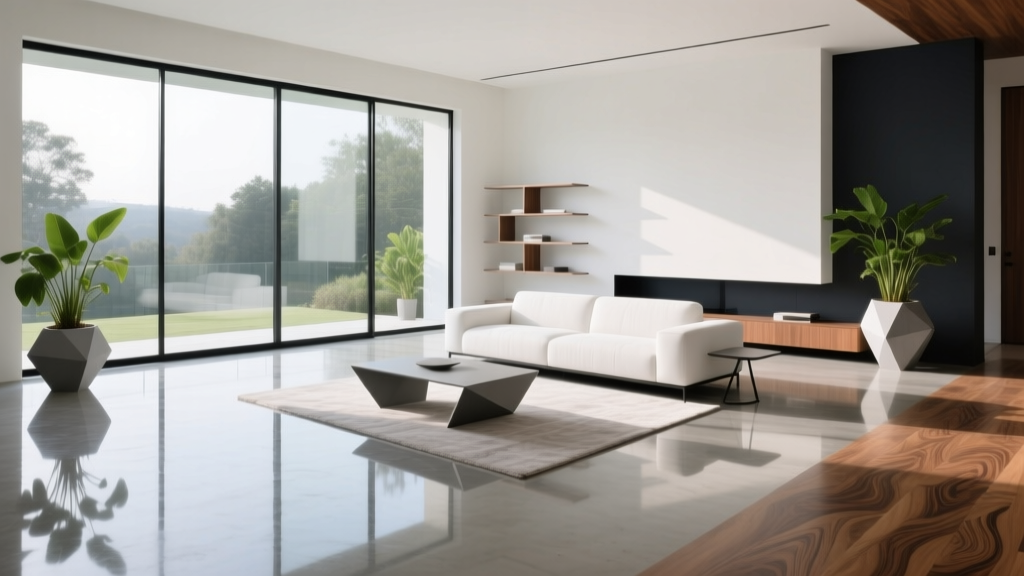
Concrete flooring in residential applications has shifted from a utilitarian subfloor to a primary design element. When evaluating concrete floor finish options for living spaces, the focus is on aesthetics, barefoot comfort, and low-VOC emissions. The two dominant systems are mechanically polished concrete and chemically stained concrete.
The Polishing Sequence and Densification
Mechanically polished concrete relies on a multi-step grinding process using planetary grinders equipped with diamond-impregnated pads. The process begins with coarse metal-bond diamonds (typically 40-grit to 80-grit) to remove surface blemishes and expose the desired aggregate profile. For a salt-and-pepper finish, grinding stops at a shallow depth; for large aggregate exposure, the grind penetrates up to 1/4 inch into the slab.
The critical chemical step is the application of a densifier. While older formulations used sodium silicate, modern residential applications require lithium silicate densifiers. Lithium molecules are smaller, penetrating deeper into the concrete matrix to react with free lime (calcium hydroxide) and form calcium silicate hydrate (CSH). This increases surface hardness to a Mohs scale rating of 5 or higher, preventing dusting and micro-scratching. Following densification, the floor is honed with resin-bond pads ranging from 400-grit (matte/satin) up to 3000-grit (high-gloss mirror finish). Expect to pay between $5.00 and $12.00 per square foot depending on the aggregate exposure level and final grit.
Acid Stains vs. Water-Based Acrylics
If the existing slab is too damaged for mechanical polishing, chemical staining is the preferred alternative. Acid stains (reactive stains) utilize metallic salts suspended in an acidic solution to react with the concrete's lime content, producing permanent, translucent, variegated earth tones. Because they rely on a chemical reaction, acid stains require a minimum curing time of 28 days for new slabs and must be neutralized with a baking soda solution before sealing. Water-based acrylic stains, conversely, are non-reactive and offer a broader, more predictable color palette, including bright blues and reds that acid stains cannot achieve. Both require a protective topcoat, typically a solvent-based acrylic sealer applied at 3 to 5 mils thickness.
Commercial and Retail: High-Traffic Coatings
Retail environments, showrooms, and commercial lobbies demand concrete floor finish options that withstand heavy foot traffic, rolling carts, and frequent chemical cleaning without sacrificing visual appeal. Unsealed or merely densified concrete will eventually stain from oil and organic spills in these environments. Therefore, film-forming polymer coatings are required.
Epoxy Terrazzo and Metallic Systems
For high-end retail, 100% solids epoxy terrazzo provides a seamless, highly decorative surface. This system involves broadcasting marble, glass, or synthetic aggregate chips into a pigmented epoxy binder, then grinding and polishing the surface similarly to a concrete polish. The result is a 3/8-inch thick, impervious floor with a lifecycle exceeding 40 years. According to the Concrete Network, 100% solids epoxies contain no volatile solvents, meaning they emit near-zero VOCs during application, a critical requirement for occupied commercial buildings.
For a lower-cost alternative, metallic epoxy systems utilize mica-infused pigments suspended in a clear epoxy carrier to create a 3D, fluid aesthetic. However, standard epoxies are susceptible to UV degradation (chalking and yellowing). To mitigate this in spaces with large storefront windows, the metallic epoxy must be top-coated with an aliphatic polyurethane or polyaspartic sealer.
| Coating Type | Dry Film Thickness | UV Stability | Walk-On Cure Time | Cost per Sq. Ft. |
|---|---|---|---|---|
| 100% Solids Epoxy | 10 - 15 mils | Poor (Yellows) | 18 - 24 hours | $4.50 - $8.00 |
| Polyaspartic Topcoat | 4 - 6 mils | Excellent | 2 - 4 hours | $3.00 - $5.50 |
| Aliphatic Urethane | 3 - 5 mils | Excellent | 12 - 18 hours | $2.50 - $4.00 |
Industrial and Garage: Thermal and Chemical Resistance
Industrial facilities, food processing plants, and residential garages subject concrete to extreme mechanical abuse, chemical spills, and thermal shock. Standard epoxies will fail in these environments through a process called hot tire pickup (where plasticizers in warm rubber tires migrate into and soften the epoxy) or delamination from steam cleaning.
Polyaspartic Flake Systems
For automotive garages and light manufacturing, polyaspartic ester coatings paired with vinyl broadcast flakes represent the current industry standard. Polyaspartics offer superior elongation properties (flexibility) compared to rigid epoxies, allowing them to bridge micro-cracks in the concrete substrate without fracturing. The installation involves scoring the concrete, applying a polyaspartic base coat, broadcasting 100% coverage of 1/4-inch vinyl flakes, and sealing with a clear polyaspartic topcoat. This system cures to vehicular traffic in under 24 hours, drastically reducing facility downtime.
Heavy-Duty Urethane Mortar
In food and beverage processing, floors are subjected to daily washdowns with 180°F water and harsh caustic sanitizers. The Portland Cement Association notes that standard concrete degrades rapidly under thermal cycling and chemical attack. The only viable concrete floor finish option here is a heavy-duty urethane mortar (often referred to by legacy brand names like Stonclad or Flowfresh). Applied at a thickness of 1/4 inch to 3/8 inch using a gauging trowel, urethane mortars possess a coefficient of thermal expansion nearly identical to the concrete substrate. This prevents delamination during thermal shock. Furthermore, they are inherently antimicrobial and resistant to concentrated organic acids (like lactic and citric acid) that would eat through standard epoxy.
Exterior and Landscape: Slip Resistance and Weathering
Exterior concrete floor finish options must prioritize safety, freeze-thaw durability, and UV resistance. Film-forming coatings like epoxy and standard urethanes are strictly prohibited outdoors, as they trap moisture vapor trying to escape the concrete slab, leading to blistering and catastrophic coating failure.
Stamped Concrete and Integral Color
Stamped concrete utilizes polyurethane texture mats to imprint patterns resembling stone, brick, or slate into freshly placed concrete. To ensure color longevity, specify integral color (pigment added directly to the concrete mix at the batch plant) combined with a dry-shake color hardener applied to the surface. The color hardener not only provides the primary aesthetic hue but also densifies the top 1/8 inch of the slab, increasing abrasion resistance.
Broom Finish with Silane/Siloxane Penetrating Sealer
For driveways and municipal pathways, a standard broom finish remains the most cost-effective and durable option. Instead of applying a topical acrylic sealer that will peel and require reapplication every two years, treat the cured concrete with a penetrating silane/siloxane sealer. These molecules are small enough to penetrate up to 1/4 inch into the pores, where they react to form a hydrophobic resin barrier. This prevents water and chloride ions (from de-icing salts) from entering the matrix, effectively eliminating freeze-thaw spalling and rebar corrosion without altering the natural traction of the broom finish.
Application Decision Matrix
Selecting the correct finish requires aligning the environmental stressors with the material properties. Use this framework to finalize your specification:
- If the space is a residential interior with radiant heating: Specify mechanically polished concrete with a lithium silicate densifier and a 800-grit satin finish. Avoid topical sealers that can off-gas when heated.
- If the space is a high-end retail storefront with UV exposure: Specify metallic epoxy topped with an aliphatic polyurethane, or use a UV-stable polyaspartic system to prevent yellowing.
- If the space is an automotive garage or warehouse: Specify a polyaspartic base coat with 100% vinyl flake broadcast to hide dirt, resist hot tire pickup, and provide a fast return-to-service timeline.
- If the space is a food processing plant with steam cleaning: Specify a 1/4-inch heavy-duty urethane mortar trowel-down system for thermal shock and chemical resistance.
- If the space is an exterior pool deck or driveway: Specify stamped concrete with integral color, a dry-shake hardener, and a non-slip acrylic sealer, or a broom finish treated with a penetrating silane/siloxane water repellent.
By matching the specific chemical, mechanical, and environmental demands of the application to the precise flooring technology, you ensure a concrete surface that performs flawlessly over its intended lifecycle while minimizing long-term maintenance costs.
Written by
James ThorntonJames Thornton is a construction industry veteran with 25 years of hands-on experience in wood framing, lumber grading, and residential building codes. He started as a framing carpenter in rural Oregon, earned his ICC Residential Building Inspector certification, and eventually became a senior plan reviewer for the City of Portland Bureau of Development Services. James holds a B.S. in Wood Science & Technology from Oregon State University and is a certified lumber grader through the West Coast Lumber Inspection Bureau (WCLIB). He has inspected over 3,000 residential construction sites and authored the city's internal guide on advanced framing techniques (2x6 at 24" O.C.). James lives in Bend, OR, where he builds custom timber-frame cabins and competes in lumberjack sports.
More from James Thornton
View all
Insulation
Best Home Insulation Materials: Complete 2026 Guide
Compare top home insulation materials for 2026. Find R-values, installed costs per square foot, and best uses for fiberglass, spray foam, and mineral wool.
Aug 4, 2026

Sustainable Building
Certify Your Green Building Material for LEED and WELL
Step-by-step guide to certifying a green building material for LEED v5 and WELL v2. Master EPDs, HPDs, and VOC limits for 2026 project specifications.
Aug 4, 2026

Stone & Masonry
Veneer Stacked Stone Panels: Interior Design & Style Showcase
Discover how veneer stacked stone panels transform interiors. Explore modern design profiles, material pairings, and technical installation specs.
Aug 4, 2026