Trowel Finish vs. Float Finish Concrete: 2026 Cost Breakdown
Analyze the 2026 cost breakdown of trowel finish vs. float finish concrete. Compare labor rates, tooling expenses, and long-term value for your slab.

The Economics of Surface Tolerance
The decision between a trowel finish and a float finish dictates not only the aesthetic and functional performance of a concrete slab but also its final price tag. While the base material cost for a standard 4-inch thick 3,000 PSI concrete mix remains constant regardless of the finishing technique, the labor, equipment, and curing variables diverge significantly. In 2026, skilled concrete finishing labor continues to command premium rates, making the choice of finish one of the most impactful line items in any flatwork budget.
Understanding the cost breakdown of trowel finish vs. float finish concrete requires looking beyond the initial pour. A float finish—characterized by a slightly textured, granular surface—is achieved by dragging a wood, sponge, or magnesium float over the slab. A trowel finish—yielding a dense, smooth, and hard surface—requires steel trowels (hand or powered) and multiple passes. This guide dissects the exact pricing structures, labor hours, and hidden costs associated with both methods.
2026 Cost Breakdown Matrix: Finishing Adders
The following table isolates the finishing adders—the costs applied strictly to the finishing phase, excluding the base excavation, forming, and concrete material costs. Prices reflect national averages for commercial and high-end residential contractors in 2026.
| Cost Category | Float Finish (Broom/Magnesium) | Hand Trowel Finish | Power Trowel Finish (Large Slabs) |
|---|---|---|---|
| Finishing Labor Rate | $1.50 – $2.50 / sq. ft. | $3.50 – $5.50 / sq. ft. | $2.50 – $4.00 / sq. ft. |
| Tooling & Equipment | $0.05 – $0.10 / sq. ft. | $0.10 – $0.20 / sq. ft. | $0.25 – $0.45 / sq. ft. (Rental/Fuel) |
| Curing & Sealing | $0.20 – $0.40 / sq. ft. | $0.50 – $1.20 / sq. ft. | $0.50 – $1.20 / sq. ft. |
| Total Finishing Adder | $1.75 – $3.00 / sq. ft. | $4.10 – $6.90 / sq. ft. | $3.25 – $5.65 / sq. ft. |
| Time on Site (per 1,000 sq ft) | 3 – 5 Hours | 8 – 12 Hours | 5 – 8 Hours |
Note: Base concrete material and placement (pumping and screeding) typically adds an additional $6.00 to $9.00 per square foot to the total project cost.
Float Finish: Cost Drivers and Application Economics
A float finish is the most economical choice for exterior flatwork. The process involves using a bull float immediately after screeding to push down aggregate and level the surface, followed by a hand float (often magnesium or wood) once the bleed water evaporates.
The Timing Advantage
The primary cost-saving factor of a float finish is the forgiving nature of its timing. According to the Portland Cement Association, floating can commence as soon as the sheen of bleed water leaves the surface. Because the objective is to open the pores slightly and create a uniform texture rather than seal the surface completely, finishers do not need to wait for the concrete to reach a high degree of initial set. This allows crews to complete the job in a single continuous phase, minimizing overtime and multiple site visits.
Tooling Depreciation
Magnesium floats and wood floats are inexpensive and have long lifespans. A 10-inch magnesium hand float costs roughly $45 and can last for hundreds of pours. There is no need for heavy machinery, fuel, or specialized PPE beyond standard concrete boots and knee boards, keeping the equipment overhead near zero.
Trowel Finish: Why Smooth Costs More
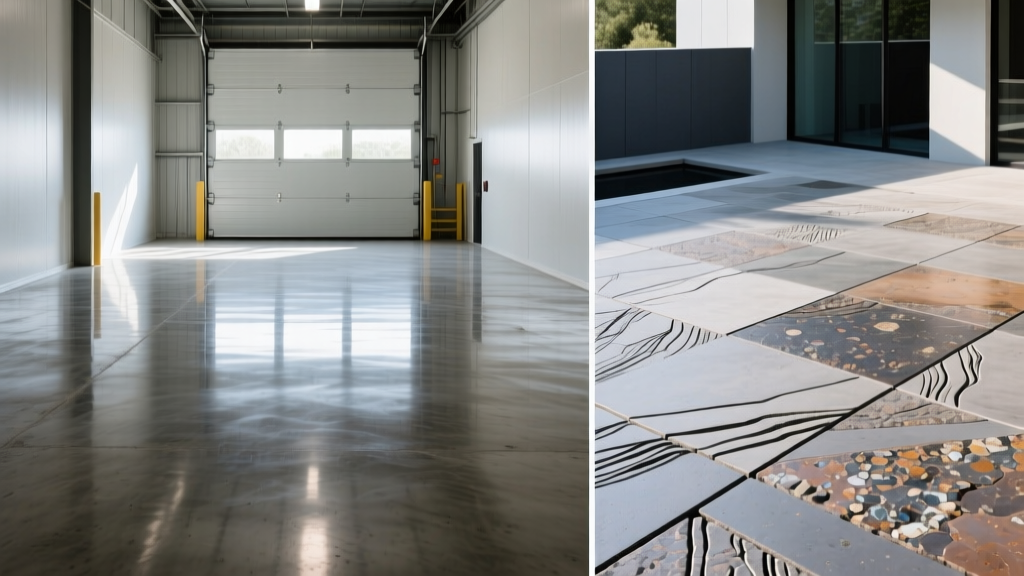
Troweling compresses the surface mortar, creating a dense, impermeable layer. This is mandatory for interior warehouse floors, garage slabs, and commercial retail spaces where forklift traffic or chemical spills are expected. However, this density comes at a strict labor premium.
The Multi-Pass Labor Penalty
Unlike floating, steel troweling requires multiple passes. A standard specification (such as those outlined in ACI 302.1R) for a hard-troweled floor dictates a minimum of two to three passes. The first pass is done with the blade flat to level minor imperfections; subsequent passes are done with the blade pitched at increasing angles to burnish the surface. Each pass requires the concrete to cure further, meaning the finishing crew is tethered to the slab for an extended period, often working late into the evening as the slab sets.
Power Troweling vs. Hand Troweling
For slabs exceeding 1,500 square feet, contractors pivot to walk-behind or ride-on power trowels. While a 36-inch walk-behind power trowel rents for approximately $110 to $150 per day in 2026, the machine drastically reduces the manual labor hours required to achieve a high F-number (Floor Flatness/Levelness) tolerance. However, power troweling introduces edge-work complications: the machine cannot reach within 4 to 6 inches of walls or columns. Finishers must hand-trowel these perimeters, creating a localized labor bottleneck that drives up the per-square-foot cost on complex floor plans with many obstructions.
Hidden Costs and Failure Modes
Warning: The Premature Troweling Trap
The most expensive mistake in concrete finishing is troweling while bleed water is still present on the surface. If a steel trowel traps this water beneath the dense surface layer, it guarantees surface dusting (laitance) and scaling once the slab cures. Remediating a dusting floor requires mechanical diamond grinding (costing $1.50 to $3.00 per sq. ft.) followed by the application of a chemical densifier like lithium silicate. If the slab is severely compromised, epoxy coatings will delaminate, leading to catastrophic warranty claims. Float finishes are highly resistant to this specific failure mode because the surface remains breathable.
Curing and Long-Term Maintenance Economics
The lifecycle cost of the slab is heavily influenced by the finish type. A float finish, being porous, readily accepts penetrating silane/siloxane sealers. These sealers cost roughly $0.30 per square foot for materials and require reapplication every 3 to 5 years. Maintenance involves simple power washing.
Conversely, a steel-troweled interior floor requires a different chemical approach. Because the surface is highly dense, standard penetrating sealers will not absorb properly. Contractors must apply specialized cure-and-seal compounds (like acrylics or epoxies) immediately after the final trowel pass, or wait 28 days for a full cure before applying a polished guard or densifier. Furthermore, high-traffic troweled floors require periodic burnishing or waxing to maintain their abrasion resistance, adding $0.15 to $0.30 per square foot to annual facility maintenance budgets.
Strategic Decision Matrix
Use the following framework to determine which finishing method aligns with your project's structural requirements and budget constraints.
| Application Scenario | Recommended Finish | Budget Impact | Technical Justification |
|---|---|---|---|
| Exterior Sidewalks & Pool Decks | Float / Broom Finish | Lowest | Provides essential slip resistance (ADA compliance); allows for moisture vapor transmission without blistering. |
| Residential Driveways | Float / Light Broom | Low | Withstands freeze-thaw cycles better than hard-troweled surfaces, which are prone to scaling if air-entrainment is compromised. |
| Interior Garages & Basements | Hard Steel Trowel | Medium-High | Prevents dusting; creates a dense surface capable of supporting vehicle loads and resisting oil/chemical stains when sealed. |
| Warehouse & Industrial Slabs | Power Trowel (Burnished) | High | Required to achieve FF/FL 50+ tolerances for forklifts; minimizes tire wear and joint degradation. |
Final Specifications for 2026 Projects
When drafting your concrete specifications, explicitly define the finish to avoid contractor change orders. For exterior work, specify a 'float finish followed by a medium-bristle broom sweep perpendicular to the primary path of travel.' For interior work, reference the NRMCA CIP-15 guidelines for floor tolerances, specifying a 'minimum of two passes with a steel power trowel to achieve a hard, dense surface free of trowel marks.' By aligning your specification with the correct economic tier, you eliminate ambiguity and ensure the finishing crew allocates the appropriate labor hours and tooling to your site.
Written by
Elena RodriguezElena Rodriguez is a civil engineer and technical writer specializing in concrete technology, masonry systems, and ASTM/ACI compliance. She earned her B.S. in Civil Engineering from Texas A&M University and spent a decade at a materials testing laboratory, performing over 2,000 concrete compressive strength tests and masonry prism evaluations. Elena is an ACI-certified Field Testing Technician (Grade I) and a member of ASTM Committee C12 on Natural Building Stone. She currently consults on forensic engineering cases involving concrete failures and moisture intrusion. Based in San Antonio, TX, Elena is a proud member of the Society of Women Engineers (SWE) and coaches her daughter's FIRST Robotics team.
More from Elena Rodriguez
View all
Walls & Panels
Cost Analysis: Light Gauge Steel Framing Advantages and Disadvantages
Evaluate light gauge steel framing advantages and disadvantages through a strict cost analysis lens, comparing material, labor, and lifecycle expenses.
Aug 4, 2026

Walls & Panels
Gypsum Board Types: Exact Specifications, Thickness & Dimensions
Compare standard, Type X, and moisture-resistant gypsum board types. Get exact specifications, thicknesses, dimensions, and ASTM standards for your project.
Aug 4, 2026

Fire Resistance
Best Fire-Resistant Outdoor Decking Materials: 2026 Buyer Guide
Discover the best fire-resistant outdoor decking materials for 2026. Compare Class A PVC, aluminum, and hardwood options for WUI compliance and safety.
Aug 4, 2026