Flexible Concrete Stone Veneer: Top Applications, Curved Walls & Costs
Discover how flexible concrete stone veneer transforms curved walls, exterior facades, and interiors. Explore real applications, 2026 costs, and install tips.

The Material Science: What Makes Concrete Veneer Flexible?
Flexible concrete stone veneer is an advanced composite material engineered to overcome the rigid limitations of traditional masonry. Unlike standard thin-stone veneer, which is sliced from natural quarried blocks and remains brittle, flexible concrete veneer is manufactured by suspending crushed limestone, quartz, or recycled concrete aggregate in an aliphatic polyurethane or epoxy binder. This mixture is troweled onto a woven, alkali-resistant fiberglass mesh (typically 4x4 or 5x5 weave) and cured under high pressure.
The result is a highly durable sheet ranging from 2mm to 5mm in thickness, weighing between 1.8 and 2.8 pounds per square foot. The polymer matrix provides tensile strength, allowing the material to bend, wrap, and absorb kinetic vibration without cracking, while the concrete aggregate delivers the authentic texture, thermal mass, and visual depth of natural stone.
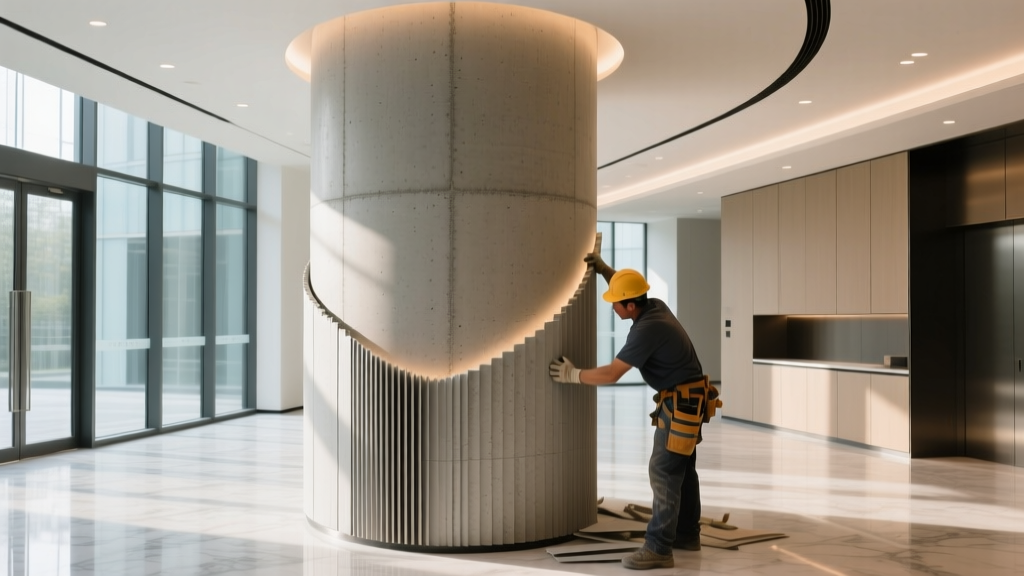
Application Showcase 1: Wrapping Curved Architectural Columns
One of the most demanding applications for any masonry product is wrapping a curved substrate. Traditional stone requires kerfing, wet-cutting, and extensive mortar scaffolding. Flexible concrete stone veneer solves this by conforming directly to radiused substrates like curved MDF, flexible plywood, or bent drywall.
Bend Radius and Adhesive Chemistry
The minimum bend radius is dictated by the veneer thickness. A 2mm sheet can wrap a column with a 12-inch radius, while a 4mm sheet requires a minimum 24-inch radius. For these applications, standard cementitious mortars will fail due to shear stress. Instead, installers must use a high-tack MS Polymer (Modified Silicone) or 100% polyurethane construction adhesive, such as SikaTack or Loctite PL Premium. These adhesives cure with a slight elastomeric property, accommodating the micro-movements of the column substrate without breaking the bond.
When wrapping curves, air pockets frequently form between the veneer and the substrate, resulting in a hollow 'drumming' sound when tapped. To prevent this, 100% back-buttering is mandatory. Apply a thin, continuous skim coat of adhesive to the back of the veneer sheet in addition to the notched trowel application on the substrate.
Application Showcase 2: Direct-to-ICF Exterior Facades
Insulated Concrete Forms (ICF) are dominating 2026 commercial and high-performance residential builds due to strict energy codes. However, ICFs leave an expanded polystyrene (EPS) foam exterior that cannot support the 12+ lbs/sq ft dead load of traditional adhered stone masonry without extensive steel furring and lath.
Flexible concrete stone veneer bypasses this structural hurdle. At under 3 lbs/sq ft, it can be applied directly over a properly prepared ICF substrate. The preparation requires a base coat of polymer-modified stucco embedded with alkali-resistant mesh over the EPS foam to create a rigid, waterproof plane. Once cured, the flexible veneer is bonded using a polymer-modified thin-set. According to adhered masonry standards outlined by The Masonry Society, keeping the total dead load of adhered veneer systems low significantly reduces the risk of substrate deflection and long-term delamination on insulated wall assemblies.
Application Showcase 3: Marine and RV Interior Fit-Outs
Weight is the primary adversary in marine and recreational vehicle design. Replacing 40 square feet of traditional stone (approx. 480 lbs) with flexible concrete veneer (approx. 80 lbs) yields a massive 400 lb weight reduction, directly improving fuel efficiency and payload capacity. Furthermore, the constant vibration and torsional flexing of a moving vehicle will shatter rigid cementitious bonds. The polyurethane binder in flexible concrete veneer acts as a shock absorber, dissipating kinetic energy and preventing crack propagation across the stone face.
2026 Cost Breakdown and Material Specifications
While the material cost of flexible concrete stone veneer is higher per square foot than basic manufactured stone, the elimination of heavy structural reinforcement, metal lath, and specialized masonry labor results in a lower total installed cost for complex projects.
| Component | Specification | Cost per Sq Ft | Notes |
|---|---|---|---|
| Flexible Veneer Material | 3mm thickness, standard aggregate | $9.00 - $16.00 | Varies by aggregate rarity and finish |
| MS Polymer Adhesive | High-tack, elastomeric cure | $1.50 - $2.25 | Assumes 1/8' V-notch trowel coverage |
| Substrate Prep (ICF) | Polymer stucco base coat + mesh | $3.00 - $5.00 | Required for EPS foam substrates |
| Installation Labor | Carpenter/Finisher (not Mason) | $6.00 - $11.00 | Significantly lower than masonry rates |
| Total Installed Cost | Complete system | $19.50 - $34.25 | Excludes complex scaffolding or furring |
Critical Installation Framework: The 3-Step Bonding Method
The American Concrete Institute (ACI) emphasizes that surface preparation and adhesive selection are the primary determinants of longevity in adhered veneer systems. Follow this strict three-step protocol for interior and exterior applications:
- Substrate Deflection Check and Priming: Ensure the substrate framing meets the L/240 deflection limit. Any flexing beyond this threshold will snap the rigid aggregate face, even if the mesh backing holds. Prime porous substrates (like raw drywall or concrete block) with an acrylic masonry primer to prevent the substrate from sucking moisture out of the adhesive before it cures.
- Directional Troweling and Back-Buttering: Use a 1/8-inch V-notch trowel to apply the MS Polymer adhesive to the substrate in horizontal, directional ridges. For exterior applications or curved surfaces, back-butter the veneer sheet with a flat trowel to ensure 100% adhesive contact, eliminating voids where water could pool and freeze.
- Vapor-Permeable Sealing: Once installed, seal the concrete face with a penetrating silane/siloxane sealer. Do not use film-forming acrylic sealers, which trap moisture vapor behind the stone and cause blistering. A silane sealer penetrates the pores, providing hydrophobic protection while maintaining vapor permeability.
Troubleshooting Common Delamination Failures
When flexible concrete stone veneer fails, it is almost always due to installer error rather than material defect. Industry guidelines from the Architectural Record highlight the following edge cases:
- Edge Lifting on Tall Walls: On interior walls exceeding 10 feet in height, the sheer weight of the sheets can cause the bottom edges to lift before the adhesive fully cures. Use concealed mechanical fasteners (stainless steel trim screws) at the bottom course and perimeter edges, then fill the holes with matching aggregate dust and cyanoacrylate glue.
- White Efflorescence Staining: If white, powdery stains appear on the concrete face, the installer likely used a Portland cement-based mortar instead of the required polymer adhesive. Cementitious mortars contain water-soluble salts that migrate to the surface. The only fix is dry-brushing and applying a specialized efflorescence cleaner, followed by a strict silane seal.
- UV Degradation on Exterior Facades: If the polyurethane binder turns yellow or chalky, the manufacturer's UV-stable topcoat was omitted. Always specify aliphatic (UV-stable) polyurethane binders for exterior applications, as aromatic polyurethanes will degrade under direct sunlight within 24 months.
Written by
Elena RodriguezElena Rodriguez is a civil engineer and technical writer specializing in concrete technology, masonry systems, and ASTM/ACI compliance. She earned her B.S. in Civil Engineering from Texas A&M University and spent a decade at a materials testing laboratory, performing over 2,000 concrete compressive strength tests and masonry prism evaluations. Elena is an ACI-certified Field Testing Technician (Grade I) and a member of ASTM Committee C12 on Natural Building Stone. She currently consults on forensic engineering cases involving concrete failures and moisture intrusion. Based in San Antonio, TX, Elena is a proud member of the Society of Women Engineers (SWE) and coaches her daughter's FIRST Robotics team.
More from Elena Rodriguez
View all
Walls & Panels
Cost Analysis: Light Gauge Steel Framing Advantages and Disadvantages
Evaluate light gauge steel framing advantages and disadvantages through a strict cost analysis lens, comparing material, labor, and lifecycle expenses.
Aug 4, 2026

Walls & Panels
Gypsum Board Types: Exact Specifications, Thickness & Dimensions
Compare standard, Type X, and moisture-resistant gypsum board types. Get exact specifications, thicknesses, dimensions, and ASTM standards for your project.
Aug 4, 2026

Fire Resistance
Best Fire-Resistant Outdoor Decking Materials: 2026 Buyer Guide
Discover the best fire-resistant outdoor decking materials for 2026. Compare Class A PVC, aluminum, and hardwood options for WUI compliance and safety.
Aug 4, 2026