Concrete Patio vs Paver Patio Cost: 2026 Mix & Material Guide
Compare concrete patio vs paver patio cost in 2026. Analyze mix designs, material pricing, labor rates, and long-term ROI for your outdoor space.

The Core Debate: Monolithic Slabs vs. Flexible Hardscapes
When evaluating the concrete patio vs paver patio cost, homeowners often focus solely on the surface material. However, the true cost divergence lies in the structural engineering beneath the surface and the specific mix designs or material types employed. A poured concrete patio is a monolithic, rigid structure dependent on chemical hydration, tensile reinforcement, and precise jointing. A paver patio is a flexible, segmented system reliant on mechanical interlock, granular base friction, and edge restraint. Understanding the material science behind both options is the only way to accurately forecast 2026 installation and lifecycle costs.
2026 Quick Cost Baseline (Per Square Foot Installed)
- Standard Broom-Finish Concrete (4,000 PSI): $9.00 – $13.00
- Stamped/Exposed Aggregate Concrete: $14.00 – $21.00
- Standard Concrete Pavers: $16.00 – $24.00
- Premium Clay Brick Pavers: $22.00 – $32.00
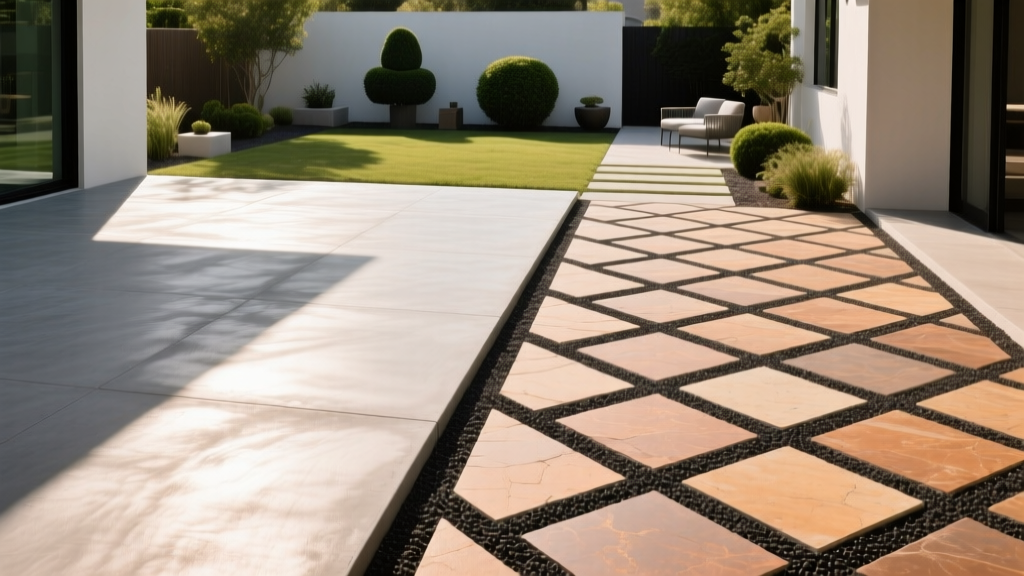
Concrete Patio Costs: How Mix Design Dictates the Price
The price of a poured concrete patio is heavily influenced by the ready-mix truck's batch ticket. Contractors who cut costs by ordering substandard mixes inevitably pay for it in surface scaling, cracking, and callbacks. In 2026, material costs for ready-mix concrete have stabilized, but admixture and reinforcement choices create significant price variations.
Standard 3,000 PSI vs. High-Performance 4,000 PSI Mixes
A standard 3,000 PSI mix (typically achieving this strength at 28 days) is the baseline for residential flatwork. However, for patios exposed to freeze-thaw cycles or heavy load-bearing requirements (like supporting a hot tub), a 4,000 PSI mix is mandatory. A 4,000 PSI mix requires a lower water-to-cement (w/c) ratio—usually 0.40 to 0.45—meaning it contains more cementitious material and requires superplasticizers (water-reducing admixtures) to maintain a workable 4-to-5-inch slump. This upgrade typically adds $15 to $25 per cubic yard to the material cost, translating to roughly $0.40 to $0.65 extra per square foot for a standard 4-inch thick slab.
Air-Entrainment and Fiber Reinforcement
According to the Portland Cement Association, air-entraining agents (AEAs) are non-negotiable in climates with freezing winters. AEAs create microscopic, disconnected air bubbles (targeting 5% to 7% air content) that give expanding freezing water room to expand without spalling the concrete surface. This adds roughly $5 to $8 per cubic yard. Furthermore, replacing traditional welded wire mesh with macro-synthetic fibers (such as FiberStrand or MasterFiber) adds $8 to $14 per cubic yard but provides superior three-dimensional micro-crack control and eliminates the labor cost of tying and chairing wire mesh.
Paver Patio Costs: Material Types and Base Engineering
While concrete relies on chemical strength, pavers rely on physical confinement and base stability. The cost of a paver patio is less about the surface stones and more about the extensive excavation, base compaction, and edge restraint systems required to keep the modular units from shifting.
Paver Types: Concrete vs. Clay
Concrete pavers (manufactured by brands like Belgard or Techo-Bloc) are made from zero-slump concrete vibratory-compacted into molds. They offer high compressive strength (often exceeding 8,000 PSI) and cost between $3.50 and $7.00 per square foot for materials alone. Clay brick pavers, fired in kilns, offer superior UV color retention and a classic aesthetic but cost $6.00 to $11.00 per square foot for materials. Clay pavers are also dimensionally less consistent, requiring more skilled labor to maintain straight bond lines.
The Hidden Cost: Base Preparation and Polymeric Sand
The Interlocking Concrete Pavement Institute (ICPI) mandates a minimum 4-to-6-inch base of compacted, angular, crushed aggregate (such as 3/4-inch minus limestone or granite) for pedestrian patios. Rounded river gravel is strictly prohibited as it rolls under load. Proper base preparation, including geotextile fabric separation in clay soils, accounts for up to 40% of the total paver installation cost. Additionally, filling joints with polymeric sand—which contains water-activated polymers that bind the sand grains together to resist washout and weed growth—adds $1.50 to $2.50 per square foot in material and labor.
Head-to-Head Cost and Performance Matrix
| Feature | Poured Concrete (4,000 PSI Broom) | Stamped Concrete | Concrete Pavers (Standard) | Clay Brick Pavers |
|---|---|---|---|---|
| Material Cost (per sq ft) | $2.50 – $4.00 | $4.00 – $6.50 | $3.50 – $7.00 | $6.00 – $11.00 |
| Labor & Base Prep | $6.50 – $9.00 | $10.00 – $14.50 | $12.50 – $17.00 | $16.00 – $21.00 |
| Total Installed Cost | $9.00 – $13.00 | $14.00 – $21.00 | $16.00 – $24.00 | $22.00 – $32.00 |
| Installation Time | 1 – 2 Days (plus 7-day cure) | 2 – 4 Days | 3 – 6 Days | 4 – 8 Days |
| Immediate Usability | 7 Days (Foot), 28 Days (Heavy) | 7 Days (after sealing) | Immediate | Immediate |
Long-Term ROI and Failure Modes
Evaluating the concrete patio vs paver patio cost requires looking past the initial invoice to the 20-year lifecycle. Each material fails in highly specific, predictable ways based on its structural design.
⚠️ Critical Failure Mode: Frost Heave and Edge Blowout
Concrete: If control joints are not cut to a depth of 25% of the slab thickness (1 inch deep for a 4-inch slab) and spaced every 10 to 12 feet, the concrete will crack randomly to relieve tensile stress. In freeze-thaw climates, a non-air-entrained slab will experience surface scaling, where the top 1/8-inch of paste flakes off, exposing the aggregate.
Pavers: The most common paver failure is edge restraint blowout. If the perimeter is secured with cheap plastic edging spiked into the ground rather than poured-in-place concrete curbs or heavy-duty structural restraints, the lateral forces of foot traffic and freezing will push the pavers outward. Once the joints open, bedding sand washes out, leading to severe settling and uneven surfaces.
Maintenance Economics
Poured concrete requires minimal ongoing maintenance but is virtually impossible to repair invisibly if it cracks or settles. If a tree root heaves a concrete slab, the entire section must be demolished and repoured. Concrete also requires resealing every 2 to 3 years if a stamped or exposed aggregate finish is used.
Pavers require joint sand replenishment every 3 to 5 years and occasional re-leveling. However, their modular nature provides a massive long-term financial advantage: if a section settles or utility work is required beneath the patio, the pavers can be unzipped, the base repaired, and the exact same stones reinstalled with zero visual evidence of the repair. For properties with mature trees or unstable soils, this modularity makes pavers the more cost-effective choice over a 20-year horizon, despite the higher initial investment.
Frequently Asked Questions
Can I install pavers directly over an existing concrete patio?
Yes, this is known as an overlay installation and can save $4 to $7 per square foot in demolition and base prep costs. However, the existing concrete must be structurally sound, free of major heaving, and sloped correctly for drainage (minimum 1/4-inch per foot). You will lose roughly 3 inches of height clearance, which can interfere with door thresholds. A 1-inch bedding sand layer is still required between the concrete slab and the pavers to allow for leveling and drainage.
Does adding color to the concrete mix increase the cost significantly?
Integral color (adding liquid or powdered pigments directly to the ready-mix truck) adds approximately $1.50 to $3.00 per square foot. While it increases the upfront cost, it is vastly superior to surface-applied color hardeners or stains, as the color penetrates the entire depth of the slab. If the surface chips or wears down over decades, the underlying concrete remains the same color.
Which option is better for heavy loads like hot tubs or outdoor kitchens?
A poured concrete patio engineered with a 4,000 PSI mix, thickened edge footings, and #4 rebar tied on 24-inch centers is the superior structural choice for concentrated, static loads like hot tubs. Pavers can support heavy loads, but the point-loads from hot tub feet can cause localized settling in the bedding sand over time unless a specialized reinforced concrete base is poured beneath the pavers in that specific zone.
Written by
David NakamuraDavid Nakamura is a licensed architect (AIA) and construction technology writer focused on sustainable building methods, mass timber engineering, and high-performance building envelopes. He holds a Master of Architecture from the University of Washington and is a certified Passive House Consultant (CPHC). David spent eight years at the Seattle firm Mithun, where he led the design of three LEED Platinum projects, before founding his own practice specializing in net-zero residential design. He serves on the editorial advisory board of GreenBuilder Magazine and has authored peer-reviewed papers on cross-laminated timber (CLT) connections for the Journal of Structural Engineering. In his spare time, David teaches woodworking at Pratt Fine Arts Center and kayaks the Puget Sound.
More from David Nakamura
View all
Construction Cost
Labor Cost to Build a Deck Per Sq Ft: 2026 Installation Guide
Discover the exact labor cost to build a deck per sq ft in 2026. This installation guide breaks down contractor rates, complexity factors, and hidden fees.
Aug 4, 2026

Construction Cost
How Much Does It Cost to Build a 3 Bedroom House? Financing Guide
Learn exactly how much it costs to build a 3 bedroom house and explore 2026 financing options, construction loan types, and budget frameworks for your build.
Aug 4, 2026

Construction Cost
Cost to Build a Tennis Court: 2026 Guide
How much does it cost to build a tennis court in 2026? Breakdowns for asphalt, concrete, and synthetic surfaces plus fencing and lighting.
Jul 30, 2026