Concrete Pad Cost Guide: Specs, PSI Ratings & 2026 Pricing
Discover how PSI ratings, slab thickness, and reinforcement specifications directly impact your total concrete pad cost in 2026. Expert pricing data inside.
The Engineering Behind the Estimate: How Specs Drive Price
The total concrete pad cost is rarely just a function of square footage. While surface area dictates the volume of material required, the structural specifications—compressive strength, slab thickness, reinforcement matrices, and subgrade preparation—are the true variables that separate a $6 per square foot basic patio from a $16 per square foot heavy-duty industrial pad. Understanding the performance ratings defined by the American Concrete Institute (ACI) allows property owners and project managers to align their budget with the actual load-bearing requirements of the site, preventing both dangerous under-engineering and wasteful over-specification.
Compressive Strength (PSI) and Base Material Costs
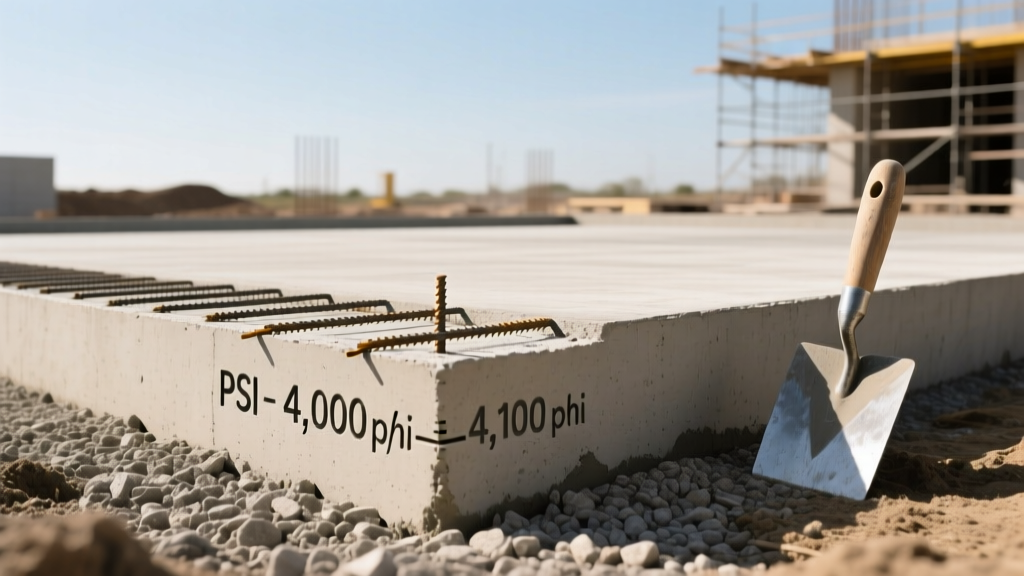
Compressive strength, measured in pounds per square inch (PSI) after a 28-day curing period, dictates the cement-to-water ratio and aggregate quality in the mix design. Higher PSI mixes require more Portland cement, lower water-to-cement (w/c) ratios, and often specialized admixtures like water reducers or fly ash, directly increasing the ready-mix delivery cost.
3000 PSI: Standard Residential & Light Commercial
A 3000 PSI mix typically utilizes a w/c ratio of 0.55 and contains approximately 564 pounds of cement per cubic yard. This is the industry standard for pedestrian walkways, standard patios, and light-duty shed pads. Because it requires less cement and tolerates a higher water content, it is the most cost-effective option, averaging $6.00 to $8.00 per square foot installed. However, it is highly susceptible to surface scaling if exposed to de-icing salts without a proper sealer.
4000 PSI: Driveways, RV Pads, & Garage Floors
Upgrading to 4000 PSI drops the w/c ratio to 0.45 and increases cement content to roughly 611 pounds per cubic yard. This density provides superior resistance to freeze-thaw cycling and heavy vehicular loads. For residential driveways and motorhome pads, this is the minimum recommended specification by the National Ready Mixed Concrete Association (NRMCA). Expect installed costs between $8.50 and $11.50 per square foot.
5000+ PSI: Industrial, Commercial, & Heavy Equipment
Mixes exceeding 5000 PSI (often reaching 6000 or 8000 PSI for specialized applications) require strict quality control, low w/c ratios (0.40 or below), and high-range water reducers (superplasticizers) to maintain workability. These pads support semi-truck traffic, forklift point-loads, and heavy manufacturing equipment. Material and finishing costs push the total installed price to $13.00 to $18.00+ per square foot.
Thickness, Load-Bearing, and Application Matrix
Slab thickness is the second major cost multiplier. Every additional inch of depth increases the concrete volume by 25% per 100 square feet. Below is the 2026 performance matrix mapping application types to minimum thickness and PSI requirements.
| Application Scenario | Min. Thickness | Target PSI | Est. Cost / Sq Ft (2026) |
|---|---|---|---|
| Pedestrian Walkways & Patios | 4 inches | 3000 PSI | $6.50 - $8.50 |
| Standard Passenger Vehicle Driveways | 4 to 5 inches | 4000 PSI | $9.00 - $12.00 |
| RV Pads & Dump Truck Aprons | 6 inches | 4000 - 4500 PSI | $11.50 - $14.50 |
| Commercial Loading Docks & Warehouses | 6 to 8 inches | 5000+ PSI | $14.00 - $19.00 |
Reinforcement Specifications: Rebar, Mesh, and Fibers
Concrete possesses high compressive strength but low tensile strength. Reinforcement is required to hold micro-cracks together and distribute point loads. The choice of reinforcement drastically alters both material costs and labor time.
#4 Rebar at 18-Inch Centers
Using Grade 60, #4 (1/2-inch diameter) deformed steel rebar tied in an 18-inch by 18-inch grid is the gold standard for structural driveways and commercial pads. The steel must be chaired up to sit in the upper third of the slab depth to be effective. Cost Impact: Adds $1.50 to $2.50 per square foot to the total pad cost due to material prices and the intensive labor required to tie and chair the grid.
Welded Wire Mesh (WWM)
W1.4xW1.4 (6x6 inch grid) welded wire mesh is standard for residential patios and sidewalks. It is faster to install than rebar but offers less tensile strength and is prone to being pushed to the bottom of the slab during the pour if not properly elevated. Cost Impact: Adds $0.50 to $0.90 per square foot.
Macro-Synthetic Fibers
Dosed directly into the ready-mix truck at the plant (typically 3 to 5 lbs per cubic yard), macro-synthetic fibers provide secondary, three-dimensional reinforcement that reduces plastic shrinkage cracking and improves impact resistance. While they do not replace primary structural rebar in heavy-load scenarios, they eliminate the labor cost of laying mesh. Cost Impact: Adds just $0.15 to $0.30 per square foot in material costs, often resulting in a net savings over wire mesh due to labor elimination.
Subgrade Preparation and Vapor Retarders: The Hidden Cost Drivers
A concrete slab is only as stable as the earth beneath it. Inadequate subgrade preparation leads to differential settlement, resulting in catastrophic structural cracking that no amount of surface repair can fix. According to guidelines published by the Portland Cement Association (PCA), proper sub-base engineering is non-negotiable for long-term performance.
- Excavation & Compaction: Removing organic topsoil and compacting the native subgrade to 95% Standard Proctor density. Cost: $1.00 - $2.00 per sq ft.
- Aggregate Base: Laying 4 to 6 inches of 3/4-inch minus crushed stone, mechanically compacted in 2-inch lifts. This provides drainage and a stable working platform. Cost: $1.50 - $3.00 per sq ft.
- Vapor Retarders: For any pad that will support an enclosed structure (garages, workshops), a 10-mil polyethylene vapor barrier meeting ASTM E1745 must be placed over the aggregate to prevent moisture migration, which can destroy floor coverings and cause epoxy delamination. Cost: $0.40 - $0.75 per sq ft.
2026 Regional Pricing Variations by Performance Tier
Material availability, local aggregate quality, and union labor rates cause significant regional fluctuations in concrete pad costs. The table below outlines estimated installed costs for a standard 600 sq ft driveway pad (4000 PSI, 5-inch thickness, rebar reinforced) across major U.S. markets in 2026.
| Region / Market | Material Cost (Per CY) | Total Installed Cost (Per Sq Ft) | Primary Cost Driver |
|---|---|---|---|
| Pacific Northwest (Seattle/Portland) | $185 - $210 | $12.50 - $15.00 | High labor rates, strict environmental runoff regs |
| Midwest (Chicago/Detroit) | $145 - $165 | $9.50 - $12.00 | Frost-heave mitigation requires deeper excavation |
| Sunbelt (Dallas/Atlanta) | $135 - $155 | $8.50 - $11.00 | Expansive clay soils require thicker aggregate base |
| Northeast (Boston/NY Metro) | $175 - $220 | $13.00 - $17.50 | Union labor, dense urban logistics, permit fees |
Specification Failures: When Cost-Cutting Backfires
Value engineering a concrete pad often leads to premature failure modes that cost exponentially more to remediate than the initial savings. Avoid these common specification errors:
1. Sawcutting Too Late: Control joints must be sawcut to one-quarter of the slab depth within 4 to 12 hours of placement, depending on ambient temperature. Waiting until the next day often results in uncontrolled, jagged shrinkage cracking as the concrete cures and contracts.
2. Adding Water on Site: If the ready-mix truck arrives and the concrete is too stiff, contractors may be tempted to add water to improve workability. Adding just one gallon of water per cubic yard to a 4000 PSI mix can drop the ultimate compressive strength by over 200 PSI and severely increase surface permeability, leading to rapid spalling in freeze-thaw climates.
3. Skipping the Curing Compound: Concrete does not "dry"; it cures via a chemical hydration reaction. If moisture evaporates from the surface too quickly, the reaction halts, resulting in a weak, dusty surface prone to crazing. Applying an ASTM C309 approved curing membrane or wet-curing with burlap for a minimum of 7 days is mandatory for achieving the specified PSI rating.