Essential Types of Concrete Trowels for Perfect Slab Finishes
Explore essential types of concrete trowels, from hand floats to ride-on power trowels, with pro tips on blade materials, pricing, and finishing techniques.

The Anatomy of a Concrete Trowel
Achieving a dense, abrasion-resistant, and visually uniform concrete surface requires precise tool selection. The types of concrete trowels available to modern finishers range from simple 12-inch hand tools to 120-inch ride-on machines. The fundamental anatomy of any trowel consists of the blade and the handle. Blade thickness typically ranges from 1/16 inch for flexible finishing trowels to 1/8 inch for rigid edging tools. Handle configurations include D-grips for high downward pressure, pronged handles for even weight distribution, and straight poles for extended reach. Selecting the correct combination of blade geometry, metallurgy, and handle type dictates the success of the final finish.
Hand Trowels vs. Power Trowels: The Core Distinction
Before evaluating specific models, contractors must understand the operational boundaries between manual and mechanized troweling. Hand trowels offer tactile feedback and precision for edges, tight corners, and architectural details. Power trowels provide the mechanical force necessary to densify large expanses of commercial flooring. Below is a comparative framework for 2026 project planning.
| Feature | Hand Trowels | Walk-Behind Power Trowels | Ride-On Power Trowels |
|---|---|---|---|
| Ideal Area | Under 500 sq ft, edges, stairs | 500 to 10,000 sq ft | 10,000+ sq ft (warehouses, tilt-up) |
| Production Rate | 50 - 150 sq ft / hour | 1,000 - 2,500 sq ft / hour | 3,000 - 6,000+ sq ft / hour |
| 2026 Avg. Cost | $25 - $120 per unit | $2,200 - $4,500 | $18,000 - $45,000+ |
| Surface Density | Moderate (dependent on user) | High | Maximum (multi-rotor overlap) |
Hand Trowels: Breakdown by Blade Shape and Application
Professional finishers maintain an arsenal of specialized hand trowels. Using a general-purpose tool for a specialized task leads to edge gouging, aggregate exposure, or joint failure.
1. The Fresno Trowel
The Fresno trowel features a large, flat, rectangular blade (typically 14 to 24 inches wide and 4 to 5 inches deep) mounted on a long pole. It is the first trowel used after bullfloating. Its primary function is to embed large aggregate just below the surface and level out minor ridges without pulling excess water (bleed water) to the top. Using a Fresno too early will trap water; using it too late will tear the surface.
2. The Pool Trowel
Designed with heavily rounded corners and a highly flexible 1/16-inch blue steel or stainless steel blade, the pool trowel prevents the sharp edges of standard trowels from gouging curved surfaces. While mandatory for swimming pool plastering and shotcrete, it is also the preferred tool for finishing curved architectural walls, radius curbs, and decorative stamped concrete borders.
3. The Margin Trowel
Measuring just 5 to 8 inches in length with a stiff, narrow blade, the margin trowel is a high-precision instrument. Finishers use it to tool tight inside corners, clean up edges against formwork, and patch small voids. Its rigid blade allows for aggressive downward pressure in confined spaces where a standard finishing trowel cannot pivot.
4. The Standard Finishing (Steel) Trowel
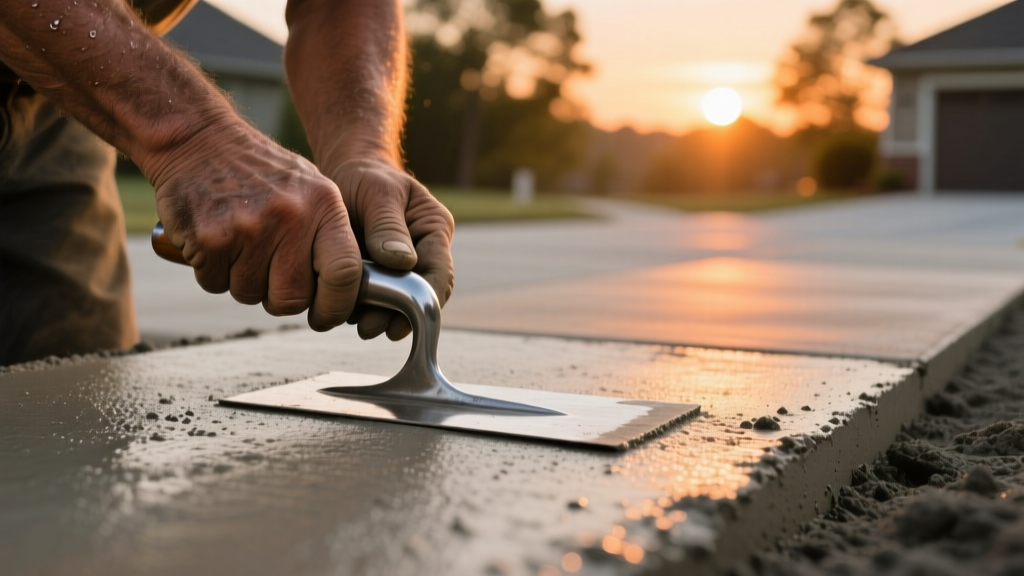
This is the workhorse for the final burnishing pass. Standard sizes are 14x4 inches or 18x4 inches. The thin, flexible steel blade lays flat against the slab, applying immense pressure to close surface pores, densify the cement paste, and produce a hard, smooth, light-reflective finish. According to the Portland Cement Association (PCA), steel troweling should only commence after the concrete has stiffened sufficiently to support the worker's weight with only a 1/4-inch indentation.
5. The Concrete Edger
Featuring a radiused edge (usually 1/4-inch to 1/2-inch radius), the edger is run along the perimeter of the slab and against formwork. It compresses the edge to prevent chipping and spalling while creating a clean, rounded joint line. Edging must occur before final steel troweling to prevent the trowel from catching the rounded edge.
Pro Tip: The New Blade Break-In Rule
Never use a brand-new, unbroken steel hand trowel on fresh concrete. The factory-sharp edges will slice into the slab, leaving permanent gouges. Break in a new trowel by rubbing it vigorously on a dry, cured concrete slab or using 120-grit sandpaper to dull the leading edges until they are smooth to the touch. Alternatively, purchase pre-broken-in trowels from manufacturers like Kraft Tool or Marshalltown.
Power Trowels: Configurations and Specifications
For commercial and industrial slabs, mechanized troweling is non-negotiable. Power trowels use rotating blades to float and finish concrete, driven by gasoline, diesel, or electric motors.
Walk-Behind Power Trowels
Walk-behinds typically feature a single rotor with three or four blades, ranging from 24 to 46 inches in diameter. The 36-inch model is the industry standard for general commercial work. As of 2026, commercial-grade 36-inch walk-behinds from brands like Multiquip and Wacker Neuson feature variable RPM controls (usually 70 to 140 RPM). Lower RPMs with float pans or plastic shoes are used for early-stage leveling, while higher RPMs with steel finish blades are used for the final burn.
Ride-On Power Trowels
Ride-on machines utilize two or three overlapping rotors, ranging from 60 to 120 inches in total width. The overlapping blade paths eliminate the un-troweled 'dead zone' found between single-rotor passes. High-end models from Allen Engineering or Wacker Neuson feature hydrostatic drives, joystick controls, and 25 to 35 HP engines. These machines generate massive downward pressure, resulting in exceptionally dense, low-permeability floors ideal for heavy forklift traffic and VNA (Very Narrow Aisle) warehouse racking systems.
Selecting the Right Trowel Blade Material
The metallurgy of the trowel blade directly impacts the finish quality, tool lifespan, and maintenance requirements. The American Concrete Institute (ACI) emphasizes that surface durability is heavily influenced by the finishing tools used and the timing of their application.
- Carbon Steel: The traditional standard. It offers excellent flexibility and a smooth finish but is highly susceptible to rust. Carbon steel blades must be cleaned and oiled immediately after every use.
- Stainless Steel: Mandatory for white cement, architectural concrete, and decorative overlays. Stainless steel prevents rust stains (iron oxide transfer) that would otherwise ruin light-colored surfaces. It is slightly more rigid than carbon steel.
- Blue Steel: Heat-treated to a higher hardness than standard carbon steel. Blue steel holds a sharp edge longer and resists bending under heavy downward pressure, making it the preferred choice for high-production commercial finishers who 'burn' the floor to a glass-like sheen.
- Plastic/Composite: Used exclusively on power trowels during the early floating stage. Plastic shoes clip onto steel blades to distribute the machine's weight over a wider area, preventing the machine from sinking into soft, freshly poured concrete.
Critical Timing and Common Troweling Failure Modes
The most expensive mistakes in concrete finishing are caused by improper timing. Troweling is a race against the hydration clock, and misjudging the concrete's set time leads to catastrophic surface defects.
Failure Mode 1: Blisters and Delamination
The Cause: Troweling too early, specifically while bleed water is still present on the surface or rising through the matrix. The trowel seals the top crust, trapping the rising water and air bubbles just beneath the surface.
The Result: As the trapped water evaporates or the slab is subjected to traffic, the thin surface crust pops off, leaving craters and blisters.
The Fix: Wait for the bleed water to completely evaporate. Perform the 'footprint test'—step on the slab; if the indentation is deeper than 1/4 inch, it is too early to steel trowel.
Failure Mode 2: Surface Scaling and Dusting
The Cause: Over-troweling or adding water to the surface to make troweling easier. Excessive troweling brings too much fine cement paste and water to the top.
The Result: This weak, water-rich layer shrinks excessively as it cures, leading to micro-cracking, dusting (chalking), and eventual scaling when exposed to freeze-thaw cycles or deicing salts.
The Fix: Never sprinkle water on the surface to ease the trowel's glide. If the concrete has set too hard for manual troweling, switch to a mechanical power trowel or use a liquid chemical floor hardener/densifier post-cure.
Warning: The Danger of Over-Troweling Exterior Slabs
While interior warehouse floors require aggressive steel troweling for maximum density, exterior flatwork (driveways, sidewalks, patios) must never be hard-steel troweled. A slick, steel-troweled exterior surface lacks macro-texture, creating a severe slip hazard when wet. Exterior slabs should be finished with a wood float or a coarse synthetic broom finish to ensure adequate slip resistance.
Maintenance and Storage for Longevity
Concrete is highly alkaline and aggressively corrosive to bare metal. Proper maintenance of trowels ensures they remain flat and rust-free. After every use, scrape off all wet concrete with a putty knife. Wash the blade with water and dry it completely with a rag. Apply a thin coat of boiled linseed oil, WD-40 Specialist Corrosion Inhibitor, or a dedicated tool-protectant spray. Store hand trowels hanging vertically in a dry environment; never leave them resting on damp dirt or inside a sealed, humid truck bed, which will induce flash-rusting overnight. For power trowel blades, check the mounting bolts and blade pitch linkages weekly to ensure even pressure distribution across the rotor.
Written by
David NakamuraDavid Nakamura is a licensed architect (AIA) and construction technology writer focused on sustainable building methods, mass timber engineering, and high-performance building envelopes. He holds a Master of Architecture from the University of Washington and is a certified Passive House Consultant (CPHC). David spent eight years at the Seattle firm Mithun, where he led the design of three LEED Platinum projects, before founding his own practice specializing in net-zero residential design. He serves on the editorial advisory board of GreenBuilder Magazine and has authored peer-reviewed papers on cross-laminated timber (CLT) connections for the Journal of Structural Engineering. In his spare time, David teaches woodworking at Pratt Fine Arts Center and kayaks the Puget Sound.
More from David Nakamura
View all
Construction Cost
Labor Cost to Build a Deck Per Sq Ft: 2026 Installation Guide
Discover the exact labor cost to build a deck per sq ft in 2026. This installation guide breaks down contractor rates, complexity factors, and hidden fees.
Aug 4, 2026

Construction Cost
How Much Does It Cost to Build a 3 Bedroom House? Financing Guide
Learn exactly how much it costs to build a 3 bedroom house and explore 2026 financing options, construction loan types, and budget frameworks for your build.
Aug 4, 2026

Construction Cost
Cost to Build a Tennis Court: 2026 Guide
How much does it cost to build a tennis court in 2026? Breakdowns for asphalt, concrete, and synthetic surfaces plus fencing and lighting.
Jul 30, 2026