Concrete Stone Veneer: Comprehensive Material, Cost, and Install Guide
Discover everything about concrete stone veneer, from ASTM C1670 standards and 2026 pricing to mortar vs. mortarless installation techniques.

Composition and ASTM Standards for Manufactured Stone
Concrete stone veneer—technically classified as adhered manufactured stone masonry veneer (MSV)—is an engineered building material designed to replicate the aesthetic profile of natural stone at a fraction of the weight and cost. Unlike natural stone, which is quarried and sliced, MSV is cast in molds taken directly from real stone.
The material matrix consists of three primary components:
- Portland Cement: Typically Type I or II, acting as the binder.
- Lightweight Aggregates: Expanded shale, clay, or slate, which reduce the overall density while maintaining structural integrity.
- Iron Oxide Pigments: Integrated throughout the mix and surface-applied to ensure UV-stable, fade-resistant coloration that penetrates the entire cross-section.
All high-quality concrete stone veneer must comply with ASTM C1670 (Standard Specification for Adhered Manufactured Stone Masonry Veneer). This standard mandates strict performance thresholds, including a maximum water absorption rate of 22% for lightweight units and 28% for medium-weight units, alongside rigorous freeze-thaw durability testing. Always verify a manufacturer's ASTM C1670 compliance before purchasing for exterior applications.
Natural Stone vs. Concrete Stone Veneer: A Data-Driven Comparison
Choosing between natural and manufactured stone requires evaluating structural load limits, budget, and installation timelines. The following matrix breaks down the critical differences based on 2026 industry data.
| Metric | Concrete Stone Veneer (MSV) | Natural Stone Veneer |
|---|---|---|
| Weight | 8 – 12 lbs per sq. ft. | 15 – 25+ lbs per sq. ft. |
| Thickness | 0.5" – 3.5" | 1.0" – 5.0" |
| Structural Support | Standard wood framing (no footer needed) | Often requires masonry ledge or steel angles |
| Material Cost | $4.50 – $9.00 per sq. ft. | $12.00 – $22.00 per sq. ft. |
| Waste Factor | 5% – 8% | 10% – 15% |
2026 Cost Breakdown: Material, Labor, and Hidden Expenses
Budgeting for concrete stone veneer requires looking beyond the per-box material price. Based on current national averages, a fully installed exterior MSV project ranges from $13.50 to $24.00 per square foot.
Material Costs
- Flat Stones (Field): $4.50 – $7.50 per sq. ft.
- Corner Pieces: Sold by the linear foot, ranging from $8.00 – $14.00 per LF. (Corners are critical for a realistic installation; never wrap flat stones around outside corners).
- Mortar & Scratch Coat: Adds approximately $1.20 – $1.80 per sq. ft.
- Lath & WRB (Weather Resistive Barrier): $0.80 – $1.50 per sq. ft. for 2.5 lb self-furring galvanized lath and building paper.
Labor Costs
Professional masonry contractors typically charge between $8.00 and $13.00 per square foot for traditional mortar installation. Complex architectural details, high gables requiring scaffolding, or intricate patterns like "dry-stack" will push labor toward the higher end of this spectrum.
Installation Methods: Traditional Mortar vs. Mortarless Systems
The installation methodology dictates both the project timeline and the long-term performance of the veneer.
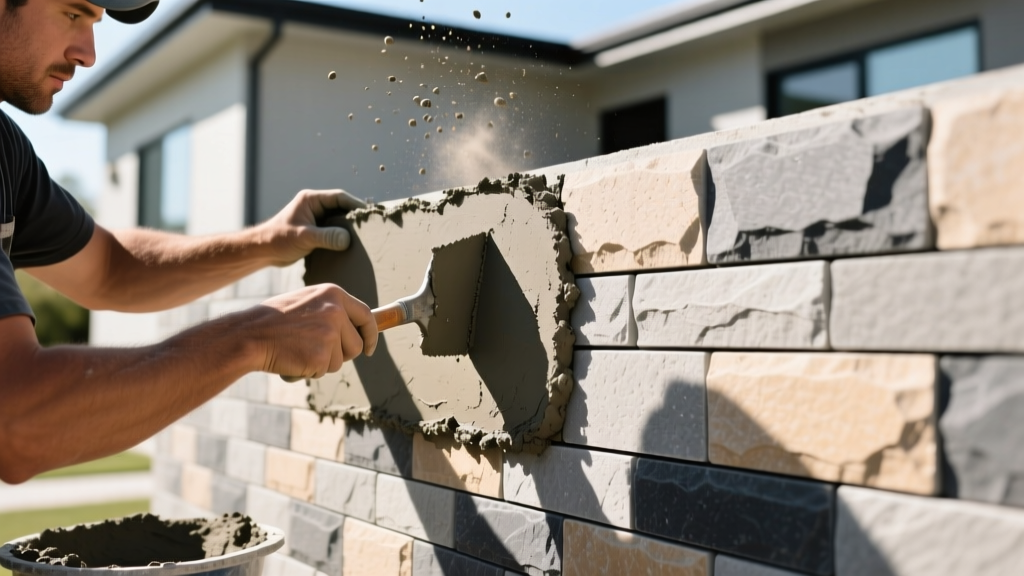
Method A: Traditional Scratch Coat and Mortar
This is the industry-standard method governed by the Masonry Veneer Manufacturers Association (MVMA). It requires a multi-step process:
- WRB Application: Two layers of Grade D building paper or a fluid-applied membrane over wood sheathing.
- Lath Attachment: 2.5 lb self-furring galvanized steel lath fastened with corrosion-resistant nails or staples every 6 inches on center into the framing.
- Scratch Coat: A 1/2-inch thick layer of Type S mortar applied over the lath and scored horizontally to provide a mechanical key for the setting bed.
- Setting: Stones are buttered with a 1/2-inch layer of Type S mortar and pressed firmly into a fresh mortar bed on the scratch coat.
Method B: Mortarless Interlocking Systems
Brands like ClipStone and certain Eldorado Stone profiles offer mortarless, mechanical-fastening systems. These utilize galvanized steel clips or integrated interlocking lips that screw directly into the wall sheathing or a specialized track system.
- Pros: Eliminates the need for lath, scratch coats, and wet mortar. Installation is up to 50% faster and can be done in freezing temperatures.
- Cons: Material costs are 20-30% higher. The aesthetic can sometimes look slightly repetitive compared to the organic variation achieved with wet-set mortar joints.
Moisture Management and Common Failure Modes
Concrete stone veneer is highly durable, but it is a porous, reservoir cladding. When it rains, the stone absorbs water and slowly dries inward and outward. If moisture management is ignored, catastrophic failures occur. According to building enclosure experts at Building Science Corporation, managing the inward drying potential of reservoir claddings is critical for preventing mold and structural rot.
Troubleshooting the Big Three Failures
1. Efflorescence (White, powdery staining)
- Cause: Water moving through the mortar and concrete dissolves soluble salts, depositing them on the surface as it evaporates.
- Prevention: Use low-alkali Portland cement, ensure proper roof overhangs, and install weep screeds at the base of the wall to allow bulk water to escape. Never use acid washes to clean MSV, as this degrades the cement matrix and exposes aggregate.
2. Delamination (Stones falling off the wall)
- Cause: Improper lath attachment, failure to use self-furring lath (which traps the scratch coat behind the wire), or applying the setting bed to a dried-out scratch coat.
- Prevention: Ensure lath is pulled away from the WRB by its built-in dimples. Re-dampen the scratch coat just before applying the setting mortar to prevent it from sucking the moisture out of the setting bed too quickly.
3. Spalling (Surface flaking and cracking)
- Cause: Freeze-thaw damage resulting from water trapped inside the stone expanding as it freezes. This often happens if a non-breathable, film-forming sealer is applied to the stone.
- Prevention: Do not seal exterior concrete stone veneer unless using a highly breathable, silane/siloxane-based penetrating water repellent. Film-forming acrylic sealers will trap moisture inside the stone, guaranteeing spalling in cold climates.
Frequently Asked Questions
Can concrete stone veneer be installed directly over painted brick or cinder block?
No. Paint acts as a bond-breaker. The painted surface must be sandblasted or mechanically scarified to bare masonry before applying the scratch coat. If scarification is impossible, you must attach pressure-treated furring strips, apply WRB and lath, and proceed with a traditional wood-framed installation.
Does concrete stone veneer add R-value (insulation) to a wall assembly?
Minimally. The rigid foam molds used in casting provide a slight thermal break, and the air gap in mortarless systems adds a fraction of an R-value, but MSV should be calculated at roughly R-0.1 to R-0.2. It is a cladding, not an insulation strategy. Continuous exterior insulation (ci) behind the sheathing should be used to meet modern energy codes.
How do I cut concrete stone veneer for tight fits around windows?
Use a 4-inch or 7-inch angle grinder equipped with a continuous-rim diamond masonry blade. For wet-cutting to reduce silica dust, use a masonry wet saw. Always score the back of the stone first, then snap it, finishing the edge with a masonry rubbing stone to mimic the natural fracture lines of quarried rock.
Written by
Priya KapoorPriya Kapoor is a real estate market analyst and construction economics researcher with expertise in housing affordability, development feasibility, and infrastructure investment. She holds a Master of Regional Planning from Cornell University and previously worked as a senior analyst at CBRE's Investment Properties group, where she modeled returns for $4B in mixed-use development pipelines. Priya now runs an independent research practice advising developers, municipalities, and REITs on construction cost forecasting and market timing. She publishes the quarterly "BuildMat Market Pulse" report tracking material price indices across 12 commodity categories. Based in Austin, TX, Priya serves on the board of Habitat for Humanity Austin and is a marathon runner.
More from Priya Kapoor
View all
Construction Cost
Cost to Build a 1600 Sq Ft Home in 2026: Full Breakdown
Accurate 2026 cost to build a 1600 sq ft home—material, labor, and regional pricing breakdowns included. Plan your budget with real-time estimates.
Aug 11, 2026

Wood & Lumber
Name the Types of Wood for Pressure Treatment and Preservation
Learn how to name the types of wood best suited for pressure treatment. Compare species treatability, chemical retention levels, and 2026 preservation costs.
Aug 4, 2026

Stone & Masonry
Stone Veneer Suppliers Lindenhurst: 2026 Cost Analysis
Analyze 2026 stone veneer costs in Lindenhurst, NY. Compare local supplier pricing, delivery fees, and Suffolk County installation labor rates.
Aug 4, 2026