Concrete Driveway vs Asphalt Driveway Cost: 2026 Analysis
Compare concrete driveway vs asphalt driveway cost in 2026. Explore installation pricing, 30-year lifecycle expenses, climate impacts, and ROI.

The True Cost of Paving: Upfront vs. Lifecycle
Choosing between concrete and asphalt for a driveway requires looking past the initial contractor quote. While asphalt traditionally claims the crown for lower upfront installation costs, concrete’s extended lifespan and minimal maintenance requirements frequently result in a lower total cost of ownership over a 30-year period. In 2026, fluctuating petroleum prices and increased cement production efficiency have narrowed the upfront gap, making the decision heavily dependent on your local climate, soil conditions, and vehicle loads.
Quick Cost Snapshot (Per Square Foot)
- Standard Concrete: $8.00 – $14.00 installed
- Decorative/Stamped Concrete: $15.00 – $25.00+ installed
- Standard Asphalt: $5.00 – $10.00 installed
- 30-Year Lifecycle Cost (Concrete): $9.50 – $16.00 per sq. ft.
- 30-Year Lifecycle Cost (Asphalt): $11.00 – $18.00 per sq. ft.
Material & Installation Cost Breakdown
The initial price of a driveway is dictated by material costs, site preparation, and labor intensity. Both materials require a properly compacted aggregate sub-base, but the structural requirements of the surface layer differ significantly.
| Cost Factor | Concrete Driveway | Asphalt Driveway |
|---|---|---|
| Site Prep & Grading | $1.50 - $3.00 / sq. ft. | $1.50 - $3.00 / sq. ft. |
| Base Material (Aggregate) | $1.00 - $2.00 / sq. ft. | $1.00 - $2.00 / sq. ft. |
| Surface Material | $4.00 - $6.50 / sq. ft. | $2.00 - $4.50 / sq. ft. |
| Labor & Finishing | $3.50 - $6.00 / sq. ft. | $1.50 - $3.00 / sq. ft. |
| Sealing / Curing Agents | $0.15 - $0.30 / sq. ft. | $0.15 - $0.25 / sq. ft. (Initial) |
| Total Average Installed | $10.15 - $17.80 / sq. ft. | $6.15 - $12.50 / sq. ft. |
Concrete Driveway Specifications & Pricing
A durable concrete driveway in 2026 requires a minimum 4,000 PSI air-entrained mix. Air-entrainment introduces microscopic bubbles that allow the concrete to expand and contract during freeze-thaw cycles without spalling. The slab must be poured to a minimum thickness of 4 inches, though 5 to 6 inches is mandatory if you plan to park heavy trucks, RVs, or boat trailers. Reinforcement via 6x6 W1.4xW1.4 welded wire mesh or synthetic macro-fibers is critical to control shrinkage cracking. According to the Portland Cement Association, proper jointing (control joints cut to a depth of one-quarter the slab thickness) is non-negotiable to dictate where inevitable shrinkage cracks occur.
Asphalt Driveway Specifications & Pricing
Asphalt relies on flexibility rather than rigid compressive strength. A standard residential application requires a 2-inch to 3-inch surface course of Hot Mix Asphalt (HMA) laid over a 4-inch to 8-inch compacted crushed stone base. The National Asphalt Pavement Association emphasizes that the structural integrity of an asphalt driveway is entirely dependent on the base preparation; if the aggregate base shifts, the flexible asphalt surface will immediately mirror the depression or heave. Asphalt material costs are heavily tied to global crude oil and bitumen markets, making prices more volatile year-over-year compared to cementitious products.
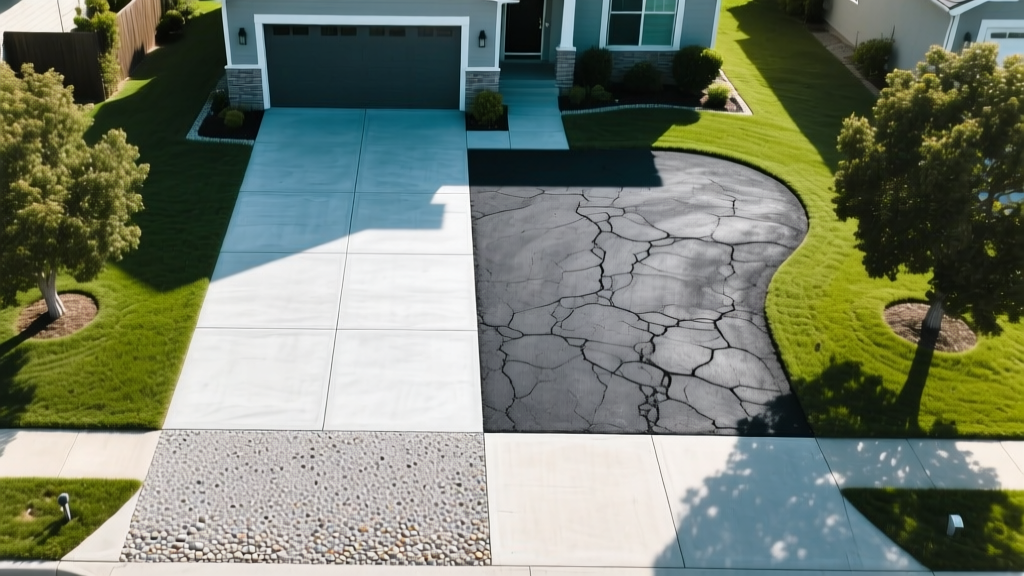
30-Year Lifecycle Cost Matrix
Upfront costs only tell half the story. Asphalt requires cyclical maintenance to prevent water intrusion and oxidation, while concrete requires minimal intervention but carries higher repair costs if structural failure occurs.
The number one cause of premature failure for both concrete and asphalt is inadequate subgrade compaction. Expansive clay soils must be amended or excavated. If a contractor bids significantly lower than the averages above, they are likely skimping on the 4-to-8-inch compacted aggregate base. A surface is only as strong as the dirt beneath it.
| Lifecycle Phase | Concrete (30-Year Span) | Asphalt (30-Year Span) |
|---|---|---|
| Initial Installation | $12.00 / sq. ft. | $8.00 / sq. ft. |
| Routine Maintenance | $0.50 / sq. ft. (Cleaning/degreasing) | $3.50 / sq. ft. (Sealcoating every 3-5 yrs) |
| Major Repairs / Resurfacing | $1.50 / sq. ft. (Mudjacking/crack fill) | $4.00 / sq. ft. (Overlay at year 15) |
| End of Life Replacement | $0.00 (Lasts 30-50 years) | $8.00 / sq. ft. (Full tear-out at year 20-25) |
| Estimated 30-Year Total | $14.00 / sq. ft. | $23.50 / sq. ft. |
Climate & Soil Application Showcase
Material performance varies drastically based on environmental stressors. Selecting the wrong material for your microclimate will accelerate depreciation and void standard warranties.
Where Concrete Excels
- High-Heat / Southern Climates: Concrete reflects solar radiation (high albedo) and remains structurally rigid in temperatures exceeding 100°F. Asphalt, conversely, can soften, rut, and track sticky bitumen onto shoes when surface temperatures exceed 140°F in direct summer sunlight.
- Heavy Static Loads: If your driveway serves as a parking pad for a 10,000-lb RV or heavy commercial work trucks, concrete’s compressive strength (4,000+ PSI) prevents the permanent depressions that asphalt will develop under prolonged static weight.
- Tree-Root Proximity: While roots will damage both, a properly thickened concrete slab with reinforced steel can bridge minor root growth, whereas asphalt will split and tear.
Where Asphalt Excels
- Severe Freeze-Thaw Cycles: Asphalt is a flexible pavement. When the ground heaves during spring thaws, asphalt can bend and settle back into place. Rigid concrete is prone to catastrophic snapping and uneven faulting at the joints if the subgrade washes out or heaves.
- Heavy De-Icing Salt Usage: While modern air-entrained concrete resists salt scaling better than older mixes, asphalt is entirely immune to the chemical corrosive effects of sodium chloride and calcium chloride used for winter ice melt.
- Steep Inclines: Asphalt provides superior traction in wet and icy conditions compared to smooth-troweled concrete. A broom-finished concrete driveway can still become dangerously slick on gradients exceeding 15%.
Maintenance Realities: Sealing, Cracking, and Resurfacing
Understanding the maintenance cadence is vital for budgeting over the lifespan of the driveway.
Asphalt Maintenance Cadence
Asphalt begins to oxidize and turn gray within six months of installation. To prevent the binder from drying out and raveling (losing aggregate), a coal tar or asphalt-based emulsion sealcoat must be applied. The first sealcoat should occur 6 to 12 months after installation, followed by reapplication every 3 to 5 years. According to the Federal Highway Administration, timely preservation treatments like sealcoating and crack-filling extend pavement life by 5 to 10 years at a fraction of the cost of structural overlays. If neglected, water penetrates the surface, freezes, and causes alligator cracking, necessitating a full-depth replacement.
Concrete Maintenance Cadence
Concrete does not require sealcoating for structural integrity, though applying a penetrating silane/siloxane water repellent every 5 to 10 years can prevent oil stains and reduce freeze-thaw scaling. The primary maintenance task is keeping control joints clear of debris and weeds. If a concrete slab settles unevenly, it can often be salvaged via polyurethane foam jacking (slabjacking) for $5 to $10 per square foot, rather than requiring demolition.
The Verdict: Decision Framework for 2026
Do not base your decision solely on the lowest initial bid. Use this framework to determine the most cost-effective material for your specific property:
Choose Concrete If:
- You plan to stay in the home for 15+ years.
- You park heavy vehicles, RVs, or trailers long-term.
- You live in a region with intense summer heat.
- You want to increase property resale value (concrete yields a higher ROI in premium housing markets).
- You prefer a low-maintenance, "install and forget" surface.
Choose Asphalt If:
- Upfront budget constraints are your primary concern.
- You live in a region with severe, prolonged freezing winters and heavy ground heaving.
- The driveway is exceptionally long (e.g., 1/4 mile rural driveways), where concrete costs become prohibitive.
- You are willing to commit to a strict 3-year sealcoating schedule.
- You plan to sell the home within 5 to 7 years.
Ultimately, the concrete driveway vs asphalt driveway cost debate resolves into a question of time horizon. Asphalt is a lease on a driveway; concrete is an ownership asset. Ensure your contractor provides soil-specific subgrade preparation plans, as the most expensive surface material will fail rapidly if poured over uncompacted, moisture-rich clay.
Written by
Marcus ChenMarcus Chen is a licensed structural engineer (PE) and building materials analyst with over 12 years of experience across residential, commercial, and industrial construction. He holds a Master of Science in Civil Engineering from UC Berkeley and spent six years at Thornton Tomasetti before transitioning to independent consulting and technical writing. Marcus specializes in material selection for seismic-prone regions, concrete reinforcement strategies, and lifecycle cost analysis. His work has been cited by the American Concrete Institute (ACI) and the Structural Engineers Association of California (SEAOC). When he is not on a job site or at his desk, you will find him hiking the Sierra Nevada or restoring a 1920s craftsman bungalow in Oakland, CA.
More from Marcus Chen
View all
Construction Cost
How Much Did the Eiffel Tower Cost to Build?
How much did the Eiffel Tower cost to build in 1889? We adjust for inflation and compare its budget to modern skyscraper construction.
Aug 4, 2026

Fire Resistance
What Is a Fire Resistant Material? Testing & Certification Guide
Discover what is a fire resistant material through ASTM and UL testing. Learn how fire ratings, certifications, and assemblies work in construction.
Aug 4, 2026

Construction Cost
How Much Did the Burj Khalifa Cost to Build?
How much did the Burj Khalifa cost to build? We break down the $1.5B project and extract 5 money-saving strategies for your next build.
Jul 30, 2026