Asphalt vs Concrete Roads: Technical Specs & Pavement Design
Compare asphalt vs concrete roads through technical specs, structural numbers, AASHTO design standards, and lifecycle pavement performance data.

Load Distribution Mechanics: Rigid vs. Flexible Systems
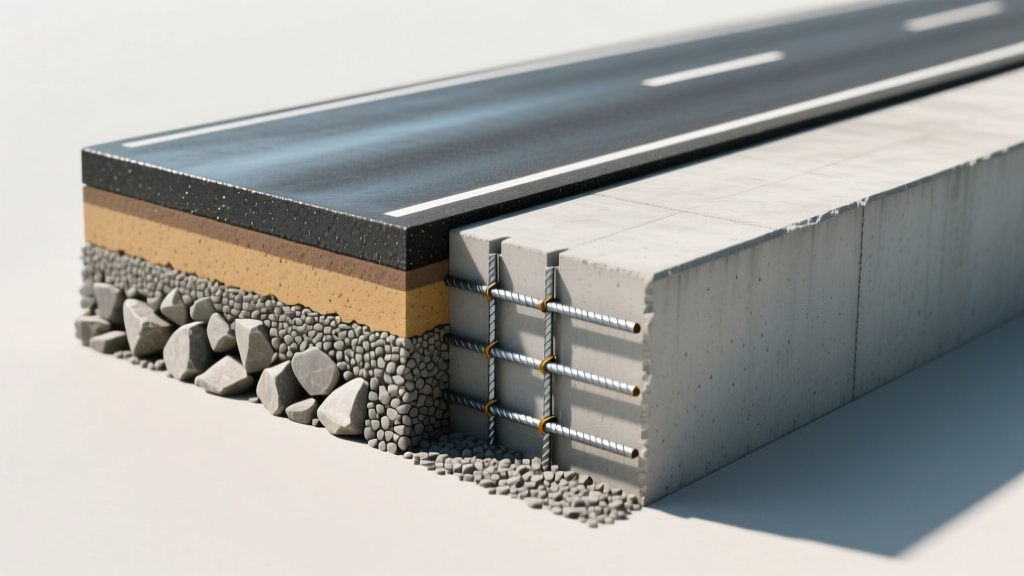
When evaluating asphalt vs concrete roads from an engineering perspective, the fundamental distinction lies in load distribution mechanics. Concrete pavements are classified as rigid systems. They rely on the high flexural strength (modulus of rupture) of the Portland cement concrete (PCC) slab to bridge over minor subgrade deficiencies and distribute traffic loads over a wide area. Conversely, asphalt pavements are flexible systems. They depend on a layered aggregate structure to distribute wheel loads downward through grain-to-grain contact, meaning the underlying subgrade must bear a higher concentration of stress.
This mechanical divergence dictates entirely different approaches to mix design, thickness calculations, and subgrade preparation. According to the Federal Highway Administration (FHWA), selecting between these materials requires a rigorous analysis of traffic equivalent single axle loads (ESALs), environmental thermal gradients, and lifecycle cost analysis (LCCA).
Material Properties and Mix Specifications
The structural integrity of both pavement types relies on strict adherence to material standards. Below is a technical breakdown of the primary specifications governing modern highway-grade mixes.
| Parameter | Portland Cement Concrete (PCC) | Hot Mix Asphalt (HMA) |
|---|---|---|
| Primary Design Standard | ACPA / PCA Thickness Design | Superpave / AASHTO M 323 |
| Strength Metric | Flexural Strength (600 - 700 psi at 28 days) | Dynamic Modulus & Rutting Resistance |
| Binder Specification | ASTM C150 (Type I/II Portland Cement) | ASTM D6373 (Performance Graded Binder, e.g., PG 64-22) |
| Aggregate Standard | ASTM C33 (Max size 1.5 to 2.0 inches) | AASHTO M 6 / Superpave Gradation Limits |
| Typical Highway Thickness | 8.0 to 12.0 inches (single lift) | 6.0 to 10.0 inches (multiple 2-3 inch lifts) |
| Curing / Cooling Time | 7 to 14 days for full design strength | Hours (traffic allowed once cooled below 120°F) |
Concrete Mix Design Nuances
For rigid pavements, compressive strength is a secondary metric; flexural strength is the primary design parameter. Highway mixes typically target a modulus of rupture (MR) of 650 psi. To achieve this while maintaining workability, engineers utilize water-cement (w/c) ratios between 0.40 and 0.45, often incorporating supplementary cementitious materials (SCMs) like fly ash or slag cement to mitigate the heat of hydration and reduce thermal cracking during the curing process.
Asphalt Binder Grading
Modern HMA relies on the Superpave Performance Grading (PG) system. A binder designated as PG 64-22 is engineered to resist rutting at a maximum pavement temperature of 64°C and thermal cracking at a minimum temperature of -22°C. In high-stress intersection zones, engineers specify polymer-modified asphalt (PMA) binders, such as PG 76-22, to drastically improve resistance to permanent deformation under heavy braking and acceleration loads.
Concrete slabs on erodible bases subjected to heavy truck traffic will deflect under wheel loads, creating a vacuum effect that draws water and fine subgrade particles up through the joints (pumping). To prevent this, AASHTO guidelines mandate the use of a non-erodible base course, such as lean concrete (cement-treated base) or a dense-graded, crushed aggregate base with strict fines limitations (less than 15% passing the No. 200 sieve).
Jointing, Load Transfer, and Cracking Mechanics
The method by which pavements handle tensile stress and thermal expansion represents the most significant structural divergence between asphalt vs concrete roads.
- Concrete Jointing: PCC slabs must be intentionally weakened to control where cracking occurs. Transverse contraction joints are saw-cut at 15 to 20-foot intervals. For highways with ESALs exceeding 1 million, smooth, epoxy-coated steel dowel bars (typically 1.25 to 1.5 inches in diameter) are placed at mid-depth across transverse joints to transfer shear loads while allowing horizontal expansion. Longitudinal joints utilize deformed tie bars to keep adjacent lanes tightly abutted.
- Asphalt Flexibility: HMA does not require jointing. It accommodates thermal contraction through its viscoelastic properties. However, reflective cracking is a primary failure mode when asphalt is overlaid on existing jointed concrete or cracked bases. Engineers mitigate this by specifying stress-absorbing membrane interlayers (SAMI) or designing thick, unbound aggregate base layers to dissipate tensile strain.
AASHTOWare Pavement ME Design Inputs
The industry standard for predicting pavement performance is the Mechanistic-Empirical Pavement Design Guide (MEPDG). The American Concrete Pavement Association (ACPA) and the Asphalt Institute both provide calibrated inputs for this software. Below is a comparison of the critical distress models evaluated for each material.
| Distress Model | Rigid (Concrete) Evaluation | Flexible (Asphalt) Evaluation |
|---|---|---|
| Primary Structural Failure | Transverse Cracking (Fatigue) | Bottom-Up Fatigue Cracking (Alligator) |
| Surface Degradation | Joint Faulting & Spalling | Top-Down Cracking & Rutting |
| Smoothness Metric | International Roughness Index (IRI) | International Roughness Index (IRI) |
| Critical Environmental Input | Thermal Gradient (°F per inch depth) | Mean Annual Temperature & Frost Depth |
Lifecycle Performance and Maintenance Interventions
While initial construction costs for concrete are typically 15% to 30% higher than asphalt, the lifecycle cost analysis (LCCA) often favors concrete for high-volume arterial roads due to extended maintenance intervals.
When a concrete road reaches the end of its initial smoothness lifecycle (typically 15-20 years), diamond grinding is the most cost-effective intervention. Removing 1/16 to 1/8 of an inch from the surface eliminates joint faulting and restores a high-friction, quiet longitudinal tining. This procedure can extend the pavement's service life by an additional 10 to 15 years at a fraction of the cost of a structural overlay.
Asphalt Maintenance Cycles
Flexible pavements require more frequent, albeit less expensive, interventions. A standard lifecycle includes micro-surfacing or chip sealing at years 5-7 to seal oxidation cracks, followed by a 2-inch structural mill-and-fill overlay at years 12-15. Complete reconstruction is typically required at the 25-to-30-year mark, depending on subgrade integrity.
Decision Framework: Selecting the Right Pavement Type
Use this technical framework to determine the optimal material for your specific infrastructure project:
- Choose Concrete (PCC) if: The route carries heavy, slow-moving truck traffic (ports, industrial corridors, weigh stations). HMA is highly susceptible to rutting under static or slow-moving heavy loads at high ambient temperatures, whereas PCC's rigid structure is immune to rutting.
- Choose Asphalt (HMA) if: The project requires rapid deployment and immediate traffic opening. HMA can bear traffic within hours of compaction, whereas PCC requires 7 to 14 days of curing to reach sufficient flexural strength for heavy loads.
- Choose Concrete (PCC) if: The subgrade consists of expansive clays with high plasticity indexes (PI > 25). The rigid slab will bridge the differential swelling, whereas a flexible asphalt pavement will mirror the subgrade heaving, leading to severe longitudinal cracking.
- Choose Asphalt (HMA) if: The project involves complex utility corridors requiring frequent subsurface access. Trenching and patching HMA is a standard, seamless operation, whereas cutting and restoring rigid concrete slabs compromises joint integrity and load transfer efficiency.
Written by
Priya KapoorPriya Kapoor is a real estate market analyst and construction economics researcher with expertise in housing affordability, development feasibility, and infrastructure investment. She holds a Master of Regional Planning from Cornell University and previously worked as a senior analyst at CBRE's Investment Properties group, where she modeled returns for $4B in mixed-use development pipelines. Priya now runs an independent research practice advising developers, municipalities, and REITs on construction cost forecasting and market timing. She publishes the quarterly "BuildMat Market Pulse" report tracking material price indices across 12 commodity categories. Based in Austin, TX, Priya serves on the board of Habitat for Humanity Austin and is a marathon runner.
More from Priya Kapoor
View all
Construction Cost
Cost to Build a 1600 Sq Ft Home in 2026: Full Breakdown
Accurate 2026 cost to build a 1600 sq ft home—material, labor, and regional pricing breakdowns included. Plan your budget with real-time estimates.
Aug 11, 2026

Wood & Lumber
Name the Types of Wood for Pressure Treatment and Preservation
Learn how to name the types of wood best suited for pressure treatment. Compare species treatability, chemical retention levels, and 2026 preservation costs.
Aug 4, 2026

Stone & Masonry
Stone Veneer Suppliers Lindenhurst: 2026 Cost Analysis
Analyze 2026 stone veneer costs in Lindenhurst, NY. Compare local supplier pricing, delivery fees, and Suffolk County installation labor rates.
Aug 4, 2026