Concrete Road vs Asphalt: Cost, Lifespan and Paving Guide
Compare concrete road vs asphalt for paving. Analyze costs, lifespan, maintenance, and environmental impact to select the optimal pavement material.
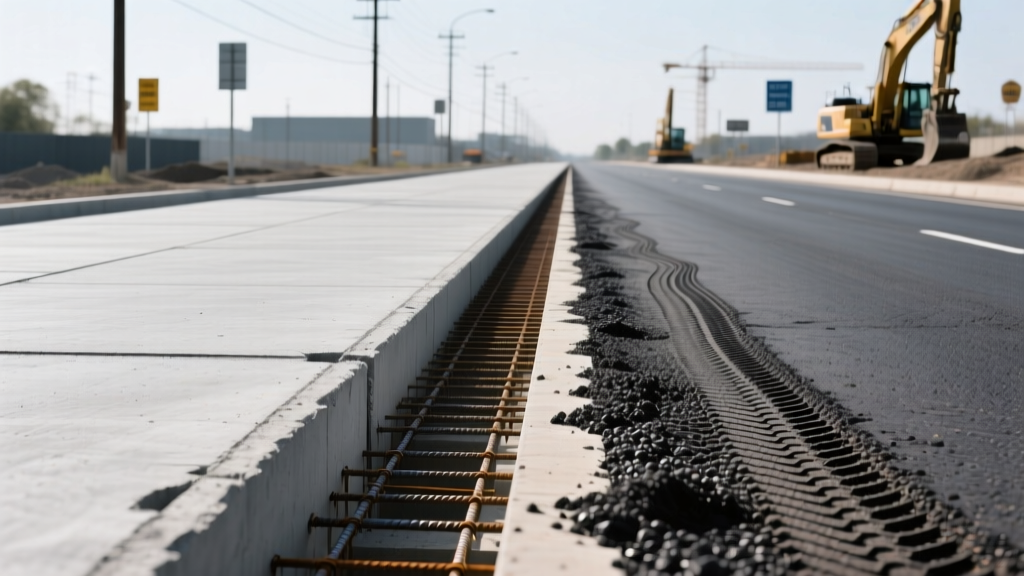
Rigid vs. Flexible Pavement: Core Structural Differences
When evaluating a concrete road vs asphalt for municipal, commercial, or heavy-duty infrastructure projects, the choice fundamentally comes down to rigid versus flexible pavement design. Concrete operates as a rigid slab that bridges over minor subgrade imperfections, distributing heavy axle loads across a wide area through beam action. Asphalt, conversely, is a flexible pavement that relies on a layered system; it distributes loads downward through a granular base, meaning the structural integrity of the underlying subgrade is absolutely critical. Selecting the wrong material for a specific traffic volume or soil condition leads to premature failure, skyrocketing lifecycle costs, and severe safety hazards.
Executive Summary Matrix
- Initial Cost: Asphalt is 40-60% cheaper upfront than concrete.
- Lifecycle Cost (40 years): Concrete is often 15-30% cheaper due to minimal overlay requirements.
- Design Lifespan: Concrete (30-50 years) vs. Asphalt (15-20 years before major structural overlay).
- Best Application: Concrete for high-ESAL (Equivalent Single Axle Load) highways and ports; Asphalt for suburban roads, low-budget projects, and areas requiring rapid construction.
Material Composition and Engineering Specifications
Portland Cement Concrete (PCC)
Modern roadway concrete is not standard sidewalk mix. It is an engineered composite typically utilizing Type I or Type II Portland cement, increasingly replaced by Portland-Limestone Cement (Type IL) to reduce embodied carbon without sacrificing strength. For arterial roads and highways, engineers specify compressive strengths between 4,000 and 5,000 PSI at 28 days, with a maximum water-to-cement ratio of 0.40 to ensure low permeability and high freeze-thaw resistance. According to the American Concrete Pavement Association (ACPA), proper joint spacing (typically 15 feet for transverse contraction joints) and the insertion of epoxy-coated steel dowel bars are mandatory to prevent faulting and ensure efficient load transfer across slab joints.
Hot Mix Asphalt (HMA)
Asphalt pavement consists of roughly 95% mineral aggregate (crushed stone, sand, and filler) and 5% bitumen binder. The engineering focus is on the Performance Graded (PG) binder specification. For a standard regional road, a PG 64-22 binder is common, meaning it resists rutting at 64°C and thermal cracking at -22°C. For heavy interstate traffic, engineers mandate Polymer Modified Asphalt (PMA), such as PG 76-22, which adds elastomers to the binder to prevent severe rutting under slow-moving, heavy truck loads. The Asphalt Institute emphasizes that a typical highway asphalt cross-section requires a 4-to-6-inch HMA surface layer placed over an 8-to-12-inch crushed aggregate base to prevent fatigue cracking.
Upfront Costs and 40-Year Lifecycle ROI
Comparing a concrete road vs asphalt requires looking beyond the initial bid. While asphalt wins the initial construction phase, concrete's durability alters the long-term financial picture, especially when factoring in traffic control costs during maintenance closures.
| Cost Metric | Concrete (PCC) | Asphalt (HMA) |
|---|---|---|
| Initial Installation (per sq. ft.) | $9.50 - $14.00 | $4.50 - $7.50 |
| Subgrade Preparation | Moderate (Slab bridges weak spots) | High (Requires uniform, compacted base) |
| Major Maintenance Interval | 20-30 years (Joint sealing, diamond grinding) | 7-12 years (Milling and overlay) |
| 40-Year Lifecycle Cost | Lower (Fewer lane closures, less material) | Higher (Multiple overlays required) |
Lifespan, Durability, and Specific Failure Modes
Both materials fail, but they fail in entirely different ways. Understanding these failure modes is critical for specifying the right material for your local climate and traffic profile.
Concrete Failure Modes
- Joint Faulting: Occurs when dowel bars are misaligned during pouring, preventing load transfer and causing one slab edge to drop lower than the adjacent one.
- Mid-Panel Cracking: Caused by inadequate slab thickness or excessive thermal curling stresses exceeding the concrete's modulus of rupture.
- Spalling: The breaking away of concrete at the joints, often due to incompressible materials entering the joint seal and expanding during thermal expansion.
Asphalt Failure Modes
- Alligator (Fatigue) Cracking: Interconnected cracks resembling reptile skin, indicating structural failure of the base layer or excessive traffic loading beyond the design ESALs.
- Rutting: Permanent longitudinal deformation in the wheel paths, caused by a weak HMA mix or inadequate binder stiffness at high temperatures.
- Thermal Cracking: Transverse cracks spaced at regular intervals caused by the asphalt binder shrinking in extreme cold temperatures.

Maintenance, Surface Friction, and Safety
According to data from the Federal Highway Administration's Long-Term Pavement Performance (LTPP) program, pavement friction directly correlates with wet-weather accident rates. New asphalt provides excellent macro-texture and high skid resistance. However, as the bitumen binder oxidizes and aggregates polish under traffic, friction drops significantly after 5 to 7 years, requiring diamond grinding or micro-surfacing to restore safety metrics.
Concrete maintains its friction longer, but can become slick if the surface mortar wears away and exposes highly polished, smooth aggregates. To mitigate this, modern concrete highways are tined transversely or longitudinally during the finishing process. When concrete friction degrades after 20 years, diamond grinding is used to remove the top 1/16th of an inch, exposing fresh, sharp aggregate and restoring a friction coefficient that often exceeds brand-new asphalt.
Environmental Impact: Albedo Effect and Recyclability
The environmental debate between concrete and asphalt is nuanced, involving both carbon emissions and operational energy use.
- The Albedo Effect: Concrete has a high solar reflectance (albedo of 0.30 to 0.40), meaning it reflects sunlight. This reduces the Urban Heat Island effect and lowers municipal street lighting costs by up to 24% due to better nighttime visibility. Asphalt has a very low albedo (0.05 to 0.10), absorbing heat, which increases local ambient temperatures and accelerates the degradation of the binder itself.
- Recyclability: Asphalt is the most recycled material in the United States. Reclaimed Asphalt Pavement (RAP) can be milled, reheated, and reused in new HMA mixes at rates of 20% to 50% without sacrificing performance, drastically lowering its lifecycle carbon footprint. Concrete can be crushed into Recycled Concrete Aggregate (RCA), but RCA is generally restricted to use as a sub-base material rather than being recycled into new structural paving slabs.
- Embodied Carbon: The calcination process in Portland cement production is highly carbon-intensive. However, the use of Supplementary Cementitious Materials (SCMs) like fly ash and slag, alongside Type IL cements, has reduced the carbon footprint of modern concrete paving by up to 20% compared to historical mixes.
Decision Framework: Specifying the Right Material
Use this practical framework to determine whether to specify a concrete road or asphalt for your next infrastructure project:
- Specify Concrete If: The route handles high volumes of heavy, slow-moving trucks (ports, industrial parks, interstate weigh stations); the project requires a 40-year design life with minimal lane-closure maintenance; or the location experiences extreme, sustained high temperatures where asphalt rutting is a known historical issue.
- Specify Asphalt If: The project has strict upfront budget constraints; the road is a low-volume residential or suburban collector; rapid construction and immediate opening to traffic are required (asphalt can be driven on as soon as it cools to 120°F, whereas concrete requires 7 to 14 days of curing); or the project mandates high percentages of recycled materials (RAP) to meet local green building mandates.
Frequently Asked Questions
Can asphalt be paved directly over an existing concrete road?
Yes, this is known as a "white-topping" overlay, but it requires extensive preparation. The concrete joints must be mapped, and a paving fabric or stress-absorbing membrane interlayer (SAMI) must be applied. If this is skipped, the joints in the concrete will quickly telegraph through the asphalt, causing reflective cracking within the first two years.
Which material handles freeze-thaw cycles better?
Properly air-entrained concrete (with 5-8% microscopic air voids) handles freeze-thaw cycles exceptionally well, as the voids give expanding ice a place to expand without cracking the slab. Asphalt struggles with freeze-thaw if water penetrates the surface and compromises the bond between the bitumen and the aggregate, leading to rapid pothole formation.
How does subgrade soil type affect the choice?
Expansive clay soils that swell with moisture and shrink during droughts are highly detrimental to asphalt, which will flex and crack as the subgrade moves. Concrete's rigid slab design allows it to bridge over these minor subgrade movements, making it the superior choice for regions with highly active, expansive soils.
Written by
Priya KapoorPriya Kapoor is a real estate market analyst and construction economics researcher with expertise in housing affordability, development feasibility, and infrastructure investment. She holds a Master of Regional Planning from Cornell University and previously worked as a senior analyst at CBRE's Investment Properties group, where she modeled returns for $4B in mixed-use development pipelines. Priya now runs an independent research practice advising developers, municipalities, and REITs on construction cost forecasting and market timing. She publishes the quarterly "BuildMat Market Pulse" report tracking material price indices across 12 commodity categories. Based in Austin, TX, Priya serves on the board of Habitat for Humanity Austin and is a marathon runner.
More from Priya Kapoor
View all
Construction Cost
Cost to Build a 1600 Sq Ft Home in 2026: Full Breakdown
Accurate 2026 cost to build a 1600 sq ft home—material, labor, and regional pricing breakdowns included. Plan your budget with real-time estimates.
Aug 11, 2026

Wood & Lumber
Name the Types of Wood for Pressure Treatment and Preservation
Learn how to name the types of wood best suited for pressure treatment. Compare species treatability, chemical retention levels, and 2026 preservation costs.
Aug 4, 2026

Stone & Masonry
Stone Veneer Suppliers Lindenhurst: 2026 Cost Analysis
Analyze 2026 stone veneer costs in Lindenhurst, NY. Compare local supplier pricing, delivery fees, and Suffolk County installation labor rates.
Aug 4, 2026