Concrete Slab Calculator: Matching Inputs to Your Project Scenario
Learn how to adjust concrete slab calculator inputs for different scenarios like driveways, patios, and foundations to avoid short loads and over-ordering.
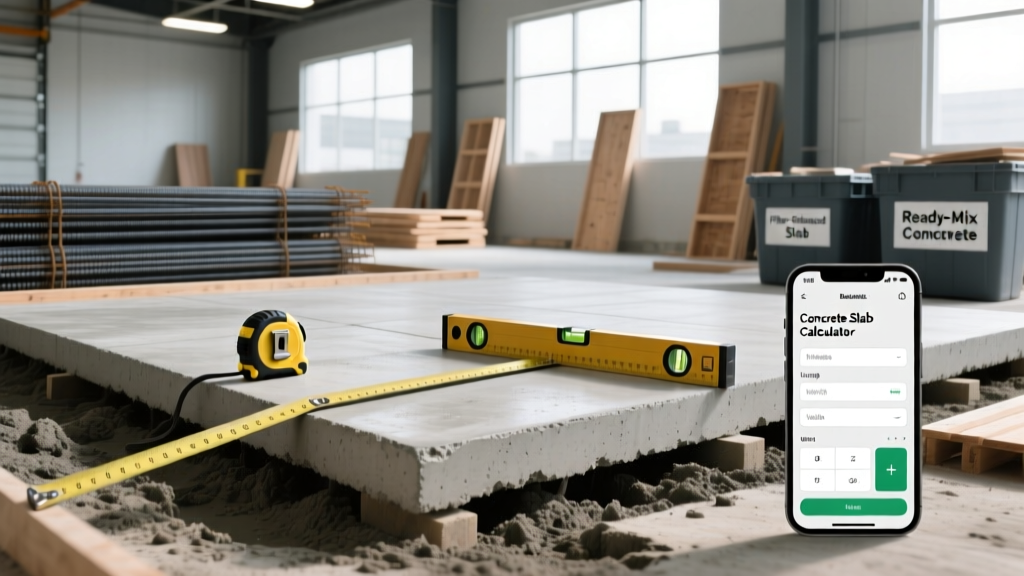
The Flaw in Generic Concrete Slab Calculators
Most basic concrete slab calculators operate on a simple geometric formula: Length × Width × Thickness. While mathematically sound for a perfect vacuum, this approach fails in real-world construction. A 4-inch thick patio slab and a 6-inch thick RV pad require vastly different mix designs, slump tolerances, and waste factors. Relying on a raw volumetric output without adjusting for application-specific variables is the leading cause of short loads, cold joints, and blown budgets.
To use a concrete slab calculator effectively, you must treat it as a baseline tool and apply scenario-specific modifiers. This guide breaks down how to adjust your calculator inputs based on structural loads, subgrade conditions, and placement methods, ensuring your final yardage order matches the reality of your job site.
Scenario Matching: Adjusting Inputs by Application
The American Concrete Institute (ACI) outlines distinct requirements for slab thickness and compressive strength based on anticipated loads. When inputting data into your calculator, you must first define the application scenario to determine the correct thickness and waste multiplier.
| Application Scenario | Target Thickness | Required PSI | Target Slump | Waste Factor |
|---|---|---|---|---|
| Residential Patios & Walkways | 3.5 to 4 inches | 3,000 psi | 4 to 4.5 inches | 5% |
| Standard Driveways (Passenger Vehicles) | 4 to 5 inches | 3,500 to 4,000 psi | 4.5 to 5 inches | 8% |
| Heavy-Duty Pads (RVs, Boat Lifts) | 6 inches | 4,000 psi | 4.5 to 5 inches | 10% |
| Garage & Shop Foundations | 5 to 6 inches | 4,000 to 5,000 psi | 5 to 5.5 inches | 10% |
Why Waste Factors Vary by Scenario
A 5% waste factor is sufficient for a simple, square patio poured directly from a chute. However, a 10% waste factor is mandatory for garage foundations and RV pads. These scenarios involve deeper forms, complex rebar grids that displace volume, and the use of concrete boom pumps. A standard pump truck retains 0.5 to 1.0 cubic yards of concrete in its hopper and delivery lines at the end of the pour. If your calculator does not account for this 'pump retention' and formwork bowing, you will inevitably order a short load.
Beyond Volume: Calculating Reinforcement and Subgrade
A concrete slab calculator only yields the volume of the wet mix. It does not calculate the tonnage of the subgrade base or the linear footage of steel reinforcement. According to the Portland Cement Association (PCA), a properly compacted subgrade is critical to preventing differential settlement and slab cracking.
Subgrade Gravel Tonnage Calculation
For most residential and light-commercial slabs, a 4-inch compacted base of 3/4-inch minus crushed stone is required. To calculate the tonnage needed for your gravel order:
- Calculate the square footage of the slab (Length × Width).
- Multiply by 0.33 (the decimal equivalent of a 4-inch depth in feet).
- Multiply the resulting cubic footage by 0.05 (the approximate conversion factor for crushed stone weight per cubic foot).
Example: A 24×30 foot driveway extension (720 sq ft). 720 × 0.33 = 237.6 cubic feet. 237.6 × 0.05 = 11.88 tons. You would order 12 tons of 3/4-inch minus gravel.
Rebar and Wire Mesh Estimation
For driveways and heavy pads, #4 (1/2-inch) rebar tied in a grid is standard. To estimate linear feet of #4 rebar for a 16-inch on-center (O.C.) grid:
- Linear feet per direction: (Width in inches ÷ 16) × Length in feet.
- Total linear feet: Multiply the above result by 2 (for both directions).
- Add 10%: Account for overlapping splices (minimum 30-bar-diameter overlap, or 15 inches for #4 bar).
For patios, 6×6 W1.4×W1.4 welded wire mesh (WWM) is often sufficient. Calculate the square footage and add 15% to account for the required 6-inch edge overlaps between sheets.
Real-World Walkthrough: 24x30 RV Pad Calculation
Let us apply this framework to a specific scenario: pouring a 24-foot by 30-foot RV pad using a concrete boom pump.
24 ft × 30 ft × 0.5 ft (6 inches) = 360 cubic feet.
360 ÷ 27 = 13.33 cubic yards.
An RV pad requires a 10% waste factor due to pump retention, deep 6-inch forms, and subgrade ruts.
13.33 × 1.10 = 14.66 cubic yards.
Ready-mix trucks typically carry up to 10 cubic yards. You will need one full 10-yard truck and a second truck with 5 yards. Always round up to the nearest half-yard when dealing with pumped heavy-load scenarios. Final order: 15.0 cubic yards of 4,000 psi mix with a 4.5-inch slump.
Common Calculator Pitfalls That Lead to Short Loads
Even when using an advanced concrete slab calculator, contractors and DIYers frequently make specific input errors that result in costly short loads. Avoid these critical mistakes:
- Ignoring Formwork Bowing: Wooden forms (especially 2x4s and 2x6s) bow outward under the hydrostatic pressure of wet concrete. A 100-foot perimeter can easily expand outward by 1/4 inch, adding 2 to 3 cubic feet of required volume that the calculator did not predict.
- Miscalculating Slope and Grade: If your slab requires a 1/4-inch per foot slope for drainage, the thickness at the high end might be 4 inches, but the low end could be 5.5 inches. Calculators that only accept a single uniform thickness will underestimate the volume by up to 15% on sloped pours. Always input the average thickness.
- Overlooking Trench Footings: Many garage slabs and structural pads include thickened edge footings or monolithic trenches. A standard 12-inch deep by 12-inch wide trench footing around a 24x24 garage adds nearly 3.5 cubic yards of concrete. Ensure your calculator has a dedicated 'footing' input field, or calculate the trench volume separately and add it to your slab total.
- Forgetting the Chute Washout: If you are pouring directly from the truck chute, the final 0.25 yards often gets stuck in the truck's hopper and chute, or is used to wash out the chute into a waste pit. Never order down to the exact decimal; always maintain a minimum 0.5-yard buffer for chute washout and site cleanup.
By treating a concrete slab calculator as a dynamic framework rather than a static math equation, you align your material orders with the physical realities of your specific project scenario. This prevents the cascading delays and premium 'short load' fees associated with underestimating yardage.