Fibreglass vs Concrete Pool: 2026 Cost & Structural Guide
Compare fibreglass vs concrete pool costs, structural integrity, and maintenance. Expert 2026 data on shotcrete strength, FRP gelcoats, and soil mechanics.

The Material Science: Shotcrete vs. Fibre-Reinforced Polymer
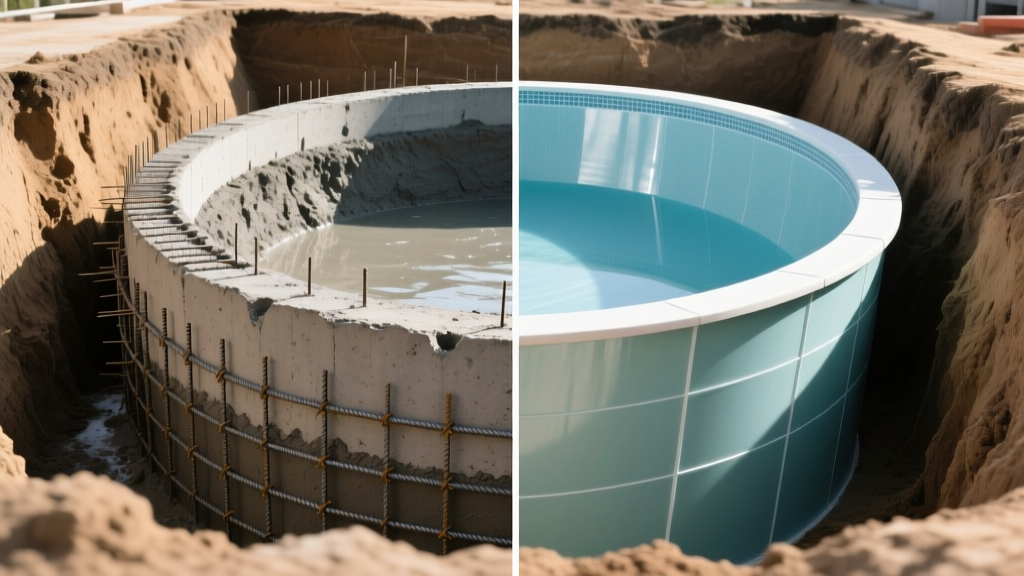
Choosing between a fibreglass vs concrete pool requires understanding the fundamental structural differences between site-cast concrete and factory-moulded composites. Modern concrete pools are rarely poured; they are constructed using shotcrete (wet-mix) or gunite (dry-mix). According to guidelines from the American Concrete Institute (ACI), structural shotcrete for swimming pools must achieve a minimum compressive strength of 4,000 psi, though high-performance mixes often reach 5,000 to 6,000 psi. This shell is typically 8 to 12 inches thick and reinforced with a continuous grid of #4 or #5 steel rebar spaced at 10-inch centers, creating a rigid, monolithic structure capable of resisting immense lateral earth pressures.
Fibreglass pools, technically classified as Fibre-Reinforced Polymer (FRP) shells, are manufactured off-site using a multi-layered process. The interior surface is a 15-to-20-mil thick polyester gelcoat, followed by layers of chopped strand mat, woven roving, and structural honeycomb core materials. While FRP possesses high tensile strength and flexural modulus, it lacks the compressive mass of concrete. The shell is typically only 3/8 to 1/2 inch thick, meaning it relies entirely on the surrounding backfill and hydrostatic equilibrium to maintain its shape.
Quick Decision Matrix
- Choose Concrete If: You require a custom geometric shape, a pool wider than 16 feet, or your site features highly expansive clay soils requiring engineered retaining walls.
- Choose Fibreglass If: You need a rapid installation (under 6 weeks), prefer a non-porous surface that resists algae, and are selecting from standard pre-engineered moulds.
2026 Installation Cost & Timeline Matrix
Material costs and labor rates have shifted significantly. The following data reflects 2026 national averages for a standard 14' x 28' residential pool, including excavation, shell, basic plumbing, and standard coping. Site-specific variables like rock excavation or extreme access limitations will increase both figures.
| Cost & Timeline Factor | Shotcrete / Gunite (Concrete) | Pre-Moulded Fibreglass (FRP) |
|---|---|---|
| Total Installed Cost (2026) | $85,000 – $140,000+ | $65,000 – $95,000 |
| Excavation & Shell Phase | 4 – 8 weeks | 1 – 2 weeks |
| Total Build Time | 3 – 6 months | 4 – 8 weeks |
| Crane Requirement | Rarely (pump trucks used) | Almost Always (for shell set) |
| Resurfacing Cycle | 10 – 15 years (Plaster/Pebble) | 25 – 30 years (Gelcoat) |
Soil Mechanics and Hydrostatic Pressure
The interaction between the pool shell and the surrounding soil is where many structural failures originate. Concrete pools act as subterranean retaining walls. Because the shotcrete shell is heavily reinforced and rigid, it can withstand the swelling pressures of expansive clay soils without deforming. However, this rigidity means that if the underlying soil subsides or settles unevenly, the concrete shell will not flex; it will crack.
Fibreglass pools, conversely, are designed to flex. The FRP shell can withstand minor soil shifts without fracturing, but it requires highly specific backfill procedures to prevent deformation. Industry standards endorsed by the Pool & Hot Tub Alliance (PHTA) mandate that fibreglass pools be backfilled with clean, washed 3/8-inch chip gravel (never sand or native dirt) and simultaneously filled with water. This 'water tamping' process locks the gravel into the corrugated ribs of the pool shell. If a contractor uses native soil or fails to match the interior water level with the exterior backfill height during installation, the lateral pressure will cause the pool walls to bow inward permanently.
Long-Term Surface Degradation & Maintenance
The interior finish dictates the chemical maintenance and long-term upkeep of the pool. Concrete pools are finished with a cementitious plaster (marcite) or an aggregate blend (like PebbleTec). These surfaces are inherently porous and alkaline.
- Concrete Surface Realities: Fresh plaster leaches calcium hydroxide into the water for the first 28 days, requiring aggressive acid dosing to balance the pH. Over time, the porous surface provides microscopic footholds for algae, demanding higher chlorine residuals (2.0 - 4.0 ppm). Every 10 to 15 years, the plaster will erode or stain, requiring a $10,000 to $18,000 drain-and-resurface procedure.
- Fibreglass Surface Realities: The gelcoat is completely non-porous and chemically inert. Algae cannot penetrate the surface, allowing owners to maintain lower chlorine levels (1.0 - 2.0 ppm) and reducing chemical expenditure by up to 40% annually. However, the gelcoat is susceptible to UV oxidation if the water level is kept consistently low, and it can suffer from 'cobalt spotting' (black stains caused by cobalt catalysts in the resin reacting with pool chemicals).
Critical Failure Modes: What Actually Goes Wrong?
Understanding how these materials fail is critical for long-term asset protection. The failure mechanisms are entirely distinct.
Concrete Failure Modes
- Rebar Corrosion (Spalling): If the shotcrete shell is not applied with adequate cover (minimum 2 inches of concrete over the steel), chlorinated water penetrates the porous concrete, rusting the rebar. The rust expands, blowing the interior plaster and concrete off the wall.
- Plaster Delamination: Often caused by poor troweling techniques or applying plaster to a hot, dry shotcrete shell without a proper bonding agent, resulting in hollow-sounding 'pop-offs' on the pool floor.
- Structural Cracking: Typically occurs at the deep-end hopper transitions or skimmer throats due to inadequate steel lapping or soil subsidence.
Fibreglass Failure Modes
- Osmotic Blistering: Water molecules penetrate the gelcoat and react with uncured styrene in the underlying resin, creating pressurized blisters that push the gelcoat outward. This is largely a manufacturing defect, though modern vinylester resins have minimized this risk.
- Spider Cracking: Fine, web-like fractures in the gelcoat. These rarely compromise the structural integrity of the FRP but are highly visible. They are almost always caused by improper backfill compaction or dropping heavy objects (like concrete coping stones) onto the pool edge during installation.
- Plumbing Shear: Because the fibreglass shell flexes slightly under hydrostatic load, rigid PVC plumbing connections can snap if they are not installed with flexible spa hose or expansion loops.
Site-Specific Decision Framework
The choice between a fibreglass vs concrete pool ultimately hinges on site logistics and design requirements. If your property features narrow side yards, overhead power lines, or strict HOA noise/time restrictions, a fibreglass shell—craned into place in a single afternoon—eliminates months of shotcrete truck traffic, rebound cleanup, and curing delays.
However, if you are engineering a vanishing edge, integrating a complex tanning ledge with sheer descent waterfalls, or building in a seismic zone where the pool must act as a structural tie-beam for the surrounding landscape, site-cast shotcrete remains the undisputed standard. Concrete allows for infinite geometric customization and structural integration with the home's foundation, provided you budget for the higher initial capital and the mandatory 15-year resurfacing cycle.
Written by
Sarah WhitfieldSarah Whitfield is a chartered quantity surveyor (MRICS) and construction cost analyst with 15 years of experience in material pricing, procurement strategy, and project budgeting. She earned her degree in Construction Management from the University of Reading (UK) and has worked on projects ranging from $2M custom homes to $180M mixed-use developments across North America and Europe. Sarah currently leads cost estimating for BuildMat Insight, maintaining a proprietary database of 4,000+ material price points updated quarterly. She is a frequent contributor to RSMeans cost data panels and has presented at the International Cost Engineering Council (ICEC) congress. Based in Denver, CO, Sarah is an avid trail runner and volunteer mentor for Women in Construction.
More from Sarah Whitfield
View all
Wood & Lumber
What Are the Different Types of Wood? A Builder's Guide
Compare structural softwoods, finish hardwoods, and engineered lumber. Analyze Janka ratings, MOE values, and 2026 pricing for construction.
Aug 4, 2026

Walls & Panels
Steel Framing vs Wood Framing: Corrosion and Moisture Defense
Compare steel framing vs wood framing for moisture resistance. Learn about galvanized coatings, condensation risks, and corrosion protection strategies.
Jul 21, 2026

Stone & Masonry
How to Cut Stone Veneer: Wet Saw vs Grinder Comparison
Compare the best tools for cutting stone veneer. We review wet saws, angle grinders, and chop saws to help you achieve clean, chip-free cuts.
Jul 21, 2026