Concrete Sand vs Masonry Sand: Mix Design and Application Guide
Compare concrete sand vs masonry sand for mix design. Learn ASTM C33 and C144 standards, particle gradation impacts, and exact structural applications.

The Core Difference: Gradation and Particle Geometry
When formulating cementitious mixes, the distinction between concrete sand and masonry sand dictates the structural integrity, workability, and long-term durability of the final product. While both are fine aggregates derived from crushed rock or natural deposits, their divergence lies in particle size distribution (gradation), particle shape, and the allowable percentage of fines (silt and clay).
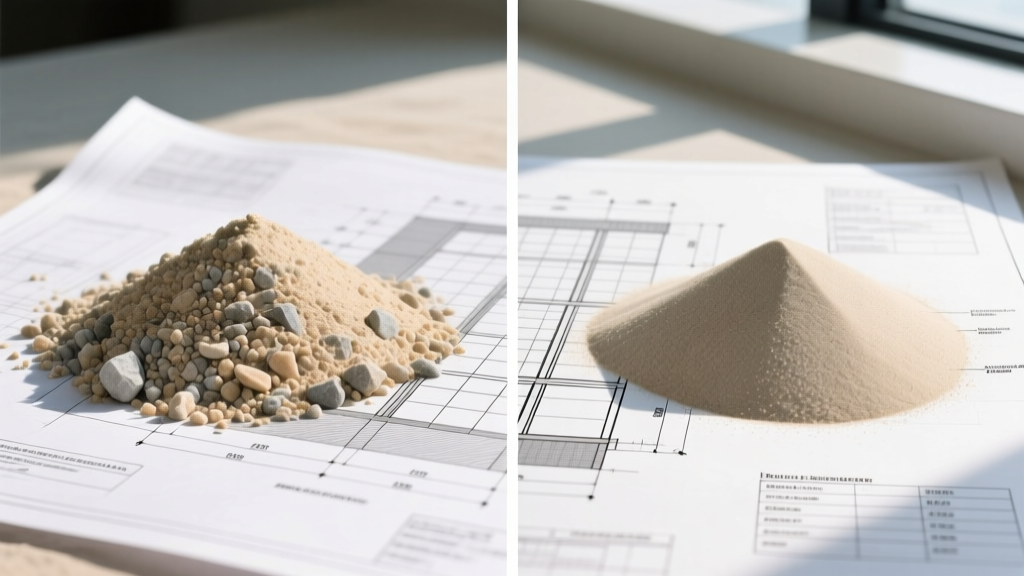
Concrete sand is a coarse, angular aggregate engineered to interlock with gravel and cement paste, providing the skeletal framework for high-compressive-strength structural concrete. Masonry sand is a finer, more uniformly graded material optimized for water retention, plasticity, and smooth troweling in thin-set mortar applications. Substituting one for the other without adjusting the water-cement ratio and admixture dosage will almost always result in catastrophic mix failure.
• Concrete Sand (ASTM C33): Coarse, angular, washed. Used for structural slabs, footings, and precast elements.
• Masonry Sand (ASTM C144): Fine, sub-angular to rounded, screened. Used for brick mortar, block grout, and paving joints.
ASTM Sieve Analysis: C33 vs C144 Gradation Limits
The ASTM C33 Standard Specification governs concrete aggregates, mandating a broader gradation curve that allows for larger particles to reduce the total surface area. Conversely, the ASTM C144 Standard Specification strictly limits the maximum particle size and requires a higher percentage of fine particles to ensure the mortar can adhere to masonry units without sagging.
| Sieve Size | ASTM C33 (Concrete Sand) | ASTM C144 (Masonry Sand) |
|---|---|---|
| 4.75 mm (#4) | 95 - 100% | 100% |
| 2.36 mm (#8) | 80 - 100% | 90 - 100% |
| 1.18 mm (#16) | 50 - 85% | 70 - 100% |
| 600 µm (#30) | 25 - 60% | 40 - 90% |
| 300 µm (#50) | 5 - 30% | 10 - 55% |
| 150 µm (#100) | 0 - 10% | 2 - 15% |
Mix Design Implications: Water Demand and Strength
The Surface Area Multiplier
The most critical variable when comparing concrete sand vs masonry sand in a batch plant or on-site mixer is the specific surface area of the aggregate. Because masonry sand contains a significantly higher volume of particles passing the #50 and #100 sieves, its total surface area is vastly larger than that of concrete sand. Every square inch of aggregate surface must be coated by the cement paste to ensure proper hydration and bonding.
If a mix designer substitutes masonry sand into a structural concrete batch without reducing the fine aggregate volume or adding a high-range water reducer (superplasticizer), the mix will demand substantially more water to achieve the target slump. According to the Portland Cement Association, increasing the water-cement (w/c) ratio from 0.40 to 0.50 to compensate for the high water demand of fine sand can drop the 28-day compressive strength from 4,500 psi down to roughly 3,200 psi. This strength reduction compromises load-bearing capacity and increases the permeability of the cured concrete.
Entrained Air and Freeze-Thaw Durability
Fine aggregates heavily influence the air-void system in concrete. Masonry sand's high fines content tends to stabilize microscopic air bubbles, which can cause the total air content to spike unpredictably if standard air-entraining admixture (AEA) dosages are used. While 4% to 7% entrained air is ideal for freeze-thaw resistance in exterior slabs, excessive air (above 8%) caused by uncalibrated AEA reacting with masonry sand fines will severely weaken the concrete matrix, reducing compressive strength by approximately 5% for every 1% of excess air.
Failure Modes: What Happens When You Swap Them?
Understanding the physical failure modes of incorrect aggregate selection prevents costly teardowns and structural remediation.
- Using Masonry Sand in Structural Concrete Slabs: The high water demand leads to excessive bleeding and plastic shrinkage cracking as the slab cures. The lack of coarse interlock results in a weak surface paste that is highly susceptible to scaling, spalling, and dusting under foot or vehicular traffic.
- Using Concrete Sand in Brick/Block Mortar: The coarse, angular particles act like tiny ball bearings, destroying the plasticity of the mortar. Masons will experience severe 'slump' in the joints, poor adhesion to the masonry units, and an inability to tool the joints smoothly. The mortar will cure brittle and fail to accommodate minor thermal expansion, leading to stepped cracking in the masonry veneer.
- Using Unwashed Sand in Either Application: If the sand contains more than 3% silt or clay by weight, the clay particles will coat the cement grains, physically blocking hydration. This results in a chalky, friable matrix that will fail to reach its design MPa regardless of the cement dosage.
On-Site Quality Control: The Jar Test for Fines
Batch tickets from the quarry will state compliance with ASTM C33 or C144, but stockpiles can become contaminated with silt, topsoil, or crusher dust during transport and storage. Before incorporating any fine aggregate into a critical mix, perform a field jar test to quantify the deleterious fines content.
- Take a clear, straight-sided 16 oz glass or heavy plastic jar.
- Add exactly 2 inches of the sand sample from the center of the stockpile (avoid the crusty outer edges).
- Fill the jar with clean water up to the 12 oz mark.
- Seal the jar and shake vigorously for 60 seconds to fully suspend all particles.
- Set the jar on a level surface and let it settle undisturbed for exactly 1 hour.
- Observe the stratification. The heavy sand will settle at the bottom, while the lighter silt and clay will form a distinct, lighter-colored layer on top of the sand.
Pro Tip for Site Superintendents: If the silt layer resting on top of the sand measures greater than 1/8 inch, or exceeds 5% of the total sand volume, the aggregate must be rejected or run through an on-site log washer. Do not attempt to 'fix' high-silt sand by simply adding more cement; the clay will still interfere with the chemical hydration process and compromise the structural integrity of the pour.
Sourcing, Pricing, and Logistics in 2026
The economic distinction between these two materials is driven by the processing required at the quarry. Concrete sand requires basic crushing, screening, and a single-pass wash to remove deleterious organics and clays. Masonry sand requires secondary and tertiary screening to ensure the strict removal of particles larger than the #8 sieve, alongside more rigorous washing to control the exact percentage of micro-fines passing the #200 sieve.
As of 2026, bulk pricing reflects this processing disparity. Standard washed concrete sand (ASTM C33) typically ranges from $18 to $28 per ton at the quarry gate, depending on regional freight and local bedrock geology. Masonry sand (ASTM C144) commands a premium, generally pricing between $30 and $45 per ton. For large-scale commercial masonry projects, this 60% price premium makes it economically vital to maintain strict inventory separation on the job site, ensuring that expensive masonry sand is not accidentally fed into the hopper of a concrete paving mixer.
Ultimately, the choice between concrete sand and masonry sand is not a matter of preference, but a strict adherence to the rheological requirements of the mix design. Concrete sand provides the structural skeleton required for compressive load transfer, while masonry sand provides the lubrication and water retention necessary for thin-set adhesion. Respecting the ASTM boundaries for each ensures that the cementitious matrix performs exactly as engineered.
Written by
Marcus ChenMarcus Chen is a licensed structural engineer (PE) and building materials analyst with over 12 years of experience across residential, commercial, and industrial construction. He holds a Master of Science in Civil Engineering from UC Berkeley and spent six years at Thornton Tomasetti before transitioning to independent consulting and technical writing. Marcus specializes in material selection for seismic-prone regions, concrete reinforcement strategies, and lifecycle cost analysis. His work has been cited by the American Concrete Institute (ACI) and the Structural Engineers Association of California (SEAOC). When he is not on a job site or at his desk, you will find him hiking the Sierra Nevada or restoring a 1920s craftsman bungalow in Oakland, CA.
More from Marcus Chen
View all
Construction Cost
How Much Did the Eiffel Tower Cost to Build?
How much did the Eiffel Tower cost to build in 1889? We adjust for inflation and compare its budget to modern skyscraper construction.
Aug 4, 2026

Fire Resistance
What Is a Fire Resistant Material? Testing & Certification Guide
Discover what is a fire resistant material through ASTM and UL testing. Learn how fire ratings, certifications, and assemblies work in construction.
Aug 4, 2026

Construction Cost
How Much Did the Burj Khalifa Cost to Build?
How much did the Burj Khalifa cost to build? We break down the $1.5B project and extract 5 money-saving strategies for your next build.
Jul 30, 2026