Concrete Slab Cost Calculator: 2026 Pricing & Estimation Guide
Use our concrete slab cost calculator guide for 2026. Learn exact material, labor, and hidden fees to accurately budget your next pour.
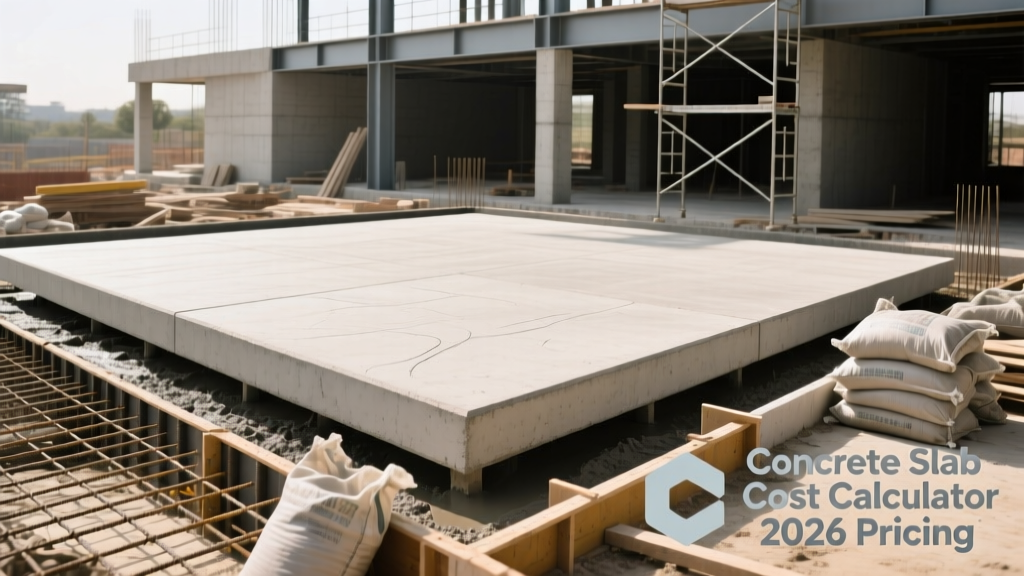
The Core Math: Calculating Exact Yardage
Before evaluating pricing, you must determine the exact volume of concrete required. Ready-mix concrete is sold by the cubic yard. The foundational formula for any concrete slab cost calculator is:
Volume (Cubic Yards) = (Length in feet × Width in feet × Depth in feet) ÷ 27
For a standard residential patio measuring 20 feet by 20 feet with a 4-inch thickness (0.33 feet), the math is: (20 × 20 × 0.33) ÷ 27 = 4.88 cubic yards. However, ordering exactly 4.88 yards is a critical mistake. Subgrade irregularities, formwork bowing, and spillage always consume extra material.
2026 Material Costs: Ready-Mix vs. Bagged Concrete
Material selection dictates your baseline budget. In 2026, the crossover point where ready-mix becomes more cost-effective than bagged concrete is approximately 2.5 cubic yards. Below this threshold, bagged concrete saves money; above it, the labor savings and superior quality control of ready-mix justify the delivery fees.
| Material Type | 2026 Unit Cost | Best Application | Yield / Notes |
|---|---|---|---|
| Ready-Mix (3000 PSI) | $135 - $150 / yard | Patios, walkways, shed pads | Standard structural baseline |
| Ready-Mix (4000 PSI) | $150 - $175 / yard | Driveways, garage floors, RV pads | Required for heavy vehicle loads |
| 80lb Bagged Mix (e.g., Quikrete) | $5.50 - $6.50 / bag | Fence posts, small repairs, steps | Yields 0.60 cubic feet per bag |
| Fiber-Mesh Reinforced Additive | $8 - $12 / yard | All exterior slabs | Reduces plastic shrinkage cracking |
According to the National Ready Mixed Concrete Association (NRMCA), specifying the correct compressive strength (PSI) is vital for longevity. While 3000 PSI is sufficient for foot traffic, any slab subjected to vehicular traffic or de-icing salts must utilize a minimum 4000 PSI mix with a low water-to-cement ratio (0.45 or lower) to prevent surface scaling.
Labor, Finishing, and Site Prep Costs
Material costs represent only 30% to 40% of the total project budget. Labor, site preparation, and finishing techniques make up the remainder. In 2026, baseline concrete labor (forming, pouring, and basic screeding) averages $3.50 to $5.00 per square foot. However, the final finish dramatically alters this price.
Finish Type Price Matrix
- Standard Broom Finish: $0.50 - $1.00 per sq. ft. (Provides essential slip resistance for exterior flatwork).
- Smooth Trowel Finish: $1.00 - $1.50 per sq. ft. (Standard for interior garage floors and basements; requires power troweling).
- Exposed Aggregate: $4.00 - $7.00 per sq. ft. (Requires surface retarders and pressure washing to reveal the stone matrix).
- Stamped / Decorative: $9.00 - $16.00+ per sq. ft. (Includes color hardeners, release agents, stamping mats, and sealing).
The "Hidden" Fees That Destroy Budgets
When using a basic concrete slab cost calculator, most homeowners miss the logistical surcharges imposed by ready-mix suppliers. Failing to account for these fees can inflate your final bill by 20% or more.
A standard ready-mix truck holds 10 cubic yards. If you order 5.5 yards, the supplier will charge a "short load fee" for the unused capacity. Expect to pay an additional $40 to $75 per missing yard. In some regions, ordering less than 4 yards triggers a flat short-load penalty of $150 to $250.
- Wait Time Penalties: Trucks typically include 90 minutes of free discharge time. After that, suppliers charge $3.00 to $5.00 per minute. If your crew is slow or the site is difficult to access, a 30-minute delay can add $150 to your invoice.
- Concrete Pump Truck: If the truck cannot back directly up to the forms (common for backyard patios), you must hire a line pump or boom pump. Base fees range from $150 to $250, plus $65 to $85 per hour, with a typical 4-hour minimum.
- Washout Fees: Environmental regulations require trucks to wash their chutes in designated areas. If you do not provide a designated washout pit or bin on-site, the driver may charge a $50 to $100 environmental washout fee to take the slurry back to the plant.
Reinforcement: Rebar vs. Wire Mesh
Concrete has high compressive strength but low tensile strength. Reinforcement is non-negotiable for slabs larger than 100 square feet. The American Concrete Institute (ACI) provides strict guidelines on reinforcement spacing to control cracking.
For a standard 4-inch residential slab, 6x6 W1.4xW1.4 welded wire mesh (WWM) is the most cost-effective option, costing roughly $0.45 to $0.60 per square foot. However, for driveways or garage floors subject to heavy point loads, #4 (1/2-inch) steel rebar is superior. Rebar should be tied on a 24-inch grid and elevated on 2-inch plastic chairs so it sits in the middle of the slab. #4 rebar costs approximately $12 to $15 per 20-foot stick in 2026. Remember to factor in the cost of tie wire and chairs, which add roughly $0.15 per square foot.
Real-World Estimation: 24x24 Garage Slab
Let us apply this framework to a real-world scenario: pouring a 24-foot by 24-foot (576 sq. ft.) garage slab, 4 inches thick, with a broom finish and #4 rebar reinforcement.
- Volume Calculation: 24 × 24 × 0.33 = 190.08 cubic feet. Divide by 27 = 7.04 cubic yards. Add 10% overage = 7.74 yards. Order 8.0 cubic yards.
- Material Cost: 8 yards of 4000 PSI mix with fiber mesh @ $165/yard = $1,320.
- Short Load Fee: 2 yards missing from a 10-yard truck @ $50/yard = $100.
- Rebar Cost: A 24x24 grid at 24" spacing requires 12 lines horizontally and 12 lines vertically (24 lines × 24 feet = 576 linear feet). Add 10% for overlaps = 633 linear feet. Divided by 20-foot sticks = 32 sticks. 32 sticks × $14 = $448.
- Labor & Finishing: 576 sq. ft. × $4.50/sq. ft. (base labor and broom finish) = $2,592.
- Site Prep & Forming: Grading, gravel base (4 inches of compacted crushed stone), and 2x4 wooden formwork = $850.
- Curing Compound: ASTM C309 Type 1 liquid membrane (3 gallons @ $45/gal) = $135.
Total Estimated Project Cost: $5,445 (Approximately $9.45 per square foot). This detailed breakdown illustrates why basic online calculators that only multiply square footage by a generic average often fail to prepare homeowners for the actual invoice.
Curing and Long-Term Protection
The final, often overlooked step in the estimation process is curing. The Portland Cement Association (PCA) emphasizes that improper curing can reduce surface strength by up to 50%. For exterior slabs, applying a liquid membrane-forming curing compound immediately after finishing costs about $0.05 to $0.10 per square foot in materials. For interior garage slabs, budget for a penetrating silane/siloxane sealer applied 28 days after the pour, which costs $0.25 to $0.40 per square foot and protects against oil stains and de-icing salt intrusion.
By mapping out exact yardage, selecting the correct PSI mix, anticipating logistical surcharges, and pricing reinforcement accurately, you can transform a vague guess into a precise, defendable construction budget.