Concrete vs Asphalt Driveway Cost: 2026 Repair & Lifecycle Guide
Analyze the true concrete vs asphalt driveway cost in 2026. Compare installation, 20-year repair economics, failure modes, and maintenance.
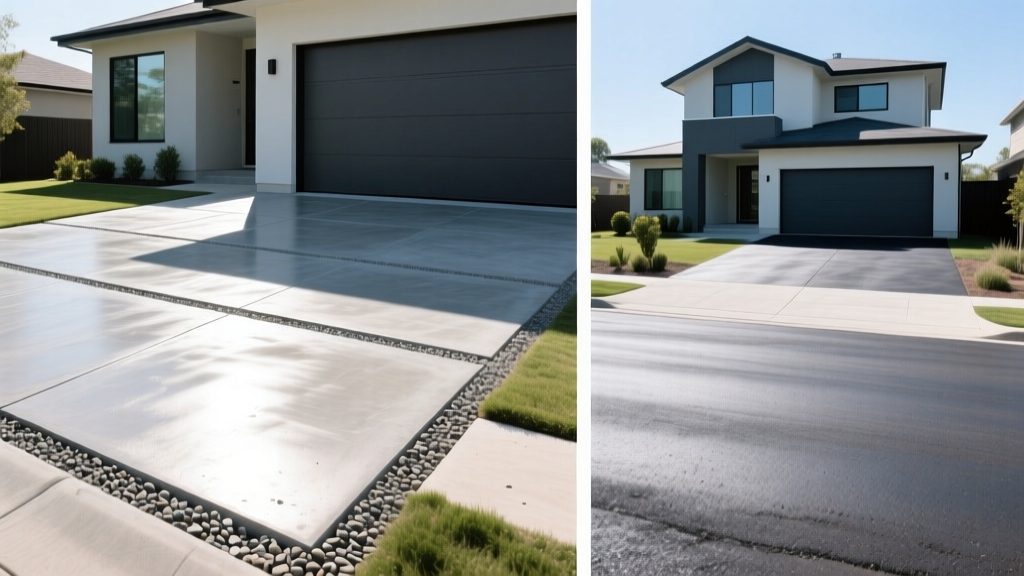
The Hidden Lifecycle: Initial Installation vs. 20-Year Repair Costs
When homeowners evaluate the concrete vs asphalt driveway cost, they typically fixate on day-one installation prices. In 2026, a standard 600-square-foot concrete driveway costs between $5,400 and $9,000 ($9–$15 per square foot), while an equivalent asphalt driveway ranges from $2,400 to $4,800 ($4–$8 per square foot). However, this initial snapshot ignores the 20-year lifecycle reality. Asphalt requires biennial sealcoating and periodic overlays, while concrete demands targeted structural troubleshooting and joint maintenance. The true cost of ownership is dictated by how each material responds to subgrade shifts, freeze-thaw cycles, and UV degradation over two decades.
Troubleshooting Concrete Driveway Failures (and Repair Costs)
Concrete is a rigid pavement system. When it fails, it usually stems from subgrade instability, chemical attacks, or improper curing during the initial pour. Understanding the specific failure mode is critical before committing to a repair method.
Spalling and Scaling (Winter Damage)
Scaling occurs when the top 1/8 to 1/4 inch of the concrete surface flakes away, exposing the aggregate. This is rarely a structural failure; it is a chemical one. In 2026, the primary culprit is the use of calcium chloride or magnesium chloride deicers, which react with the calcium hydroxide in the cement paste to form calcium oxychloride (CAOXY) crystals. These crystals expand and literally pop the surface off.
- Diagnostic Check: Run your hand over the surface. If it feels like coarse sandpaper and aggregate is visibly exposed, scaling has occurred.
- Repair Protocol: Scarify the surface using a planetary grinder, apply a silane-siloxane penetrating sealer to halt moisture ingress, and apply a polymer-modified micro-topping.
- 2026 Repair Cost: $4.50 to $7.00 per square foot. Full slab replacement is unnecessary unless the spalling exceeds 1/2 inch in depth.
Differential Settlement and Slab Voids
Unlike asphalt, which flexes over minor subgrade voids, concrete bridges them until the tensile limit is reached, resulting in a catastrophic snap. Settlement is usually caused by downspout washout or poor initial soil compaction.
- Repair Protocol: High-density polyurethane foam jacking (e.g., Alchemy-Spetec Deep Lift). Technicians drill 5/8-inch holes and inject structural resin that expands to lift the slab and stabilize the subgrade.
- 2026 Repair Cost: $8.00 to $14.00 per square foot. This is roughly 40% cheaper than demolishing and repouring the affected slabs, and the driveway is ready for vehicle traffic in 15 minutes.
Troubleshooting Asphalt Driveway Failures (and Repair Costs)
Asphalt is a flexible pavement. Its failures are predominantly tied to the aging of the bitumen binder, water infiltration into the base course, and thermal fatigue. According to the National Asphalt Pavement Association, timely preservation is vastly more economical than structural rehabilitation.
Alligator (Fatigue) Cracking
Interconnected cracks that resemble alligator skin indicate that the asphalt base or subgrade has completely failed under repeated loading. This is not a surface issue; it is a structural collapse.
- Diagnostic Check: Press on the edges of the cracks. If the asphalt pieces move independently or pump water/mud when stepped on, the base is compromised.
- Repair Protocol: Sealcoating or crack filling will not fix this. The affected area must be saw-cut, excavated to the subgrade, re-compacted with aggregate base course (ABC), and patched with hot-mix asphalt (HMA).
- 2026 Repair Cost: $14.00 to $22.00 per square foot for full-depth patching. If alligator cracking covers more than 30% of the driveway, a complete mill-and-overlay ($6–$9 per square foot) is the only economically viable solution.
Binder Oxidation and Raveling
UV radiation and oxygen strip the lightweight, oily maltene fractions from the asphalt binder, leaving behind brittle asphaltenes. The surface turns gray, and the aggregate begins to loosen (raveling).
- Repair Protocol: Apply an asphalt emulsion sealcoat or a rejuvenating fog seal that penetrates the surface and restores the maltene-asphaltene balance.
- 2026 Repair Cost: $0.20 to $0.35 per square foot for professional sealcoating. This must be repeated every 3 to 4 years to prevent irreversible raveling.
The 2026 Repair & Maintenance Cost Matrix
The following table breaks down the specific interventions required for both materials, providing a clear framework for budgeting long-term driveway ownership.
| Intervention Type | Concrete Cost (2026) | Asphalt Cost (2026) | Frequency / Trigger |
|---|---|---|---|
| Routine Crack Sealing | $3.00 - $6.00 / linear ft (Polyurethane) | $0.75 - $1.50 / linear ft (Rubberized) | Annually / As needed |
| Surface Protection | $0.25 - $0.50 / sq ft (Penetrating Silane) | $0.20 - $0.35 / sq ft (Emulsion Sealcoat) | Every 3-5 years |
| Subgrade Settlement Fix | $8.00 - $14.00 / sq ft (Poly-jacking) | $14.00 - $22.00 / sq ft (Full-depth patch) | As needed (Reactive) |
| Major Surface Renewal | $5.00 - $8.00 / sq ft (Micro-topping) | $4.00 - $6.00 / sq ft (2-inch Overlay) | Year 12-15 |
| Complete Tear-Out & Replace | $12.00 - $18.00 / sq ft | $8.00 - $12.00 / sq ft | Year 25-30 (Concrete) / Year 15-20 (Asphalt) |
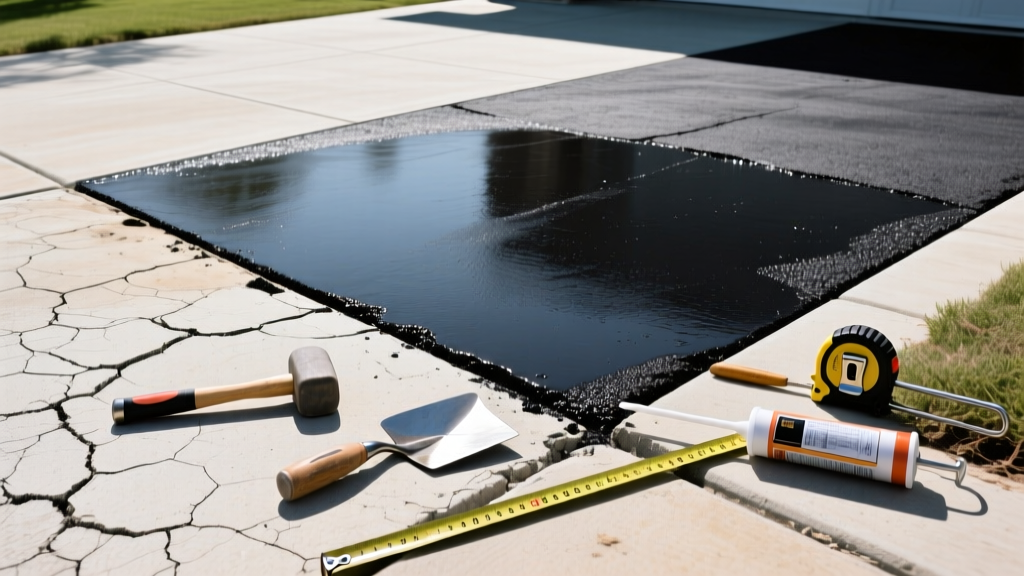
Diagnostic Flowchart: When to Repair vs. Replace
Homeowners often waste money repairing pavements that have reached the end of their structural life. Use this diagnostic framework, supported by guidelines from the Federal Highway Administration (FHWA), to make the correct capital decision.
- Evaluate Joint Deterioration (Concrete Only): If the concrete exhibits 'D-cracking'—a series of fine cracks parallel to the joints caused by freeze-thaw damage in the aggregate itself—the slab is structurally compromised. Decision: Replace. D-cracking cannot be patched or halted.
- Assess Base Failure (Asphalt Only): If more than 30% of the driveway exhibits alligator cracking, or if deep rutting (>1/2 inch) is present in the wheel paths, the base course has failed. Decision: Mill and overlay, or full replacement. Surface treatments will fail within 6 months.
- Check for Alkali-Silica Reaction (ASR): If the concrete features map cracking accompanied by a gel-like substance oozing from the cracks, the aggregate is reacting with the cement alkalis. Decision: Replace. ASR is an internal chemical expansion that will continue to destroy the slab from the inside out.
- Measure Surface Wear: If the asphalt is heavily raveled but the base is solid (no alligator cracking), or if the concrete is scaled but structurally sound. Decision: Resurface (Asphalt overlay or Concrete micro-topping).
Climate Variables: Freeze-Thaw vs. UV Degradation
The geographic location of your property fundamentally alters the concrete vs asphalt driveway cost equation over a 20-year period.
Freeze-Thaw Regions (Northern US, Canada)
In climates with over 50 freeze-thaw cycles annually, concrete is highly vulnerable to scaling and joint spalling if not properly air-entrained (requiring 5-8% microscopic air bubbles to give expanding water room to freeze). Deicing salts accelerate this damage. Asphalt, being flexible and impermeable when properly sealed, handles freeze-thaw cycles better, but it becomes brittle in extreme sub-zero temperatures, leading to thermal transverse cracking. Verdict: Asphalt requires more frequent winter crack-sealing, but concrete faces higher catastrophic slab-replacement risks if the initial air-entrainment was inadequate.
High-Heat and UV Regions (Southwest, Southern US)
Asphalt softens in sustained temperatures above 95°F, making it susceptible to rutting from heavy, stationary loads (like RVs or boat trailers). UV radiation rapidly oxidizes the binder, requiring strict adherence to a 3-year sealcoating schedule. Concrete thrives in high-heat environments, as it is entirely immune to UV degradation and does not soften. Verdict: Concrete offers a vastly superior lifecycle cost in high-heat, high-UV environments, requiring almost zero structural maintenance compared to the constant surface preservation asphalt demands.
Ultimately, deciding between these two materials requires looking past the contractor's initial quote. By mapping out the specific environmental stressors your property faces and understanding the exact chemical and mechanical failure modes of each pavement type, you can accurately forecast the true 20-year cost of ownership and avoid expensive, reactive emergency repairs.
Written by
James ThorntonJames Thornton is a construction industry veteran with 25 years of hands-on experience in wood framing, lumber grading, and residential building codes. He started as a framing carpenter in rural Oregon, earned his ICC Residential Building Inspector certification, and eventually became a senior plan reviewer for the City of Portland Bureau of Development Services. James holds a B.S. in Wood Science & Technology from Oregon State University and is a certified lumber grader through the West Coast Lumber Inspection Bureau (WCLIB). He has inspected over 3,000 residential construction sites and authored the city's internal guide on advanced framing techniques (2x6 at 24" O.C.). James lives in Bend, OR, where he builds custom timber-frame cabins and competes in lumberjack sports.
More from James Thornton
View all
Insulation
Best Home Insulation Materials: Complete 2026 Guide
Compare top home insulation materials for 2026. Find R-values, installed costs per square foot, and best uses for fiberglass, spray foam, and mineral wool.
Aug 4, 2026

Sustainable Building
Certify Your Green Building Material for LEED and WELL
Step-by-step guide to certifying a green building material for LEED v5 and WELL v2. Master EPDs, HPDs, and VOC limits for 2026 project specifications.
Aug 4, 2026

Stone & Masonry
Veneer Stacked Stone Panels: Interior Design & Style Showcase
Discover how veneer stacked stone panels transform interiors. Explore modern design profiles, material pairings, and technical installation specs.
Aug 4, 2026