Concrete vs Asphalt Roads: 2026 Cost Breakdown & Lifecycle Analysis
Compare the true cost of concrete vs asphalt roads. Our 2026 breakdown covers initial paving prices, maintenance, and 50-year lifecycle expenses.
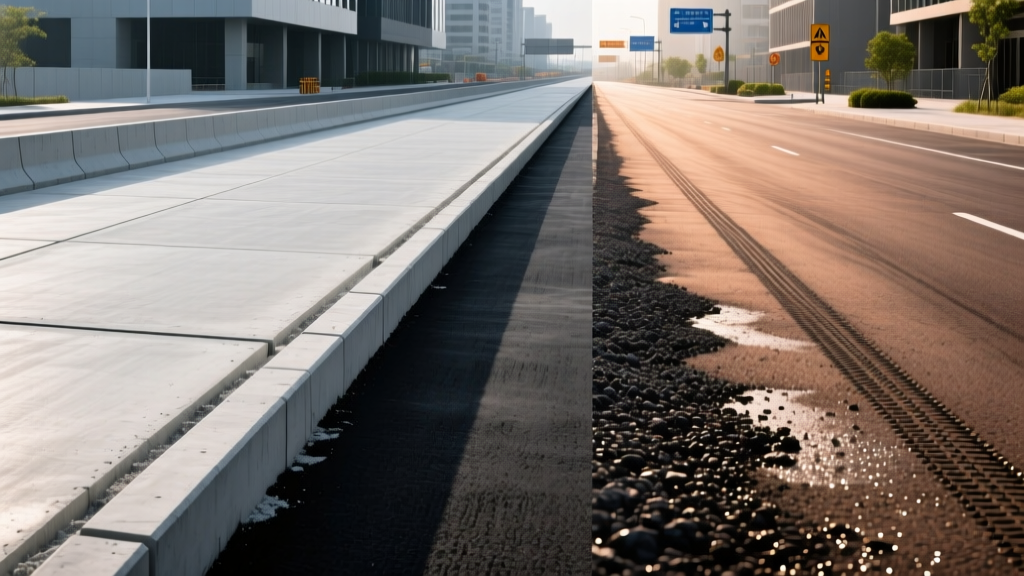
The Upfront Paving Cost Reality (2026 Pricing)
When municipal engineers and private developers evaluate pavement options, the immediate capital expenditure often dictates the initial shortlist. However, comparing the initial cost of concrete vs asphalt roads requires isolating material, labor, and subgrade preparation expenses based on current 2026 supply chain realities. Bitumen volatility and Portland cement carbon-tax adjustments have shifted the historical pricing gap, though asphalt still maintains a distinct upfront advantage.
Initial Capital Expenditure Breakdown
For a standard 12-foot wide arterial lane, initial costs are calculated per square foot and per lane mile. The following table outlines the average 2026 installed costs for heavy-duty municipal and state highway applications.
| Cost Component | Hot Mix Asphalt (HMA) | Portland Cement Concrete (PCC) |
|---|---|---|
| Material Cost (per sq. ft.) | $2.10 - $3.40 | $3.80 - $5.50 |
| Labor & Equipment (per sq. ft.) | $1.50 - $2.20 | $2.00 - $3.10 |
| Subgrade & Base Prep (per sq. ft.) | $0.90 - $1.40 | $0.70 - $1.20 |
| Total Installed (per sq. ft.) | $4.50 - $7.00 | $6.50 - $9.80 |
| Estimated Cost per Lane Mile | $285,000 - $445,000 | $410,000 - $620,000 |
While asphalt presents a 25% to 35% lower initial cost, this metric alone is insufficient for infrastructure procurement. Concrete requires less aggregate base material due to its rigid load-distribution properties, slightly offsetting the higher surface material costs.
Structural Design and Material Specifications
To accurately forecast long-term expenses, one must understand the engineering specifications that drive these initial costs. The structural design of the pavement dictates its load-bearing capacity, measured in Equivalent Single Axle Loads (ESALs).
Concrete: Jointed Plain Concrete Pavement (JPCP)
Modern rigid pavement relies on JPCP designs. A standard 2026 arterial road specification calls for a 9.5-inch to 11-inch slab thickness utilizing a 4,500 psi air-entrained concrete mix. The mix typically incorporates 15% to 25% Supplementary Cementitious Materials (SCMs) like fly ash or slag to mitigate thermal cracking and reduce the carbon footprint. Crucially, JPCP requires Grade 60 epoxy-coated dowel bars placed in precision alignment baskets at transverse joints to facilitate load transfer and prevent faulting.
Asphalt: Superpave Hot Mix Asphalt (HMA)
Flexible pavement design utilizes a layered Superpave HMA system. A heavy-duty specification requires a 6-inch to 8-inch total asphalt thickness over a dense-graded aggregate base. The surface course typically employs a Stone Matrix Asphalt (SMA) or fine-graded Superpave mix utilizing a PG 76-22 polymer-modified binder (SBS modified) to resist high-temperature rutting and low-temperature thermal cracking.
The 40-Year Lifecycle Cost Analysis (LCCA)
The true economic divergence between concrete and asphalt emerges during the operational phase. According to the Federal Highway Administration (FHWA) Life-Cycle Cost Analysis guidelines, evaluating pavement requires a Net Present Value (NPV) calculation applying a standard discount rate (typically 3% to 4%) over a 40- to 50-year analysis period.
Asphalt pavements experience a 'maintenance cliff' around year 15. While initial maintenance is limited to crack sealing, the structural degradation of the bitumen binder necessitates a mill-and-overlay rehabilitation. Concrete pavements, conversely, exhibit a linear, predictable degradation curve, requiring only joint resealing and occasional diamond grinding to restore ride quality (IRI).
Projected 40-Year Maintenance Schedules
- Asphalt (HMA): Crack sealing (Years 4, 8, 12); Mill and 2-inch overlay (Year 15); Crack sealing (Years 19, 23, 27); Full-depth reclamation or second mill-and-overlay (Year 30).
- Concrete (JPCP): Joint resealing (Year 15); Diamond grinding and joint resealing (Year 25); Minor slab replacement for isolated spalling (Years 30-40).
When calculating the 40-year NPV at a 4% discount rate, concrete frequently demonstrates a 12% to 18% lower lifecycle cost on high-volume freight corridors exceeding 10 million ESALs. On low-volume rural roads (under 1 million ESALs), asphalt maintains the lifecycle advantage due to the lower initial capital outlay and minimal structural stress.
Hidden Operational Variables: Traffic Control and Albedo
Standard LCCA models often omit secondary municipal costs that significantly impact the total economic footprint of the pavement choice.
Traffic Control and User Delay Costs
Asphalt is a flexible, thermoplastic material that cools and cures rapidly. A newly laid HMA surface can typically bear heavy traffic within 12 to 24 hours. Concrete requires hydration and curing. While modern maturity meters allow engineers to open concrete pavements once the slab reaches 3,500 psi (often within 3 to 5 days using accelerating admixtures), full design strength takes 28 days. In dense urban corridors, the user delay cost and required traffic detours for concrete curing can add $15,000 to $40,000 per day in localized economic disruption, a factor that frequently forces municipalities to choose asphalt for rapid-deployment urban overlays.
The Albedo Effect and Municipal Lighting
Pavement reflectivity (albedo) directly impacts municipal energy budgets and urban heat island effects. According to US Environmental Protection Agency (EPA) Urban Heat Island data, light-colored surfaces significantly reduce ambient temperatures and lighting requirements. Concrete possesses an initial albedo of 0.30 to 0.50, reflecting up to 50% of solar radiation. Asphalt has an albedo of 0.05 to 0.10, absorbing the vast majority of solar energy. Municipalities utilizing concrete on arterial roads can reduce street lighting wattage requirements by up to 15% due to the enhanced reflectivity of the pavement surface at night, yielding compounding utility savings over the pavement's lifespan.

Decision Matrix: Specifying the Right Pavement
Procurement officers and civil engineers should utilize the following decision framework to determine the optimal material based on specific project parameters.
Specify Hot Mix Asphalt When:
- Traffic Load: ESALs are projected to remain below 2 million over the 20-year design life.
- Budget Constraints: Initial capital is strictly capped, and municipal bond structures do not support long-term lifecycle financing.
- Urban Logistics: The project is located in a high-density commercial zone where road closure duration must be measured in hours, not days.
- Subgrade Conditions: The native soil exhibits high plasticity and differential settlement risks; flexible asphalt can tolerate minor subgrade deflection without catastrophic structural failure.
Specify Portland Cement Concrete When:
- Traffic Load: The route is a primary freight corridor or interstate with ESALs exceeding 10 million, where asphalt rutting and channelization become severe safety hazards.
- Climate Extremes: The region experiences sustained summer temperatures exceeding 95°F, which softens bitumen binders and accelerates asphalt rutting under heavy braking zones and intersections.
- Financial Structure: The project is funded via long-term infrastructure bonds where minimizing 40-year NPV and reducing future maintenance disruptions is the primary fiduciary directive.
- Environmental Mandates: The municipality has strict urban heat island mitigation targets or requires high-albedo surfaces for LEED/ENVISION certification credits.
Ultimately, the choice between concrete and asphalt is not merely a materials decision, but a financial strategy. By aligning the pavement selection with the specific ESAL projections, municipal cash flow structures, and operational constraints of the corridor, engineers can optimize both immediate budgets and long-term infrastructure resilience.
Written by
Priya KapoorPriya Kapoor is a real estate market analyst and construction economics researcher with expertise in housing affordability, development feasibility, and infrastructure investment. She holds a Master of Regional Planning from Cornell University and previously worked as a senior analyst at CBRE's Investment Properties group, where she modeled returns for $4B in mixed-use development pipelines. Priya now runs an independent research practice advising developers, municipalities, and REITs on construction cost forecasting and market timing. She publishes the quarterly "BuildMat Market Pulse" report tracking material price indices across 12 commodity categories. Based in Austin, TX, Priya serves on the board of Habitat for Humanity Austin and is a marathon runner.
More from Priya Kapoor
View all
Construction Cost
Cost to Build a 1600 Sq Ft Home in 2026: Full Breakdown
Accurate 2026 cost to build a 1600 sq ft home—material, labor, and regional pricing breakdowns included. Plan your budget with real-time estimates.
Aug 11, 2026

Wood & Lumber
Name the Types of Wood for Pressure Treatment and Preservation
Learn how to name the types of wood best suited for pressure treatment. Compare species treatability, chemical retention levels, and 2026 preservation costs.
Aug 4, 2026

Stone & Masonry
Stone Veneer Suppliers Lindenhurst: 2026 Cost Analysis
Analyze 2026 stone veneer costs in Lindenhurst, NY. Compare local supplier pricing, delivery fees, and Suffolk County installation labor rates.
Aug 4, 2026