Vinyl Pool vs Concrete: Cost, Lifespan, and Installation Compared
Compare vinyl pool vs concrete construction. Analyze 2026 costs, installation timelines, lifespan, and maintenance to choose the right inground pool.

The Material Reality: Gunite, Shotcrete, and Vinyl Liners
When evaluating a vinyl pool vs concrete for residential inground construction, the terminology requires immediate clarification. In modern pool building, "concrete" almost exclusively refers to pneumatically applied concrete—specifically gunite (dry-mix) or shotcrete (wet-mix)—rather than traditional poured-in-place forming. According to the American Concrete Institute (ACI), shotcrete provides the necessary compressive strength (typically 4,000 to 6,000 psi) and structural continuity required to withstand hydrostatic soil pressure and the immense outward force of thousands of gallons of water.
Vinyl liner pools, conversely, rely on a structural framework of galvanized steel, polymer, or aluminum panels, backed by compacted soil and a vermiculite or sand base. The water is held not by the structural walls, but by a custom-cut, non-structural PVC membrane (the liner) typically ranging from 20-mil to 30-mil in thickness. Understanding this fundamental divergence in load-bearing mechanics is critical before analyzing cost and longevity.
Upfront Installation Costs and Timelines (2026 Data)
The initial capital expenditure remains the primary friction point in the vinyl pool vs concrete debate. Concrete pools demand heavy machinery, specialized nozzle crews, and extensive curing times, driving up labor costs. Vinyl pools utilize prefabricated panel kits that can be assembled and backfilled in a fraction of the time.
| Cost & Timeline Factor | Vinyl Liner Pool | Concrete (Gunite/Shotcrete) Pool |
|---|---|---|
| Average Base Cost (30,000 gal) | $75,000 - $110,000 | $115,000 - $175,000+ |
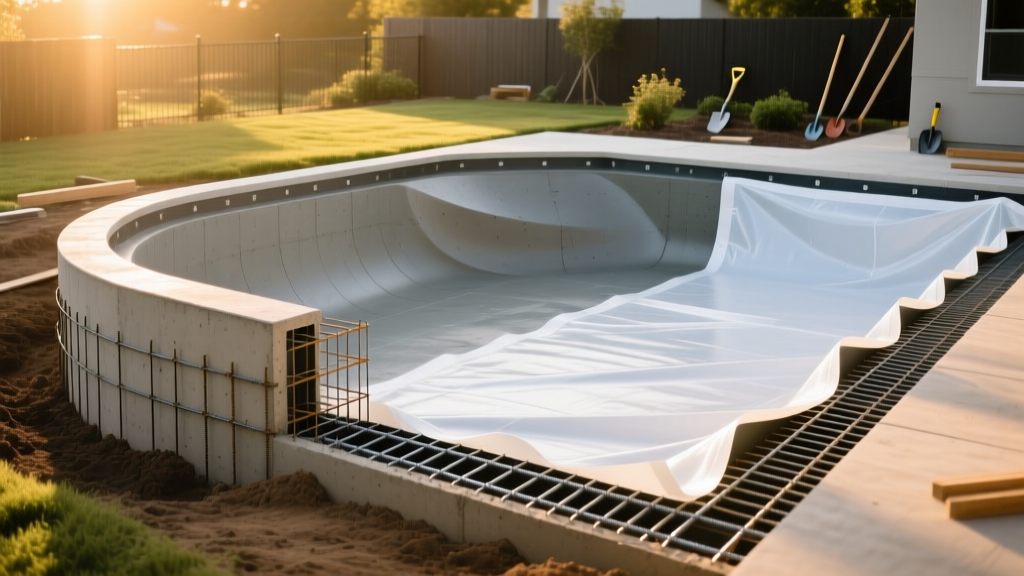
| Excavation & Framing | Steel/Poly panels bolted together | Steel rebar grid tied and spaced |
| Shell Creation Time | 2 to 4 days | 1 to 2 days (application) + 28 days (cure) |
| Total Build Timeline | 4 to 6 weeks | 10 to 16 weeks |
| Interior Finish Cost | $3,500 - $6,000 (Liner) | $8,000 - $20,000 (Plaster to Pebble) |
While the vinyl option offers a lower barrier to entry, concrete pools inherently increase property appraisal values at a higher ratio due to their perceived permanence and structural integration with the surrounding hardscape.
Long-Term Maintenance and Lifecycle Expenses
The true cost of ownership emerges in years 7 through 15. The Pool & Hot Tub Alliance (PHTA) emphasizes that water chemistry management differs vastly between the two materials, directly impacting lifecycle expenses.
The 15-Year Cost Reality Check
Vinyl Pools: The liner is a sacrificial component. UV exposure, chlorine oxidation, and physical wear dictate a replacement cycle of 7 to 12 years. A 30-mil replacement liner in 2026 costs between $4,500 and $8,000, including labor and water replacement. Furthermore, vinyl is highly susceptible to tearing from pet claws, sharp toys, or shifting vermiculite bases.
Concrete Pools: The shell is permanent, but the interior finish degrades. Standard white marcite plaster requires acid washing and eventual replacement every 10 to 15 years ($7,000 - $12,000). Upgrading to an exposed aggregate finish (e.g., PebbleTec) extends this lifespan to 20+ years, though at a higher initial premium.
Chemical consumption also favors vinyl. Concrete is highly porous and naturally alkaline. Newly plastered concrete pools require aggressive acid dosing in the first year to balance the pH spike caused by calcium hydroxide leaching. Vinyl liners are non-porous and chemically inert, requiring significantly less acid and algaecide over their lifespan.
Structural Failure Modes and Edge Cases
Every building material has specific failure vectors. Recognizing these edge cases is vital for builders and homeowners in challenging soil environments.
Concrete Failure Vectors
- Structural Cracking: Improper soil compaction or expansive clay soils can cause differential settlement, leading to structural cracks in the gunite shell. If the crack penetrates the rebar grid, water intrusion causes oxidation (rust jacking), which expands and spalls the concrete from the inside out.
- Delamination: If the shotcrete nozzle operator holds the wand at an incorrect angle or applies it too thickly in a single pass, rebound material becomes trapped, creating hollow voids (delamination) behind the plaster finish.
Vinyl Failure Vectors
- Hydrostatic Floatation: This is the most catastrophic failure mode for vinyl pools. If the pool is drained for a liner replacement during a period of high groundwater, the empty pool shell acts like a boat. Hydrostatic pressure can literally push the entire steel wall structure out of the ground, destroying the deck and plumbing. Concrete pools are heavy enough to resist this, though they still require hydrostatic relief valves in the main drain sump.
- Base Washout: If the pool develops a leak and the surrounding soil is sandy, the escaping water can wash out the vermiculite base, creating sinkholes beneath the liner that result in immediate tearing under the weight of the water.
Customization, Hydraulics, and Design Limitations
When architects and landscape designers push for complex geometries, the vinyl pool vs concrete comparison heavily skews toward concrete.
Vinyl pools are constrained by the manufacturing limits of the steel or polymer wall panels and the CNC cutting of the liner. While modern manufacturing allows for some custom radii, integrating complex features like infinity edges, deep swim-outs, integrated tanning ledges, or zero-entry beach slopes is exceptionally difficult and prone to seam failures. The U.S. Department of Energy notes that complex pool shapes also complicate hydraulic flow, requiring more robust variable-speed pump setups to prevent dead zones where algae can thrive.
Concrete pools are formed entirely by hand using rebar and wire mesh. The shell can be sculpted into any topography, depth, or architectural feature. Internal plumbing lines can be sleeved directly through the concrete shell, whereas vinyl pools require all plumbing to be routed behind the panel walls, complicating future leak detection and repair.
Decision Framework: Which Material Should You Specify?
Use this practical matrix to determine the optimal material for your specific project parameters.
| Project Parameter | Specify Vinyl Liner | Specify Concrete (Gunite) |
|---|---|---|
| Budget Constraint | Strict budget under $100k | Flexible budget, $120k+ |
| Timeline Requirement | Must be completed in < 6 weeks | 3+ months is acceptable |
| Design Complexity | Standard geometric shapes (Rectangle, Kidney) | Custom topography, infinity edges, zero-entry |
| Climate & Groundwater | Low water table, stable soils | High water table, expansive clay, rocky soil |
| Long-Term Ownership | Planning to sell the home in 5-10 years | Forever home, multi-generational investment |
Frequently Asked Technical Questions
Can a vinyl pool be converted to concrete later?
Technically, yes, but it is rarely economically viable. The process involves demolishing the existing steel walls, excavating further to accommodate the thickness of a gunite shell (usually 8 to 12 inches), and completely replacing the plumbing and deck. It is almost always more cost-effective to build concrete from the start if it is within the long-term financial plan.
Which material retains heat better?
Concrete has a higher thermal mass, meaning it takes longer to heat up initially but retains that heat longer overnight. However, the actual heat loss in any pool occurs primarily at the water surface through evaporation. Neither material negates the need for an automated thermal cover or a high-efficiency heat pump to maintain ambient swimming temperatures.
How do dog owners fare with vinyl liners?
Poorly. Even the thickest 30-mil vinyl liners are highly susceptible to punctures from canine claws when dogs exit the pool via the stairs or shallow ledges. If pets are a primary consideration, a concrete pool with an exposed pebble finish is the mandatory choice to prevent structural water loss.
Written by
Priya KapoorPriya Kapoor is a real estate market analyst and construction economics researcher with expertise in housing affordability, development feasibility, and infrastructure investment. She holds a Master of Regional Planning from Cornell University and previously worked as a senior analyst at CBRE's Investment Properties group, where she modeled returns for $4B in mixed-use development pipelines. Priya now runs an independent research practice advising developers, municipalities, and REITs on construction cost forecasting and market timing. She publishes the quarterly "BuildMat Market Pulse" report tracking material price indices across 12 commodity categories. Based in Austin, TX, Priya serves on the board of Habitat for Humanity Austin and is a marathon runner.
More from Priya Kapoor
View all
Construction Cost
Cost to Build a 1600 Sq Ft Home in 2026: Full Breakdown
Accurate 2026 cost to build a 1600 sq ft home—material, labor, and regional pricing breakdowns included. Plan your budget with real-time estimates.
Aug 11, 2026

Wood & Lumber
Name the Types of Wood for Pressure Treatment and Preservation
Learn how to name the types of wood best suited for pressure treatment. Compare species treatability, chemical retention levels, and 2026 preservation costs.
Aug 4, 2026

Stone & Masonry
Stone Veneer Suppliers Lindenhurst: 2026 Cost Analysis
Analyze 2026 stone veneer costs in Lindenhurst, NY. Compare local supplier pricing, delivery fees, and Suffolk County installation labor rates.
Aug 4, 2026