Concrete vs Blacktop Driveway: Real-World Application Showcase
Explore our concrete vs blacktop driveway application showcase, comparing load-bearing specs, climate resilience, and 2026 lifecycle costs.

The Core Material Divide: Hydration vs. Bitumen Binding
When evaluating a concrete vs blacktop driveway, the decision extends far beyond curb appeal. The fundamental difference lies in the binding chemistry. Concrete relies on Portland cement hydration—a crystalline matrix that cures into a rigid, high-compressive-strength slab. Blacktop (hot mix asphalt) utilizes bitumen, a petroleum-derived viscous liquid that acts as a flexible, waterproof glue holding aggregate together. Understanding this rigid-versus-flexible dichotomy is the first step in matching the material to your specific property requirements.
Application Showcase: Where Each Material Excels
Rather than declaring a universal winner, this showcase examines three distinct real-world applications to demonstrate where each material outperforms the other based on structural engineering and environmental stressors.
Scenario A: Heavy-Duty RV and Boat Storage
For homeowners parking 15,000-pound motorhomes or storing boat trailers on jack stands, concrete is the mandatory choice. Blacktop suffers from 'creep' and rutting under static point loads, especially when summer surface temperatures exceed 140°F (60°C), softening the bitumen binder. RV leveling jacks will permanently indent asphalt within a single season. A properly engineered concrete driveway for heavy loads requires a 4,000 PSI mix, a minimum 6-inch thickness, and a reinforced sub-base. Fiber mesh or #4 rebar placed at 18-inch centers prevents the slab from snapping under dynamic axle loads.
Scenario B: Steep Slopes and Extreme Freeze-Thaw Cycles
In regions with severe winters and steep driveway grades (exceeding a 12% slope), blacktop often claims the advantage. Asphalt's inherent flexibility allows it to absorb minor subgrade shifts without cracking. When installing blacktop in freezing climates, contractors must specify a Performance Grade (PG) binder like PG 58-28, which remains pliable at -28°C to prevent thermal cracking. Concrete on steep, freezing slopes requires meticulous air-entrainment (5-7% microscopic air bubbles) to survive freeze-thaw expansion. Without it, surface scaling and spalling will destroy the driveway within five years.
Scenario C: Modern Architectural Integration and Heat Islands
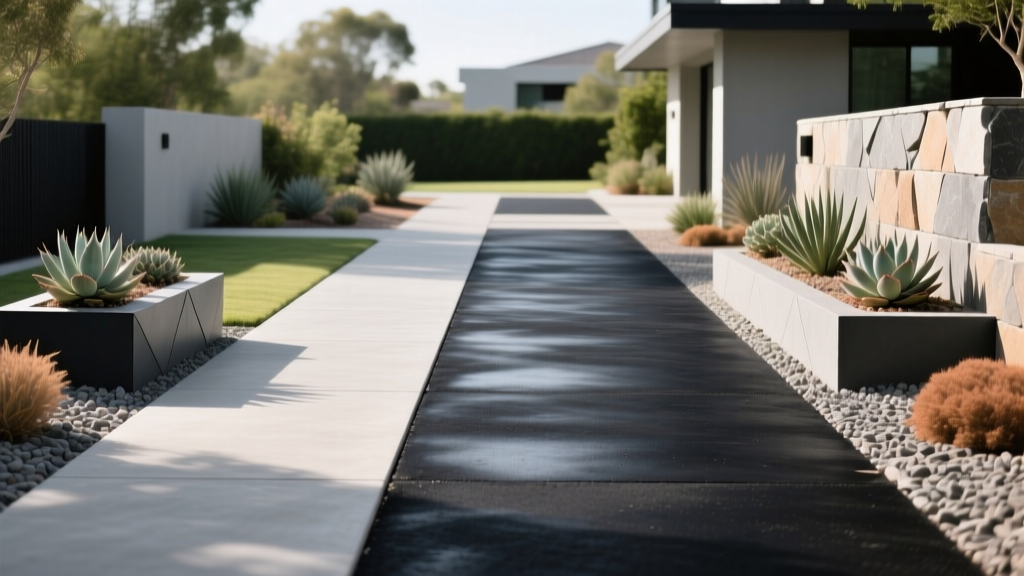
For contemporary homes emphasizing clean lines and sustainable microclimates, concrete dominates. Broom-finished, exposed aggregate, or stamped concrete can be integrally colored to match architectural facades. Furthermore, concrete's high albedo (solar reflectance) reduces the urban heat island effect. A blacktop driveway absorbs up to 95% of UV radiation, radiating heat back into the home's envelope and increasing summer cooling loads by up to 15% in adjacent rooms.
The Great Equalizer: Subgrade Preparation
Neither material will survive a poor foundation. According to the Asphalt Institute and the American Concrete Institute, 80% of driveway failures stem from inadequate base preparation. Both applications require a minimum 4-to-6-inch layer of compacted Aggregate Base Course (ABC) or crushed angular gravel. If your soil has high clay content, a geotextile fabric separator must be laid before the gravel to prevent clay migration and subsequent subsidence.
2026 Cost & Lifecycle Matrix
Pricing reflects national averages for 2026, accounting for recent fluctuations in cement kiln energy costs and petroleum-derived bitumen pricing. Costs assume standard site preparation and a 4-inch gravel base.
| Metric | Concrete Driveway | Blacktop (Asphalt) Driveway |
|---|---|---|
| Initial Installed Cost | $9.00 – $16.00 / sq. ft. | $5.00 – $10.00 / sq. ft. |
| Expected Lifespan | 30 – 50 Years | 15 – 25 Years |
| Routine Maintenance | Joint sealing every 3-5 years | Sealcoating every 2-3 years |
| Curing / Drive Time | 7 days for vehicles | 3 – 5 days for vehicles |
| Resale Value Impact | High (Premium aesthetic) | Neutral (Expected baseline) |
Failure Modes and Edge Cases
Understanding how these materials fail allows you to mitigate risks during the specification phase.
Concrete Failure Modes
- Improper Jointing: Concrete will crack; the goal is to force it to crack in straight lines. Control joints must be cut to a depth of 1/4 the slab thickness (1 inch for a 4-inch slab) and spaced no more than 10 to 12 feet apart. Skipping this results in random, jagged map-cracking.
- Deicer Scaling: Using calcium chloride or magnesium chloride-based ice melts on concrete less than two years old will cause severe surface spalling. Only use calcium magnesium acetate (CMA) or plain sand for traction on new pours.
- Alkali-Silica Reaction (ASR): If the local aggregate contains reactive silica, it can swell and crack the concrete from the inside out. Specify low-alkali cement (ASTM C150 Type II) if building in regions with known reactive aggregates.
Blacktop Failure Modes
- UV Oxidation and Raveling: Sunlight oxidizes the bitumen binder, turning it brittle and gray. This leads to raveling, where the surface aggregate loosens and washes away. Biannual sealcoating is non-negotiable to prevent this.
- Edge Raveling: Asphalt lacks lateral structural support. If the edges of a blacktop driveway are not backed by soil or concrete curbing, vehicle tires driving near the edge will snap the asphalt off in chunks.
- Tree Root Heaving: While flexible, asphalt cannot accommodate the upward thrust of mature tree roots. Plant shade trees at least 15 feet from the driveway edge, or install deep root barriers.
According to the Portland Cement Association, properly proportioned and cured concrete actually gains strength over its first 28 days, but continues to hydrate and harden for years. Asphalt, conversely, begins degrading the moment it is exposed to oxygen and UV light.
The Decision Framework: Which Should You Pour?
Use this actionable framework to finalize your material selection based on your specific property constraints.
- Choose Concrete If: You are parking heavy RVs, trailers, or commercial work trucks; your driveway is relatively flat or moderately sloped; you prioritize long-term lifecycle costs over initial capital expenditure; or you want to integrate decorative elements like exposed aggregate or stamped borders to boost curb appeal.
- Choose Blacktop If: Your budget is strictly capped at the lower end of the spectrum; your driveway features extreme slopes or complex, sweeping curves (asphalt handles curves without the need for complex forming); you live in a region with deep frost lines and highly expansive clay soils where rigid slabs would inevitably fracture.
Ultimately, the concrete vs blacktop driveway debate is resolved not by asking which material is universally 'better,' but by aligning the material's physical properties with your site's topography, load requirements, and long-term maintenance tolerance.
Written by
James ThorntonJames Thornton is a construction industry veteran with 25 years of hands-on experience in wood framing, lumber grading, and residential building codes. He started as a framing carpenter in rural Oregon, earned his ICC Residential Building Inspector certification, and eventually became a senior plan reviewer for the City of Portland Bureau of Development Services. James holds a B.S. in Wood Science & Technology from Oregon State University and is a certified lumber grader through the West Coast Lumber Inspection Bureau (WCLIB). He has inspected over 3,000 residential construction sites and authored the city's internal guide on advanced framing techniques (2x6 at 24" O.C.). James lives in Bend, OR, where he builds custom timber-frame cabins and competes in lumberjack sports.
More from James Thornton
View all
Insulation
Best Home Insulation Materials: Complete 2026 Guide
Compare top home insulation materials for 2026. Find R-values, installed costs per square foot, and best uses for fiberglass, spray foam, and mineral wool.
Aug 4, 2026

Sustainable Building
Certify Your Green Building Material for LEED and WELL
Step-by-step guide to certifying a green building material for LEED v5 and WELL v2. Master EPDs, HPDs, and VOC limits for 2026 project specifications.
Aug 4, 2026

Stone & Masonry
Veneer Stacked Stone Panels: Interior Design & Style Showcase
Discover how veneer stacked stone panels transform interiors. Explore modern design profiles, material pairings, and technical installation specs.
Aug 4, 2026