Concrete vs Fiberglass Pool: Structural Application Showcase
Explore the structural differences in a concrete vs fiberglass pool application showcase, comparing installation timelines, costs, and long-term durability.

The Structural Foundation: Gunite vs. Molded Shells
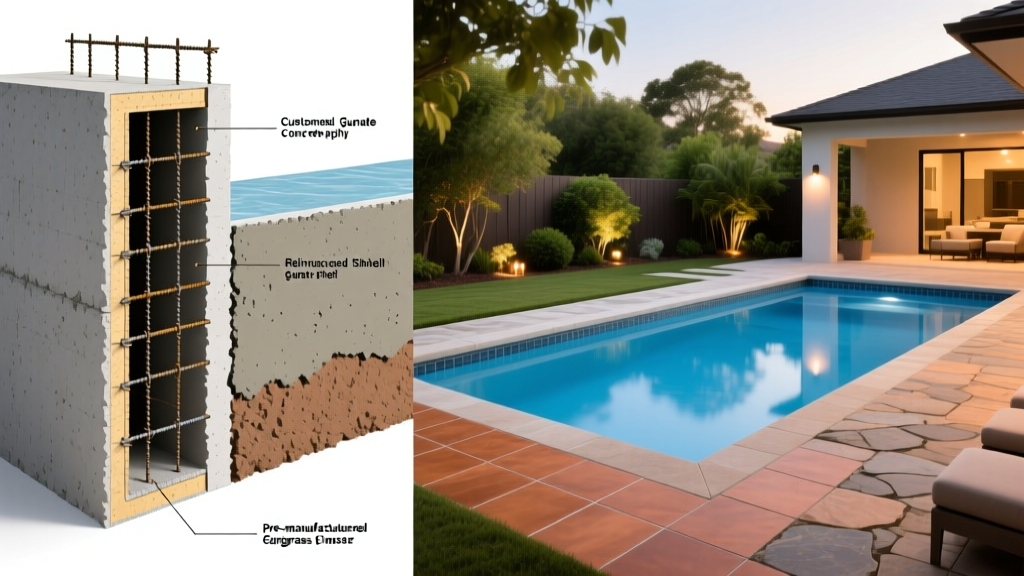
When evaluating a concrete vs fiberglass pool installation, the fundamental divergence lies in structural engineering versus logistical execution. A shotcrete (gunite) pool is a site-built, monolithic concrete structure engineered to withstand specific soil loads and hydrostatic pressures. In contrast, a fiberglass pool is a pre-manufactured, flexible shell that relies entirely on its surrounding backfill for structural support.
Concrete Shell Engineering
A standard structural concrete pool shell utilizes a 4,000 PSI shotcrete mix with a 3/8-inch maximum aggregate size. The application requires a nominal thickness of 8 inches to 12 inches, reinforced with a continuous grid of #4 (1/2-inch) steel rebar spaced at 10-inch to 12-inch centers on center. According to guidelines from the American Shotcrete Association, the pneumatic projection of the concrete at high velocity ensures a low water-cement ratio, resulting in high compressive strength and minimal rebound when applied by certified nozzlemen.
Fiberglass Shell Composition
Fiberglass pools are constructed using a layered composite process. The structural integrity comes from a combination of a 0.020-inch to 0.030-inch gelcoat surface, chopped strand mat, woven roving, and polyester or vinyl ester resin. While fiberglass boasts high tensile strength and flexural modulus, it lacks the compressive mass of concrete. It must be supported by a highly specific backfill material to prevent deflection or catastrophic structural failure under hydrostatic pressure.
Application Showcase: Step-by-Step Installation Timelines
The installation methodology drastically alters the project timeline and site disruption footprint.
Concrete Application Sequence
- Excavation and Rough Plumbing (Weeks 1-2): Over-digging by 6 to 12 inches to accommodate a gravel base and structural grade beams.
- Steel Reinforcement (Week 3): Tying the rebar cage and installing structural bond beams per engineering specs.
- Shotcrete Application (Week 4): Pneumatic projection of the concrete shell. This is followed by a mandatory 28-day curing period to reach full design strength.
- Coping, Tile, and Decking (Weeks 8-10): Installing perimeter coping and waterline tile.
- Interior Finish and Startup (Weeks 11-12): Application of quartz or pebble aggregate finishes, followed by a strict 28-day water chemistry balancing startup protocol.
Fiberglass Application Sequence
- Excavation and Base Prep (Weeks 1-2): Precision excavation using laser levels, followed by a 4-inch to 6-inch bed of clean, crushed gravel.
- Crane Set and Plumbing (Week 3): Lifting the shell into the excavation and connecting pre-plumbed suction and return lines.
- Synchronized Backfill and Fill (Week 4): The critical phase. Clean 3/8-inch chip gravel is backfilled around the shell simultaneously as the pool is filled with water. This maintains equalized hydrostatic pressure on the shell walls to prevent inward bowing.
Cost Matrix and Long-Term Financial Breakdown
Initial installation costs are only one facet of the financial equation. The 2026 pricing landscape reflects increased material costs for both steel reinforcement and petroleum-based resins.
| Cost Category | Structural Concrete (Gunite) | Pre-Manufactured Fiberglass |
|---|---|---|
| Initial Installation (Avg 14x28 ft) | $95,000 - $140,000 | $75,000 - $105,000 |
| 10-Year Chemical & Maintenance | $4,500 - $6,000 | $2,000 - $3,500 |
| Resurfacing / Refinishing Cost | $12,000 - $18,000 (at year 15-20) | $8,000 - $12,000 (Gelcoat repair at year 20+) |
| Lifetime Expectancy (Shell) | 50+ Years | 25 - 40 Years |
Edge Cases and Site-Specific Failures
Choosing between materials requires a geotechnical assessment of the build site. The American Concrete Institute (ACI) provides extensive frameworks for building in expansive soils, which directly impacts pool shell selection.
Expansive Clay Soils and High Water Tables
In regions with highly expansive clay soils (such as parts of Texas and Colorado), the soil exerts immense lateral and upward pressure when wet. A concrete pool can be structurally engineered to resist this by incorporating deep structural grade beams, thicker shell cross-sections, and specialized void forms beneath the floor slab.
Custom Geometry and Infinity Edges
Concrete is infinitely malleable. Vanishing edges, negative edge catch basins, and integrated structural spas require the monolithic continuity of reinforced shotcrete. Fiberglass is restricted to the molds available from the manufacturer, making true custom architectural integration impossible without awkward secondary concrete forming.
Surface Finishes and Material Degradation
The interior surface of the pool dictates both the aesthetic application and the long-term chemical maintenance required to prevent material degradation.
Concrete: Plaster, Quartz, and Pebble Aggregates
Modern concrete pools rarely use standard white marcite plaster. The industry standard is exposed pebble aggregate (e.g., PebbleTec or Wet Edge). These finishes embed smooth river pebbles into a Portland cement binder.
- Failure Mode: If the concrete shell is not properly hydrated during the 28-day cure, or if the plaster is troweled too late, the surface can delaminate or suffer from calcium leaching (efflorescence).
- Maintenance: Requires strict pH management (7.2 - 7.6) to prevent the water from becoming aggressive and dissolving the cementitious binder.
Fiberglass: Gelcoat and Osmotic Blistering
The gelcoat surface of a fiberglass pool is non-porous, which inhibits algae growth and reduces chemical consumption by up to 40% compared to concrete.
- Failure Mode: Prolonged exposure to low pH water (below 7.0) or high chlorine concentrations can degrade the gelcoat, leading to 'cobalt spotting' or osmotic blistering, where water molecules penetrate the gelcoat and react with the underlying fiberglass resin.
- Maintenance: While chemically easier day-to-day, repairing a faded or blistered gelcoat requires specialized composite technicians, unlike concrete replastering which is widely available.
Final Verdict: Matching Material to Site Conditions
The decision between concrete and fiberglass is not merely aesthetic; it is a structural and logistical calculation.
Specify a Concrete (Shotcrete) Application When:
- The site features expansive soils, high water tables, or steep topographical slopes requiring engineered retaining structures.
- The architectural design demands custom geometric shapes, vanishing edges, or integrated structural features.
- The project timeline is flexible, and the budget accommodates a 50-year structural lifecycle.
Specify a Fiberglass Application When:
- The site features stable, well-draining soils (sandy or loamy) with a low water table.
- Crane access is unobstructed, allowing for a single-day shell set.
- The client prioritizes a rapid installation timeline and lower weekly chemical maintenance over custom architectural integration.
By aligning the material properties with the specific geotechnical and architectural demands of the site, builders can ensure structural longevity and prevent costly post-installation remediation.
Written by
Marcus ChenMarcus Chen is a licensed structural engineer (PE) and building materials analyst with over 12 years of experience across residential, commercial, and industrial construction. He holds a Master of Science in Civil Engineering from UC Berkeley and spent six years at Thornton Tomasetti before transitioning to independent consulting and technical writing. Marcus specializes in material selection for seismic-prone regions, concrete reinforcement strategies, and lifecycle cost analysis. His work has been cited by the American Concrete Institute (ACI) and the Structural Engineers Association of California (SEAOC). When he is not on a job site or at his desk, you will find him hiking the Sierra Nevada or restoring a 1920s craftsman bungalow in Oakland, CA.
More from Marcus Chen
View all
Construction Cost
How Much Did the Eiffel Tower Cost to Build?
How much did the Eiffel Tower cost to build in 1889? We adjust for inflation and compare its budget to modern skyscraper construction.
Aug 4, 2026

Fire Resistance
What Is a Fire Resistant Material? Testing & Certification Guide
Discover what is a fire resistant material through ASTM and UL testing. Learn how fire ratings, certifications, and assemblies work in construction.
Aug 4, 2026

Construction Cost
How Much Did the Burj Khalifa Cost to Build?
How much did the Burj Khalifa cost to build? We break down the $1.5B project and extract 5 money-saving strategies for your next build.
Jul 30, 2026