Top Types of Driveway Concrete Compared to Pavers & Asphalt
Compare the best types of driveway concrete against asphalt and pavers. Explore costs, durability, and maintenance to choose the right material.

The Core Types of Driveway Concrete Explained
Selecting a driveway material requires balancing structural load capacity, climate resilience, and aesthetic preferences. While standard gray concrete remains the baseline, modern admixtures and finishing techniques have expanded the functional capabilities of cementitious driveways. Below is a technical breakdown of the primary concrete variations used in residential and light-commercial applications.
Standard Broom Finish (Plain Gray)
The industry standard for vehicular traffic. A broom finish is achieved by dragging a stiff-bristled push broom across the freshly screeded surface. This creates microscopic ridges that provide a high coefficient of friction, essential for wet or icy conditions. Standard mixes utilize a 4,000 PSI compressive strength and a maximum water-cement (w/c) ratio of 0.45 to minimize shrinkage cracking and ensure long-term durability.
Stamped and Decorative Concrete
Stamped concrete utilizes polyurethane mats to imprint patterns (such as slate, cobblestone, or wood plank) into the surface before it fully sets. Color is introduced via integral pigments in the mix or dry-shake color hardeners applied to the surface. Crucial specification: Stamped driveways require a high-quality solvent-based acrylic or polyurethane sealer applied every 2 to 3 years to prevent UV fading and protect the release agents from washing out.
Exposed Aggregate
This finish exposes the underlying stone (aggregate) by applying a chemical surface retarder immediately after placement, which delays the setting of the top cement paste. The next day, the surface is power-washed away. The result is a highly textured, slip-resistant surface that excels in steep-gradient driveways. It typically costs 20-30% more than a broom finish due to the specialized labor and precise timing required during the wash-off phase.
Permeable (Pervious) Concrete
Engineered with a high void content (typically 15% to 25%), permeable concrete allows stormwater to pass directly through the slab into a gravel subbase reservoir. According to the EPA's green infrastructure guidelines, this significantly reduces local runoff and filters pollutants. However, it requires a specialized low-slump mix and cannot handle heavy point-loads (like trailer jacks or car ramps) without surface raveling.
Concrete vs. The Alternatives: Asphalt, Pavers, and Gravel
To make an informed capital expenditure decision, concrete must be evaluated against its primary competitors. Each material behaves differently under thermal stress, UV exposure, and vehicular shear forces.
Asphalt (Bituminous Pavement)
Asphalt is a flexible pavement composed of stone aggregate bound by petroleum-based bitumen. It is typically 30% to 50% cheaper to install than standard concrete. However, asphalt is highly susceptible to thermal softening; in sustained temperatures above 90°F, heavy vehicles can cause permanent rutting. Furthermore, UV oxidation causes the binder to become brittle over time, necessitating sealcoating every 3 to 5 years. For deeper technical specifications on asphalt binders, the Asphalt Institute provides extensive resources on Performance Graded (PG) binders.
Interlocking Concrete Pavers
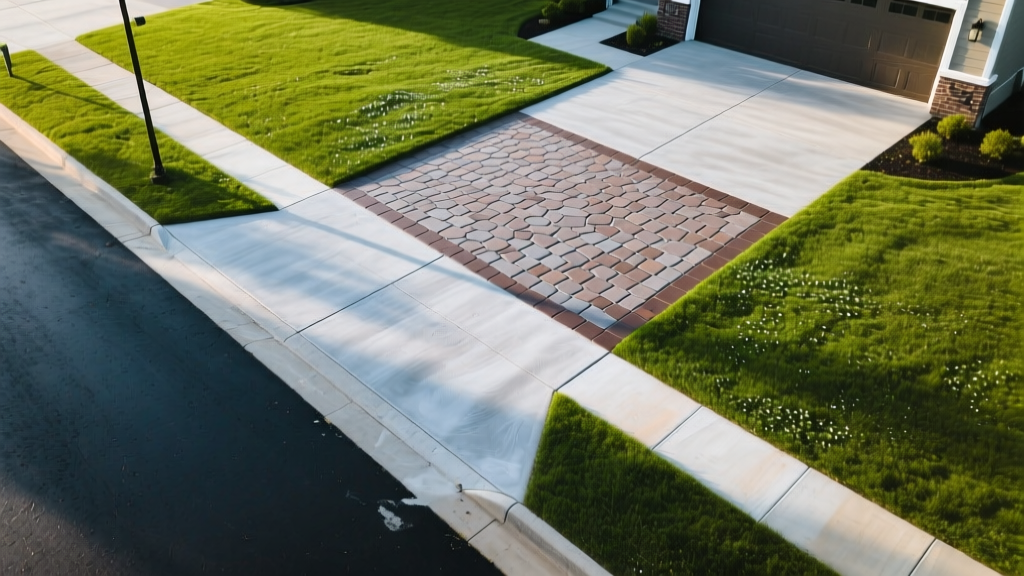
Pavers are individual concrete units laid over a compacted base and a 1-inch bedding layer of coarse sand. Their primary advantage is flexibility; they shift slightly with frost heave and settling without cracking. If a section fails or becomes stained by oil, individual pavers can be lifted and replaced. The drawback is the joint sand, which can wash out or foster weed growth unless stabilized with high-grade polymeric sand and proper edge restraints.
Crushed Gravel
The most economical option, gravel requires a deep subbase and constant maintenance. Vehicle tires displace the aggregate, leading to rutting, potholes, and the need for annual re-grading and top-dressing. It is generally only recommended for long, rural driveways where paving costs are prohibitive.
Material Showdown: Decision Matrix
| Metric | Standard Concrete | Stamped Concrete | Asphalt | Concrete Pavers |
|---|---|---|---|---|
| Initial Cost (per sq. ft.) | $8 - $12 | $14 - $22 | $5 - $8 | $15 - $25 |
| Expected Lifespan | 30 - 40+ Years | 25 - 35 Years | 15 - 20 Years | 30 - 50+ Years |
| Maintenance Frequency | Low (Seal every 5 yrs) | High (Seal every 2-3 yrs) | Med (Seal every 3-5 yrs) | Med (Re-sand joints) |
| Load Bearing Capacity | Excellent | Excellent | Good (Prone to rutting) | Very Good |
| Winter Durability | Good (If air-entrained) | Poor (Salt damages sealer) | Excellent (Dark color melts snow) | Good (Flexible) |
Structural Specifications for a Lasting Concrete Driveway
The longevity of any concrete driveway is dictated by what happens below the surface. A flawless finish will fail in three years if the subgrade is poorly engineered. The National Ready Mixed Concrete Association (NRMCA) emphasizes that proper subbase preparation and mix design are non-negotiable for vehicular pavements.
The Subgrade and Subbase
The native soil (subgrade) must be uniformly compacted to prevent differential settling. Over this, a 4-inch to 6-inch layer of Aggregate Base Course (ABC)—typically crushed angular stone—must be laid and mechanically compacted. This layer provides drainage and distributes the vehicular load. Pouring concrete directly on soft clay or topsoil guarantees transverse cracking.
Slab Thickness and Reinforcement
- Standard Passenger Vehicles: 4-inch minimum slab thickness.
- Heavy Trucks/RVs/Boats: 5-inch to 6-inch slab thickness.
- Reinforcement: Welded wire mesh (6x6 W1.4xW1.4) or fiber-reinforced concrete (synthetic macro-fibers at 3 to 5 lbs per cubic yard) is required to hold micro-cracks tightly together. Rebar (#4 bars at 24-inch centers) is recommended for driveways with poor subgrades or heavy commercial loads.
Jointing and Curing
Concrete shrinks as it hydrates. To control where it cracks, control joints must be saw-cut or tooled at intervals no greater than 10 feet (or 1.5 times the slab width in feet). The depth of the cut must be exactly 25% of the slab thickness. After finishing, the slab must be cured using a membrane-forming curing compound or continuous wet curing for a minimum of 7 days to achieve full design strength and prevent plastic shrinkage cracks.
Climate and Site-Specific Decision Framework
Choosing between these materials often comes down to your specific micro-climate and site topography.
- Hot, Arid Climates (Southwest US): Concrete is the superior choice. Asphalt will soften, track into the house, and require frequent sealcoating due to intense UV degradation.
- Cold, Snowy Climates (Northeast/Midwest): Asphalt's dark color aids in snow melt, and its flexibility handles frost heave better than rigid concrete. If choosing concrete, exposed aggregate provides superior ice-traction, but you must commit to using safe deicing chemicals.
- Steep Gradients: Standard broom-finished concrete or exposed aggregate are mandatory. Asphalt can become slippery when wet on steep inclines, and pavers risk sliding if edge restraints fail under the downward shear force of vehicles braking.
- Eco-Sensitive Zones / High Water Tables: Permeable concrete or gravel with a geotextile fabric underlayment are required to manage stormwater runoff and prevent localized flooding.
Written by
Sarah WhitfieldSarah Whitfield is a chartered quantity surveyor (MRICS) and construction cost analyst with 15 years of experience in material pricing, procurement strategy, and project budgeting. She earned her degree in Construction Management from the University of Reading (UK) and has worked on projects ranging from $2M custom homes to $180M mixed-use developments across North America and Europe. Sarah currently leads cost estimating for BuildMat Insight, maintaining a proprietary database of 4,000+ material price points updated quarterly. She is a frequent contributor to RSMeans cost data panels and has presented at the International Cost Engineering Council (ICEC) congress. Based in Denver, CO, Sarah is an avid trail runner and volunteer mentor for Women in Construction.
More from Sarah Whitfield
View all
Wood & Lumber
What Are the Different Types of Wood? A Builder's Guide
Compare structural softwoods, finish hardwoods, and engineered lumber. Analyze Janka ratings, MOE values, and 2026 pricing for construction.
Aug 4, 2026

Walls & Panels
Steel Framing vs Wood Framing: Corrosion and Moisture Defense
Compare steel framing vs wood framing for moisture resistance. Learn about galvanized coatings, condensation risks, and corrosion protection strategies.
Jul 21, 2026

Stone & Masonry
How to Cut Stone Veneer: Wet Saw vs Grinder Comparison
Compare the best tools for cutting stone veneer. We review wet saws, angle grinders, and chop saws to help you achieve clean, chip-free cuts.
Jul 21, 2026