Best Products for Concrete Spalling Repair in 2026
Compare top polymer-modified mortars for concrete spalling repair in 2026. Deep dive into Sika, MAPEI, and Euclid specs, costs, and application protocols.
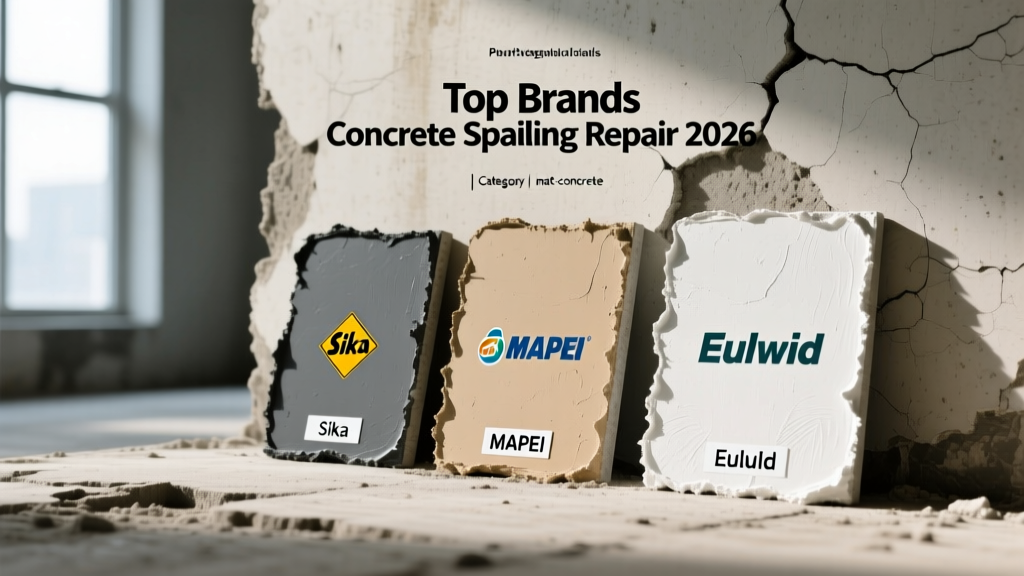
The Mechanics of Spalling and the 2026 Repair Market
Concrete spalling—the flaking, peeling, or chipping of the concrete surface—is rarely just a cosmetic issue. It is a structural symptom driven by freeze-thaw cycling, chloride-induced rebar corrosion, or improper finishing practices. When the substrate fails, standard patching compounds will inevitably crack and delaminate. Effective concrete spalling repair requires polymer-modified, shrinkage-compensated structural mortars designed to match the thermal expansion and compressive modulus of the host concrete.
In 2026, the market for structural repair mortars has consolidated around high-performance, single-component (1K) and two-component (2K) polymer-modified systems. Below is a deep-dive analysis of the top four product lines dominating commercial and high-end residential spalling repair.
Brand Deep-Dive: Top 4 Repair Mortars
1. Sika MonoTop-612 (The Heavy-Duty Standard)
Sika’s MonoTop-612 remains the benchmark for vertical and overhead concrete spalling repair. It is a one-component, polymer-modified, high-build structural mortar reinforced with silica fume.
- Compressive Strength: 6,000 psi at 28 days (ASTM C109).
- Max Thickness per Lift: 2 inches (vertical/overhead) without formwork.
- Working Time: 30 minutes at 70°F.
- 2026 Pricing: $55 - $62 per 55 lb bag.
Best Use Case: Deep spalls on bridge abutments, retaining walls, and structural columns where high-build thickness is required to encapsulate exposed rebar. The silica fume density drastically reduces chloride permeability, making it ideal for marine or de-icing salt environments.
2. MAPEI Planitop XS (The Rapid-Return Specialist)
When downtime is measured in dollars, MAPEI Planitop XS is the go-to specification. It is a fast-setting, shrinkage-compensated, polymer-modified mortar that allows for pedestrian traffic in just 2 hours and vehicular traffic in 12 hours.
- Compressive Strength: 6,500 psi at 28 days; achieves 2,500 psi in just 3 hours.
- Max Thickness per Lift: 1.5 inches.
- Working Time: 15 minutes (requires precise batch sizing and immediate placement).
- 2026 Pricing: $52 - $58 per 50 lb bag.
Best Use Case: Commercial loading docks, warehouse floors, and municipal stairwells where rapid return-to-service is critical. The 15-minute pot life demands experienced crews; it is not forgiving for DIY applications.
3. Euclid Chemical EucoRepair 300 (The Cold-Weather Warrior)
EucoRepair 300 is engineered specifically for challenging environmental conditions. Its proprietary cementitious blend allows for application at temperatures as low as 40°F (4°C) without the need for external heating blankets.
- Compressive Strength: 5,500 psi at 28 days.
- Max Thickness per Lift: 2 inches.
- Working Time: 20 minutes at 70°F; extends to 35 minutes at 40°F.
- 2026 Pricing: $60 - $68 per 50 lb bag.
Best Use Case: Late-season infrastructure repairs, parking garage restorations in northern climates, and unheated subterranean structures. The extended working time in cold weather prevents premature flash-setting.
4. Quikrete Polymer Modified Structural Repair (The Prosumer Choice)
While Sika and MAPEI dominate commercial specs, Quikrete’s Polymer Modified line bridges the gap for residential contractors and advanced DIYers. It offers excellent bond strength without the premium price tag of commercial 2K epoxy systems.
- Compressive Strength: 5,000 psi at 28 days.
- Max Thickness per Lift: 1 inch.
- Working Time: 20 minutes.
- 2026 Pricing: $26 - $32 per 20 lb bucket.
Best Use Case: Residential driveway edges, spalled patio slabs, and minor foundation parging. The 1-inch max lift limitation makes it unsuitable for deep structural beam repairs, but it is highly cost-effective for surface-level scaling.
Head-to-Head Comparison Matrix
| Product | 28-Day PSI | Max Lift | Set Time | Cost / Unit |
|---|---|---|---|---|
| Sika MonoTop-612 | 6,000 | 2.0 in | 30 min | ~$58 / 55lb |
| MAPEI Planitop XS | 6,500 | 1.5 in | 15 min | ~$55 / 50lb |
| EucoRepair 300 | 5,500 | 2.0 in | 20 min | ~$64 / 50lb |
| Quikrete Poly-Mod | 5,000 | 1.0 in | 20 min | ~$29 / 20lb |
Substrate Preparation: The ICRI Protocol
The most expensive polymer-modified mortar will fail if applied to an improperly prepared substrate. The International Concrete Repair Institute (ICRI) Guideline 310.1R mandates rigorous surface preparation to ensure mechanical interlock and chemical bond.
- Perimeter Saw-Cutting: Never feather-edge a repair. Use a diamond blade saw to cut the perimeter of the spall to a minimum depth of 1/4 inch. This creates a rigid shoulder that prevents the repair mortar from curling and delaminating at the edges.
- Concrete Removal: Chip away all unsound concrete using a pneumatic chisel. Stop when you reach solid, dense aggregate. If rebar is exposed, undercut the concrete behind the bar to allow for full encapsulation of the repair mortar.
- Rebar Passivation: If reinforcing steel is exposed and actively corroding, mechanical wire brushing is insufficient. Sandblast the rebar to bright metal, then immediately coat it with a zinc-rich or epoxy-based passivating primer (e.g., Sika Armatec 110 EpoCem) to halt the oxidation process.
- Saturated Surface Dry (SSD) Conditioning: Polymer-modified mortars require moisture from the host concrete to cure properly. Soak the repair area with clean water for 2 to 4 hours prior to mixing. Before applying the mortar, blow off all standing water with compressed air. The concrete must be dark and damp (SSD), but free of glistening puddles.
Expert Troubleshooting: Why Spalling Repairs Fail
Even with premium materials, callbacks happen. Understanding the failure modes of concrete spalling repair separates seasoned restoration contractors from general handymen.
Cause: Applying the mortar in direct sunlight or high wind without a curing compound, or exceeding the manufacturer's maximum water-to-powder ratio to make it "more workable."
Fix: Strictly adhere to the printed water ratio. Apply a breathable, water-based curing compound (like Sika Antisol) immediately after final finishing to lock in hydration.
Cause: Applying mortar to a dry substrate. The dry host concrete acts like a sponge, sucking the mixing water out of the repair mortar before the polymers can cross-link, resulting in a chalky, unbonded interface.
Fix: Always verify the SSD (Saturated Surface Dry) state. If the substrate lightens in color before placement, re-wet it immediately.
Cause: Excessively working the surface with a steel trowel after the initial set has begun. This brings excess cement paste and water to the surface, creating a weak, high-shrinkage crust that will eventually scale off.
Fix: Strike off the mortar slightly proud of the surface, then use a wood or foam float to blend the edges. Limit steel troweling to a single, light pass only when the mortar can support thumb-pressure without indentation.
Final Specification Guidance
Selecting the right product for concrete spalling repair hinges on the environmental exposure, structural load, and required return-to-service timeline. For deep, chloride-heavy structural repairs, specify Sika MonoTop-612. For high-traffic commercial floors requiring overnight turnaround, MAPEI Planitop XS is unmatched. Always pair these materials with rigorous ICRI-compliant surface preparation to ensure a permanent, monolithic bond.