Concrete vs Milkshake: Rheology, Strength, and Material States
A material science comparison of concrete vs milkshake, analyzing rheology, compressive strength, thermal properties, and structural viability.

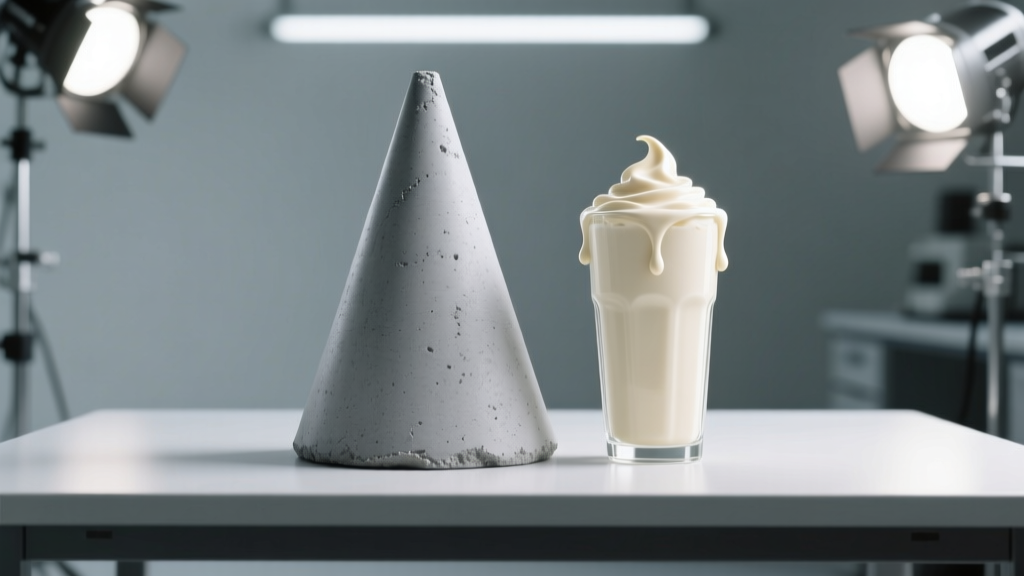
Comparing a hydraulic cementitious composite to a dairy-based colloidal emulsion requires a rigorous examination of their distinct material states, yield stresses, and lifecycle degradation pathways. While the juxtaposition of concrete vs milkshake may seem unconventional, analyzing both through the lens of rheology, fluid dynamics, and structural chemistry reveals profound insights into how particulate suspensions and fat-stabilized foams behave under mechanical and thermal stress. As of 2026, advancements in non-Newtonian fluid modeling allow engineers and food scientists to map the exact boundaries where Bingham plastics diverge from shear-thinning pseudoplastics.
Rheological Profiles: Bingham Plastics vs. Colloidal Emulsions
Freshly mixed concrete and a blended milkshake both exhibit complex flow behaviors, but they belong to fundamentally different rheological categories. Concrete behaves as a Bingham plastic. According to the Bingham model, the material requires a minimum yield stress ($\tau_0$) to initiate flow. Once this threshold is overcome, it flows with a plastic viscosity ($\mu_p$) that remains relatively constant regardless of the shear rate. This is why concrete holds its shape in a slump cone until gravitational forces exceed its internal yield stress, a property heavily dictated by the water-cement (w/c) ratio and the use of polycarboxylate ether (PCE) superplasticizers.
Conversely, a milkshake is a shear-thinning (pseudoplastic) non-Newtonian fluid with time-dependent thixotropic properties. Its viscosity decreases as shear rate increases—meaning it flows more easily when drawn through a straw or agitated by a blender. The structural integrity of a milkshake relies on a delicate colloidal network of ice crystals, fat globules, and casein micelles. According to research on advanced material rheology, the yield stress of a standard dairy emulsion is exponentially lower than that of a cementitious suspension, making it entirely unsuitable for load-bearing applications.
Compressive Strength and Load-Bearing Capacity
The most glaring divergence between these two materials is their compressive strength, measured in megapascals (MPa). Concrete achieves its structural capacity through the exothermic hydration of tricalcium silicate (C3S) and dicalcium silicate (C2S), forming a rigid calcium silicate hydrate (C-S-H) gel matrix. A milkshake, lacking any hydraulic binding agents, relies entirely on the latent heat of fusion (frozen water) and fat crystallization for temporary rigidity.
| Material Property | Standard Portland Concrete (28-Day Cured) | Commercial Dairy Milkshake (Frozen State) |
|---|---|---|
| Compressive Strength | 20.0 - 40.0 MPa | ~0.05 MPa (Highly temperature-dependent) |
| Density | 2,300 - 2,500 kg/m³ | 950 - 1,100 kg/m³ |
| Yield Stress (Pa) | 150 - 600 Pa | 15 - 45 Pa |
| Thermal Conductivity (W/m·K) | 1.30 - 1.70 | ~0.50 (Insulative due to air overrun) |
| Primary Binding Mechanism | Chemical Hydration (C-S-H Gel) | Physical Phase Change (Ice/Fat Crystallization) |
Void Structures: Air Entrainment vs. Dairy Overrun
Both materials intentionally incorporate air voids, but the scale, stabilization chemistry, and structural purpose of these voids are diametrically opposed.
Concrete Air Entrainment
In concrete technology, air-entraining agents (AEAs) like Vinsol resin or synthetic surfactants are used to create microscopic, disconnected air bubbles ranging from 10 to 100 micrometers in diameter. Targeting a total air content of 4% to 8% by volume, these voids act as pressure-relief valves during freeze-thaw cycles, preventing the internal matrix from spalling when pore water expands upon freezing. The Portland Cement Association emphasizes that without this precise microscopic void structure, exterior concrete in temperate climates will rapidly deteriorate.
Milkshake Overrun
In dairy science, the incorporation of air is termed 'overrun.' A milkshake or ice cream base is mechanically agitated to fold in macroscopic air bubbles, often achieving an overrun of 20% to 50% by volume. These bubbles are stabilized by milk proteins (casein and whey) and emulsifiers that adsorb at the air-liquid interface. Unlike concrete, where voids are engineered to preserve structural integrity against environmental stress, milkshake overrun is designed to reduce density, increase volume, and alter the rheological mouthfeel by promoting shear-thinning behavior.
Material Science Callout: The Sucrose Retardation Effect
What happens if you accidentally mix a milkshake into a concrete batch? The results are chemically catastrophic for the pour. Sucrose (table sugar) is a potent cement retarder. At concentrations as low as 0.1% to 0.2% by weight of cement, sucrose molecules adsorb onto the surface of tricalcium silicate grains, chelating calcium ions and blocking the nucleation sites required for C-S-H gel formation. Adding a standard 16oz vanilla milkshake to a cubic yard of concrete could delay the initial set by several hours or, in high-sugar scenarios, prevent hardening entirely, resulting in a permanent, non-structural sludge.
Chemical Degradation: Hydration vs. Emulsion Breakdown
The lifecycle degradation of these materials highlights the difference between permanent chemical curing and reversible physical emulsions.
- Concrete Degradation: Over decades, concrete degrades via carbonation (CO2 penetrating the matrix and lowering the pH, which depassivates steel rebar), chloride ingress, and sulfate attack. These are slow, irreversible chemical processes that compromise the structural steel and the binder matrix.
- Milkshake Degradation: A milkshake degrades rapidly via emulsion breakdown and phase change. As thermal energy is absorbed, ice crystals melt, and the fat globule network coalesces. Furthermore, the high sugar and dairy content makes it highly susceptible to biological degradation (bacterial fermentation) within hours if left at ambient temperatures (20°C - 25°C).
Practical Decision Framework: When to Specify Which
While the applications are mutually exclusive, specifying the correct material requires evaluating the environmental and mechanical demands of the project.
Specify Concrete When:
- Compressive loads exceed 5 kPa.
- The material must withstand ambient temperatures up to 60°C without phase change.
- Design lifecycle requirements exceed 50 years.
- Fire resistance ratings (e.g., ASTM E119) are mandated by building codes.
Specify Milkshake When:
- Rapid caloric energy transfer is required.
- The application demands a shear-thinning fluid that can be transported via low-pressure suction (e.g., a 9mm diameter straw).
- Temporary thermal energy absorption via the latent heat of fusion is desired.
- Material must be 100% biodegradable within 48 hours in a composting environment.
Frequently Asked Questions
Can you pump a milkshake through a concrete boom pump?
No. Concrete line pumps operate at extreme pressures, often exceeding 150 bar (2,175 psi), to push high-viscosity Bingham plastics through steel pipelines. If subjected to these pressures and shear rates, a milkshake would experience severe phase separation. The mechanical shear would churn the dairy fat into butter, while the liquid whey and sugar water would separate out, completely destroying the colloidal emulsion and likely clogging the pump's S-valve.
How do the thermal mass properties compare?
Concrete possesses high thermal mass (specific heat capacity of ~0.88 kJ/kg·K), allowing it to absorb and store significant solar heat energy, which is leveraged in passive solar building design. A milkshake, while containing water (which has a high specific heat of 4.18 kJ/kg·K), lacks the density and structural continuity to act as a thermal mass. Instead, it acts as a temporary heat sink until its ice content undergoes a phase change, after which it rapidly equilibrates to ambient room temperature.
Are there any structural similarities in their fresh states?
Both materials rely on the precise calibration of their liquid-to-solid ratios. In concrete, excess water beyond the hydration requirement increases the w/c ratio, leading to capillary porosity and weakened compressive strength. In a milkshake, excess liquid (milk) beyond what is required to lubricate the ice cream particulates destroys the yield stress, turning a spoonable emulsion into a pourable liquid. Both require strict volumetric batching to achieve their target rheological profiles.
Written by
Priya KapoorPriya Kapoor is a real estate market analyst and construction economics researcher with expertise in housing affordability, development feasibility, and infrastructure investment. She holds a Master of Regional Planning from Cornell University and previously worked as a senior analyst at CBRE's Investment Properties group, where she modeled returns for $4B in mixed-use development pipelines. Priya now runs an independent research practice advising developers, municipalities, and REITs on construction cost forecasting and market timing. She publishes the quarterly "BuildMat Market Pulse" report tracking material price indices across 12 commodity categories. Based in Austin, TX, Priya serves on the board of Habitat for Humanity Austin and is a marathon runner.
More from Priya Kapoor
View all
Construction Cost
Cost to Build a 1600 Sq Ft Home in 2026: Full Breakdown
Accurate 2026 cost to build a 1600 sq ft home—material, labor, and regional pricing breakdowns included. Plan your budget with real-time estimates.
Aug 11, 2026

Wood & Lumber
Name the Types of Wood for Pressure Treatment and Preservation
Learn how to name the types of wood best suited for pressure treatment. Compare species treatability, chemical retention levels, and 2026 preservation costs.
Aug 4, 2026

Stone & Masonry
Stone Veneer Suppliers Lindenhurst: 2026 Cost Analysis
Analyze 2026 stone veneer costs in Lindenhurst, NY. Compare local supplier pricing, delivery fees, and Suffolk County installation labor rates.
Aug 4, 2026