Fibreglass Pools vs Concrete Pools: Technical Specs & Data
Compare fibreglass pools vs concrete pools using deep technical specs, structural data, curing times, and material tolerances for expert builders.

Material Matrix Composition and Tensile Yield
When evaluating fibreglass pools vs concrete pools from a structural engineering perspective, the fundamental difference lies in how each material handles tensile and compressive loads. Concrete is a brittle, high-compressive material that requires steel reinforcement to manage tension, whereas fibreglass (Fibre-Reinforced Polymer or FRP) is a flexible, high-tensile composite.
Shotcrete and Gunite Matrix Specifications
Modern concrete pool shells are constructed using pneumatically applied mortar. According to the American Shotcrete Association, dry-mix shotcrete (Gunite) typically achieves a 28-day compressive strength of 4,000 to 6,000 psi, provided the water-cement (w/c) ratio is strictly maintained between 0.40 and 0.45 at the nozzle. Wet-mix shotcrete often yields slightly higher compressive strengths (up to 7,500 psi) due to better batch control. However, concrete's inherent tensile strength is only about 10% of its compressive strength. Therefore, structural integrity relies entirely on a continuous grid of Grade 60 (60,000 psi yield strength) steel rebar, typically #3 or #4 bars spaced at 8 to 10 inches on center, as mandated by the American Concrete Institute (ACI) 350 guidelines for environmental engineering concrete structures.
Fibre-Reinforced Polymer (FRP) Laminate
Fibreglass pool shells are manufactured using a multi-layered composite matrix. The structural wall consists of chopped strand mat (CSM) and woven roving saturated in resin. In 2026, high-tier manufacturers exclusively use vinyl ester resins or advanced isophthalic polyester resins, which offer superior hydrolytic stability compared to older orthophthalic formulations. The woven roving provides directional tensile strength, yielding a laminate tensile strength ranging from 15,000 to 35,000 psi depending on the roving orientation. The shell relies on its monolithic flexibility to absorb ground movement without fracturing, eliminating the need for internal steel reinforcement.
Dimensional Tolerances and Hydrostatic Load Resistance
Geotechnical conditions dictate the structural requirements of any subterranean vessel. The following matrix outlines the baseline engineering tolerances for both materials when subjected to standard lateral earth pressures and hydrostatic uplift.
| Specification Metric | Shotcrete / Gunite Shell | Manufactured FRP Shell |
|---|---|---|
| Nominal Wall Thickness | 6 to 8 inches (150-200mm) | 3/8 to 1/2 inch (9-12mm) |
| Compressive Strength | 4,000 - 7,500 psi | 18,000 - 24,000 psi (resin matrix) |
| Tensile Yield Mechanism | Grade 60 Steel Rebar Grid | Woven Fibreglass Roving |
| Hydrostatic Uplift Resistance | High (Mass + structural floor slab) | Low (Requires engineered gravel lock) |
| Maximum Allowable Deflection | < 0.1% span | Up to 1.5% span |
Thermal Conductivity and Heat Retention Metrics
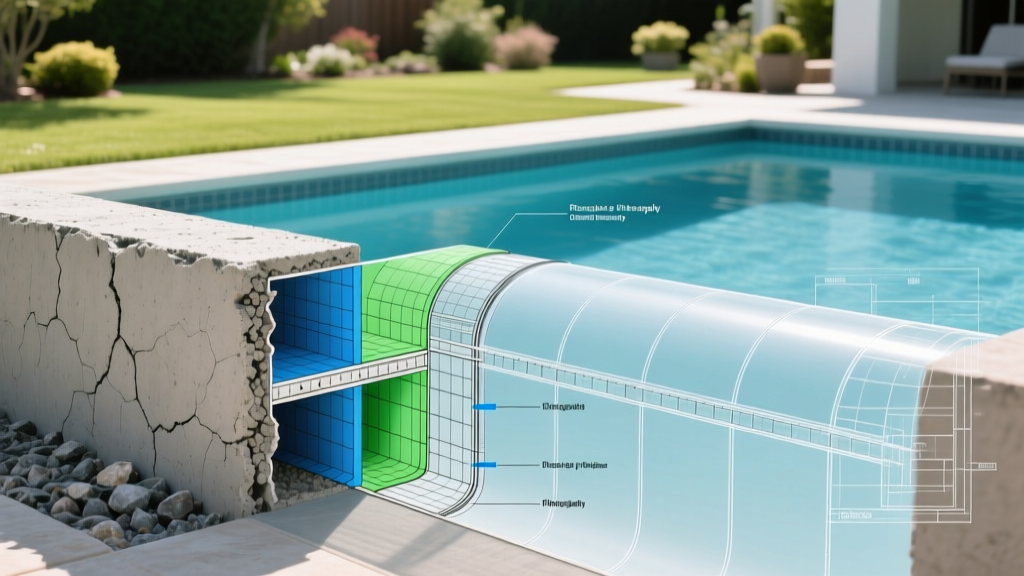
Thermodynamics play a critical role in the operational expenditure of pool heating systems. Concrete possesses high thermal mass and high thermal conductivity (approximately 1.7 W/m·K). This means a shotcrete shell acts as a massive heat sink, continuously drawing thermal energy from the water and dissipating it into the surrounding soil. During initial fill and heating, a concrete pool can lose up to 30% more BTU output to the earth compared to an insulated vessel.
Conversely, FRP laminates exhibit significantly lower thermal conductivity (approximately 0.2 to 0.4 W/m·K). The fibreglass shell acts as a mild insulator. When comparing fibreglass pools vs concrete pools in colder climates or for heated applications, the FRP shell reduces conductive heat loss to the surrounding backfill by roughly 15% to 20%. For projects requiring strict energy efficiency compliance, specifying a fibreglass shell or adding a closed-cell polyurethane spray foam coating to the exterior of a concrete shell is required to equalize the thermal envelope.
Chemical Degradation and Failure Modes
Every building material has specific environmental failure modes. Understanding these is vital for long-term structural warranties and maintenance forecasting.
Concrete: Calcium Leaching and Spalling
The primary failure mode for concrete pool shells is chemical attack from improperly balanced water. If the pool water's Langelier Saturation Index (LSI) drops below -0.3 (aggressive water), the water will leach calcium hydroxide from the cementitious matrix. This leads to surface etching, structural weakening, and eventual exposure of the steel rebar. Once the rebar is exposed to chlorides, it oxidizes, expands up to seven times its original volume, and causes catastrophic concrete spalling.
Fibreglass: Osmotic Blistering and UV Degradation
Historically, the Achilles heel of FRP pools was osmotic blistering. This occurs when water molecules permeate the gelcoat and react with unreacted styrene or water-soluble impurities in the resin matrix, creating localized high-pressure pockets that push the gelcoat outward. However, modern 2026 manufacturing standards utilizing 15-to-20-mil thick vinyl ester barrier coats and high-grade isophthalic resins have reduced osmotic blistering incidence rates to near zero. The current primary failure mode for FRP is gelcoat crazing (micro-cracking) caused by point-loads during installation or extreme, localized hydrostatic pressure from poorly compacted backfill.
"The structural longevity of any subterranean aquatic vessel is dictated less by the primary shell material and more by the geotechnical preparation and hydrostatic relief engineering implemented during the backfill phase."
— Pool & Hot Tub Alliance (PHTA) Technical Guidelines, phta.org
Installation Engineering: Excavation to Final Cure
The installation methodology drastically alters the project timeline and site engineering requirements. The curing process and backfill materials are strictly divergent between the two systems.
- Concrete Hydration Timeline: A shotcrete shell requires a continuous 28-day wet-curing period to achieve full design strength and minimize plastic shrinkage cracking. During this period, the shell must be kept moist, and backfilling is often delayed or performed in highly controlled, low-impact lifts to prevent point-loading on the green concrete.
- FRP Stabilization Timeline: A fibreglass shell arrives at the site 100% factory-cured. The structural engineering focus shifts entirely to the bedding and backfill. Manufacturers strictly mandate the use of clean, 3/8-inch crushed stone (gravel) rather than sand or native soil. The angular edges of the crushed stone lock together, creating a unified, free-draining mass that prevents hydrostatic uplift and eliminates the lateral shifting associated with saturated sand.
- Hydrostatic Relief: Both systems require hydrostatic relief valves in the main drain sump to prevent groundwater pressure from floating the empty vessel. However, because fibreglass pools are significantly lighter (often weighing 80% less than an equivalent concrete shell), the gravel backfill 'lock' and precise groundwater management are non-negotiable engineering requirements for FRP installations in areas with high seasonal water tables.
Specification Decision Matrix
Choosing between these materials requires aligning the site's geotechnical report with the architectural requirements. Use the following framework to finalize your material specification:
- Specify Shotcrete/Gunite When: The project requires a highly customized, non-standard geometric footprint (e.g., negative edge vanishing edges, complex integrated spas, or architectural infinity troughs). The site has stable, low-expansive soil with a deep water table, and the project timeline allows for a 60-to-90-day construction and curing window.
- Specify Fibreglass (FRP) When: The design fits within standard manufacturer mould dimensions (typically up to 16x40 feet). The site features highly reactive, expansive clay soils where the flexible tensile nature of FRP can absorb minor ground heave without fracturing. The client requires a rapid installation timeline (typically 3 to 6 weeks from excavation to fill) and lower long-term chemical maintenance due to the non-porous gelcoat surface.
By prioritizing structural data, thermal metrics, and geotechnical compatibility over superficial aesthetics, builders and engineers can accurately specify the optimal pool shell material for any given environment, ensuring structural longevity and minimizing lifecycle maintenance costs.
Written by
Elena RodriguezElena Rodriguez is a civil engineer and technical writer specializing in concrete technology, masonry systems, and ASTM/ACI compliance. She earned her B.S. in Civil Engineering from Texas A&M University and spent a decade at a materials testing laboratory, performing over 2,000 concrete compressive strength tests and masonry prism evaluations. Elena is an ACI-certified Field Testing Technician (Grade I) and a member of ASTM Committee C12 on Natural Building Stone. She currently consults on forensic engineering cases involving concrete failures and moisture intrusion. Based in San Antonio, TX, Elena is a proud member of the Society of Women Engineers (SWE) and coaches her daughter's FIRST Robotics team.
More from Elena Rodriguez
View all
Walls & Panels
Cost Analysis: Light Gauge Steel Framing Advantages and Disadvantages
Evaluate light gauge steel framing advantages and disadvantages through a strict cost analysis lens, comparing material, labor, and lifecycle expenses.
Aug 4, 2026

Walls & Panels
Gypsum Board Types: Exact Specifications, Thickness & Dimensions
Compare standard, Type X, and moisture-resistant gypsum board types. Get exact specifications, thicknesses, dimensions, and ASTM standards for your project.
Aug 4, 2026

Fire Resistance
Best Fire-Resistant Outdoor Decking Materials: 2026 Buyer Guide
Discover the best fire-resistant outdoor decking materials for 2026. Compare Class A PVC, aluminum, and hardwood options for WUI compliance and safety.
Aug 4, 2026