Stamped Concrete Driveway: Patterns, Mixes & Selection Guide
Select the right materials for your stamped concrete driveway. Compare mix designs, color systems, stamping tools, and sealers for durable results.
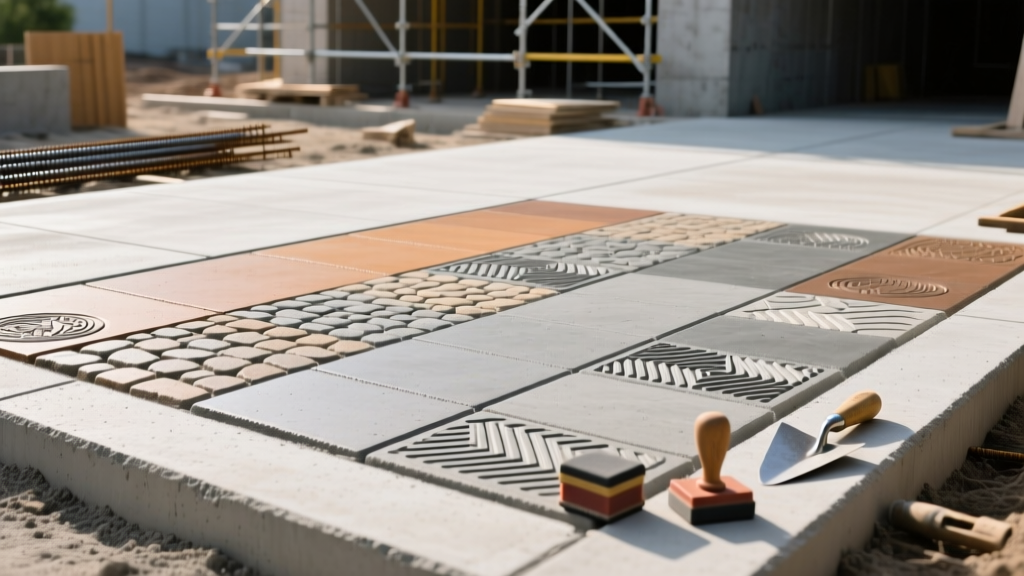
Material Taxonomy: Decoding the Stamped Concrete Driveway System
A stamped concrete driveway is not a single material, but a composite system of four distinct layers: the compacted subbase, the structural concrete matrix, the color and texture overlay, and the protective chemical sealer. Selecting the correct specifications for each layer dictates whether the driveway will withstand vehicular shear forces and freeze-thaw cycles, or succumb to cracking, delamination, and UV degradation within three years.
This guide breaks down the material taxonomy for stamped concrete systems, providing exact mix designs, chemical specifications, and selection frameworks for residential and light-commercial vehicular applications.
Concrete Mix Selection: Engineering for Vehicular Loads
The structural integrity of a stamped driveway relies entirely on the ready-mix concrete design. Decorative stamping does not add structural strength; it merely textures the surface paste. Therefore, the base mix must be engineered for high compressive strength and low permeability.
- Compressive Strength: 4,000 PSI minimum at 28 days (ASTM C39). Upgrade to 4,500 PSI for driveways supporting RVs or heavy commercial trucks.
- Slab Thickness: 4 inches minimum; 5 inches recommended for heavy-load zones.
- Aggregate Size: 3/4-inch crushed stone. Avoid pea gravel, which lacks the interlocking shear strength required for vehicular turning radii.
- Slump: 4 to 5 inches. High-slump mixes (6+ inches) cause aggregate settlement, leaving a weak, easily craze-cracked surface paste.
Air Entrainment and Freeze-Thaw Durability
In climates experiencing freezing temperatures, air-entraining admixtures (ASTM C260) are non-negotiable. These admixtures create microscopic, disconnected air bubbles (typically 5% to 7% air content by volume) that provide expansion chambers for freezing water. According to the Portland Cement Association's freeze-thaw resistance guidelines, properly air-entrained concrete prevents the internal hydraulic pressure that causes surface spalling and scaling. If your ready-mix supplier cannot guarantee strict air-content tolerances, reject the load.
Color & Texture Systems: Integral vs. Surface-Applied
The visual depth of a stamped concrete driveway is achieved through a combination of base color and antiquing release agents. The selection between integral color and dry-shake color hardeners fundamentally alters the surface durability.
| Color System | Application Method | Surface Durability | Best Use Case |
|---|---|---|---|
| Integral Color | Pigment added to the ready-mix truck at the batch plant. | Standard (same as plain concrete). | Base coats for multi-color systems; budget-friendly solid colors. |
| Dry-Shake Color Hardener | Broadcast onto wet concrete and troweled into the surface paste. | Exceptional (increases surface PSI to 8,000+). | High-traffic driveways; areas requiring maximum abrasion resistance. |
| Antiquing Release | Powder or liquid applied before stamping to prevent mat adhesion. | Moderate (acts as a secondary color accent in joints). | Creating realistic stone/slate depth; mandatory for all stamping. |
For driveways subject to tire scuffing and snow-plow blades, a dry-shake color hardener (such as Butterfield Color PermaColor or Brickform Blurri-Tone) applied at a rate of 60 to 90 lbs per 100 square feet is highly recommended. This creates a dense, iron-hard surface layer that resists de-icing salt penetration far better than integral color alone.
Stamping Tool Taxonomy: Selecting the Right Pattern
Stamping tools are manufactured from polyurethane with varying degrees of hardness (durometer). The tool selection dictates both the aesthetic outcome and the functional traction of the driveway.
Mat Types and Traction Profiles
- Rigid Interlocking Mats (Shale/Slate Patterns): These tools feature deep, aggressive grout lines. They are ideal for driveways because the pronounced joints provide natural channels for water runoff and enhance tire traction when wet.
- Seamless Texture Skins: Flexible, borderless polyurethane sheets used to blend mat edges. They lack deep joint lines and can become slippery when wet if not paired with an aggressive sealer additive.
- Wood Plank / Boardwalk Stamps: While aesthetically striking, deep wood-grain textures can trap dirt and vehicle oil drips, making them high-maintenance for primary vehicular zones. Reserve these for pedestrian borders or courtyard aprons.
Sealer Selection: The Critical Wear Layer
The sealer is the only material the vehicle tires actually touch. It must resist UV degradation, hot-tire pickup (plasticizer migration from rubber tires), and de-icing chemicals. The National Ready Mixed Concrete Association (NRMCA) emphasizes that proper curing and sealing are vital to preventing surface dusting and scaling.
Chemical Sealer Breakdown
Solvent-Based Acrylic (25% - 30% Solids): The industry standard for stamped driveways. It penetrates the pores, enhances the color with a 'wet look,' and provides a high-gloss finish. However, it is susceptible to UV yellowing over 3-5 years and requires xylene for recoating.
Water-Based Polyurethane: Offers superior UV stability (non-yellowing) and excellent resistance to hot-tire pickup. It cures to a satin or matte finish. It is more expensive and requires strict temperature controls (above 50°F) during application.
Polyaspartic / Polyurea Coatings: Premium, high-build coatings that cure in hours and offer extreme chemical resistance. Often overkill for residential driveways but necessary for commercial entrances where de-icing salts are heavily concentrated.
Anti-Skid Additives: Engineering the DCOF
Stamped concrete sealed with acrylic becomes dangerously slick when wet. You must broadcast an anti-skid additive into the wet sealer. Use clear polypropylene beads (e.g., SharkGrip) or aluminum oxide. For a driveway, mix 1 pound of additive per 5 gallons of sealer to achieve a Dynamic Coefficient of Friction (DCOF) above 0.42, ensuring safe vehicular braking and pedestrian walking.
Decision Framework: Matching Materials to Climate and Budget
Use this matrix to finalize your material selections based on your specific site conditions:
- If you live in a severe freeze-thaw climate (e.g., Midwest, Northeast): Mandate 6% air-entrainment, use a dry-shake color hardener to densify the surface against salt scaling, and seal with a breathable, water-based polyurethane to allow subsurface moisture vapor transmission.
- If you are in a high-UV, hot climate (e.g., Southwest, Southern California): Avoid dark integral colors (which absorb heat and cause thermal cracking). Use light-toned color hardeners, and specify a non-yellowing water-based sealer to prevent UV degradation and hot-tire pickup.
- If you are on a strict budget: Opt for integral color with a powdered release agent, and use a standard 20% solids solvent-based acrylic sealer. Expect to reseal every 24 to 36 months.
2026 Cost Breakdown & Material Allocation
Material and labor costs for stamped concrete driveways vary by region, pattern complexity, and color layering. Below is a representative cost allocation for a standard 600-square-foot residential driveway in 2026.
| Project Component | Material/Labor Specification | Estimated Cost (Per Sq. Ft.) |
|---|---|---|
| Subbase & Preparation | 4-inch compacted crushed stone base, forming, rebar/wire mesh. | $2.50 - $4.00 |
| Concrete Pour | 4,000 PSI air-entrained ready-mix, pumping, and placement. | $3.50 - $5.50 |
| Color & Stamping | Color hardener, release agent, stamping labor, and tool rental. | $4.00 - $8.00 |
| Sealing & Detailing | Power washing, joint cutting, anti-skid sealer application. | $1.50 - $3.00 |
| Total Installed Cost | Turnkey stamped concrete driveway system | $11.50 - $20.50 |
Multi-color systems requiring multiple dry-shake applications, custom staining, or intricate saw-cut joints will push the upper limit past $25.00 per square foot. Always allocate 10% of the total budget for contingency, specifically for weather delays or concrete truck scheduling overruns, which are common variables in decorative flatwork.