Concrete vs Pavers: Mix Design, PSI Ratings, and Structural Lifespan
Compare poured concrete and pavers through mix design, PSI strength, and freeze-thaw durability to choose the right structural paving material.

The Engineering Divide: Monolithic Slabs vs. Modular Precast
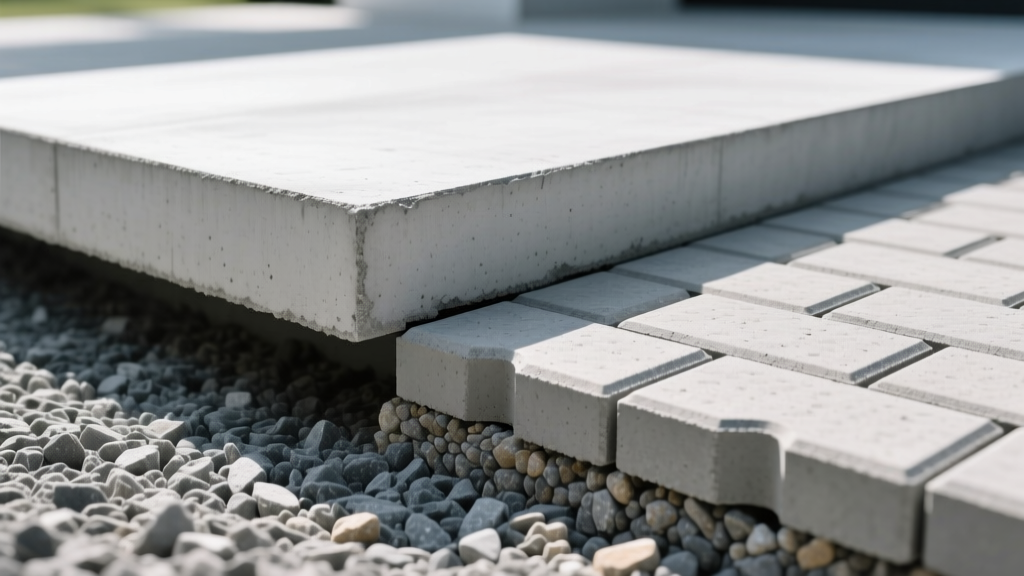
When evaluating paving materials for driveways, patios, and heavy-load walkways, the debate between poured concrete and interlocking pavers is often reduced to aesthetics. However, from a structural and materials science perspective, these are two fundamentally different systems. Poured concrete is a rigid, monolithic matrix that relies on its internal tensile and compressive strength to bridge subgrade imperfections. Interlocking concrete pavers form a flexible, modular membrane that distributes loads laterally through mechanical interlock and jointing sand. Understanding the specific mix designs, PSI ratings, and structural behaviors of each is critical for specifying the correct material for your soil conditions and load requirements.
Poured Concrete: Site-Cast Mix Designs and Proportions
A standard residential driveway pour utilizes a 4,000 PSI mix design, governed by ASTM C94 specifications. To achieve this strength while maintaining workability, ready-mix suppliers typically formulate the batch with a maximum 0.45 water-to-cement (w/c) ratio and a 3/4-inch nominal maximum aggregate size (NMAS). The low w/c ratio is non-negotiable for exterior flatwork; excess water increases capillary porosity, which directly accelerates freeze-thaw scaling and reduces the ultimate compressive strength.
For exterior applications in climates with seasonal freezing, air entrainment is mandatory. According to guidelines published by the National Ready Mixed Concrete Association (NRMCA), the mix must contain 5% to 7% entrained air. These microscopic, non-connecting air voids act as internal expansion chambers, relieving the hydraulic pressure generated when pore water freezes and expands by 9%. Furthermore, incorporating Supplementary Cementitious Materials (SCMs) like Class F fly ash or slag cement (replacing 15-25% of the Portland cement) significantly reduces permeability and mitigates the risk of alkali-silica reaction (ASR) over the slab's lifespan.
Precast Pavers: Zero-Slump Manufacturing and Material Science
Unlike site-cast concrete, precast concrete pavers are manufactured in controlled plant environments using zero-slump (extremely dry) concrete. The mix is placed into molds and subjected to high-frequency vibratory compaction under immense hydraulic pressure before immediate demolding. This manufacturing process yields a highly dense matrix with compressive strengths routinely exceeding 8,000 PSI—double that of standard poured flatwork.
Per ASTM C936 standards, high-quality concrete pavers must exhibit a water absorption rate of less than 5%. This extreme density inherently limits water ingress, providing superior resistance to deicing salts and freeze-thaw cycling without the need for the complex air-void systems required in poured concrete. Vehicular driveways require pavers with a minimum thickness of 3 1/8 inches (80mm), while pedestrian applications can utilize 2 3/8 inches (60mm).
Comparative Performance Matrix
| Material Property | Poured Concrete (4,000 PSI Mix) | Precast Concrete Pavers (ASTM C936) |
|---|---|---|
| Compressive Strength | 4,000 - 5,000 PSI | 8,000 - 10,000+ PSI |
| Water Absorption | 4% - 6% (depends on w/c ratio) | Less than 5% (highly compacted) |
| Freeze-Thaw Mechanism | Entrained air void system (5-7%) | Extreme density and low permeability |
| Structural Behavior | Rigid (bridges minor subgrade voids) | Flexible (moves with subgrade shifts) |
| Repairability | Low (requires slab replacement or patching) | High (individual units can be swapped) |
Subgrade Interaction and Load Distribution Mechanics
The longevity of either system is dictated by how it interacts with the underlying base and subgrade. Poured concrete requires a rigid, unyielding foundation. A standard specification calls for 4 to 6 inches of well-graded, compacted crushed stone (ASTM D2940) to prevent differential settlement. If the subgrade washes out or settles unevenly, the monolithic slab will experience tensile stress at the bottom of the span, leading to catastrophic structural cracking.
Conversely, pavers operate as a flexible pavement system. The load from a vehicle tire is distributed laterally through the pavers, into the bedding sand, and down through the aggregate base at a roughly 45-degree angle. The Interlocking Concrete Pavement Institute (ICPI) emphasizes that this flexibility makes pavers vastly superior in regions with highly expansive clay soils or deep frost lines. When the subgrade heaves or settles, the paver surface undulates but does not crack. The system can be disassembled, the base re-graded, and the pavers reinstalled without material loss.
The Critical Role of Jointing Sand
The structural integrity of a paver installation relies entirely on the jointing sand. Standard ASTM C33 concrete sand provides the initial vertical and horizontal interlock. However, for modern installations, polymeric sand is the standard. When activated with water, the polymers bind the sand grains together, creating a flexible mortar that resists washout, prevents weed growth, and deters insect infiltration, while still allowing the necessary micro-movements that prevent the system from becoming brittle.
Freeze-Thaw Durability and Deicing Salt Resistance
Both materials face severe degradation risks from the combination of freeze-thaw cycles and chloride-based deicing salts, but their failure modes differ.
Warning: Deicing Salt Scaling
Applying calcium chloride or rock salt to newly poured concrete (within the first year) can cause severe surface scaling. The salts lower the freezing point of water, increasing the number of freeze-thaw cycles the surface experiences, while simultaneously drawing moisture into the capillary pores. Always use sand for traction during the first winter of a new concrete slab.
According to the Portland Cement Association, properly air-entrained concrete with a hard-troweled, low-w/c surface paste will resist scaling effectively. However, if the finishing crew adds water to the surface during troweling (a common but disastrous field practice), the localized w/c ratio spikes, creating a weak, porous layer that will spall and flake off within two winters.
Precast pavers, due to their manufacturing process, do not suffer from surface troweling defects. Their extreme density prevents chlorides from penetrating deeply. When surface spalling does occur on pavers, it is usually limited to the arris (the sharp edges) if low-quality units are used, rather than the broad surface scaling seen in poorly finished poured concrete.
Real-World Failure Modes and Edge Cases
- Tree Root Heave: Poured concrete will crack and lift violently when encroached by tree roots, requiring saw-cutting and removal. Pavers will simply rise; the affected units can be removed, the root pruned or capped, and the base restored.
- Heavy Point Loads: Motorhome jacks or car lifts on thin (2 3/8") pavers will cause localized crushing or rotation. Poured concrete at 5 inches thick handles point loads significantly better due to its monolithic bridging capability.
- Oil and Chemical Stains: Both materials are porous. Poured concrete requires a penetrating silane/siloxane sealer every 3-5 years. Pavers can be sealed with acrylic film-forming sealers, which also lock the polymeric sand in place and enhance color.
Structural Decision Framework
Use the following criteria to specify the correct paving system for your project:
- Choose Poured Concrete If: The subgrade is stable, well-draining granular soil; the design requires a perfectly flat, rigid surface for heavy point loads (e.g., workshop driveways, wheelchair ramps); and the budget prioritizes lower initial installation costs over long-term repairability.
- Choose Concrete Pavers If: The site features expansive clay soils, a high water table, or deep frost penetration; utility lines run beneath the paving (requiring future access); or the project demands a 40+ year lifecycle with zero visible patching or crack-filling maintenance.
Written by
Marcus ChenMarcus Chen is a licensed structural engineer (PE) and building materials analyst with over 12 years of experience across residential, commercial, and industrial construction. He holds a Master of Science in Civil Engineering from UC Berkeley and spent six years at Thornton Tomasetti before transitioning to independent consulting and technical writing. Marcus specializes in material selection for seismic-prone regions, concrete reinforcement strategies, and lifecycle cost analysis. His work has been cited by the American Concrete Institute (ACI) and the Structural Engineers Association of California (SEAOC). When he is not on a job site or at his desk, you will find him hiking the Sierra Nevada or restoring a 1920s craftsman bungalow in Oakland, CA.
More from Marcus Chen
View all
Construction Cost
How Much Did the Eiffel Tower Cost to Build?
How much did the Eiffel Tower cost to build in 1889? We adjust for inflation and compare its budget to modern skyscraper construction.
Aug 4, 2026

Fire Resistance
What Is a Fire Resistant Material? Testing & Certification Guide
Discover what is a fire resistant material through ASTM and UL testing. Learn how fire ratings, certifications, and assemblies work in construction.
Aug 4, 2026

Construction Cost
How Much Did the Burj Khalifa Cost to Build?
How much did the Burj Khalifa cost to build? We break down the $1.5B project and extract 5 money-saving strategies for your next build.
Jul 30, 2026