Concrete vs Quartz Countertops: Mix Design and Material Science
Compare concrete vs quartz countertops through material science. Explore GFRC mix designs, resin matrices, heat tolerance, and installation costs.

The debate between concrete and engineered quartz for countertops is often reduced to superficial aesthetic preferences. However, from a materials engineering perspective, the choice hinges on fundamentally different chemical matrices: a hydrated cementitious binder reinforced with pozzolans and fibers versus a vibro-compressed aggregate matrix bound by polymer resins. Understanding the exact mix designs, structural limitations, and failure modes of both materials is critical for architects, fabricators, and homeowners specifying surfaces for high-performance kitchens and commercial spaces.
The Material DNA: Cementitious Matrices vs. Resin-Bound Aggregates
Concrete and quartz represent two entirely different branches of composite material science. Concrete is a ceramic-like composite relying on the exothermic hydration of Portland cement to bind aggregates. Engineered quartz, conversely, is a polymer matrix composite (PMC) where crushed natural stone is suspended in a thermosetting resin.
Concrete: Relies on calcium silicate hydrate (C-S-H) gel for strength. Highly porous by nature, requiring chemical densification and topical sealing. Capable of withstanding extreme heat.
Quartz: Relies on unsaturated polyester or epoxy resins for binding. Virtually non-porous and zero-maintenance, but fundamentally limited by the thermal degradation point of the polymer matrix.
Concrete Countertop Mix Designs: Engineering for Horizontal Surfaces
Standard slab concrete (typically a 4,000 psi compressive mix with a 0.50 water-to-cement ratio) will catastrophically fail when used for countertops due to excessive shrinkage, curling, and surface scaling. Countertop mix designs require precise proportioning to minimize water content while maintaining workability.
Traditional Wet-Cast and Pozzolan Blends
High-performance wet-cast countertop mixes utilize a strict water-to-cement (w/c) ratio between 0.35 and 0.40. To achieve flowability at this low water content, fabricators use polycarboxylate ether (PCE) based superplasticizers. Furthermore, modern mixes replace 10% to 15% of the Portland cement with pozzolans such as metakaolin or silica fume. According to the Portland Cement Association, these supplementary cementitious materials react with the free calcium hydroxide (lime) produced during hydration. This secondary C-S-H reaction densifies the paste, drastically reducing the capillary pore structure and mitigating the risk of efflorescence and acid etching.
GFRC (Glass Fiber Reinforced Concrete)
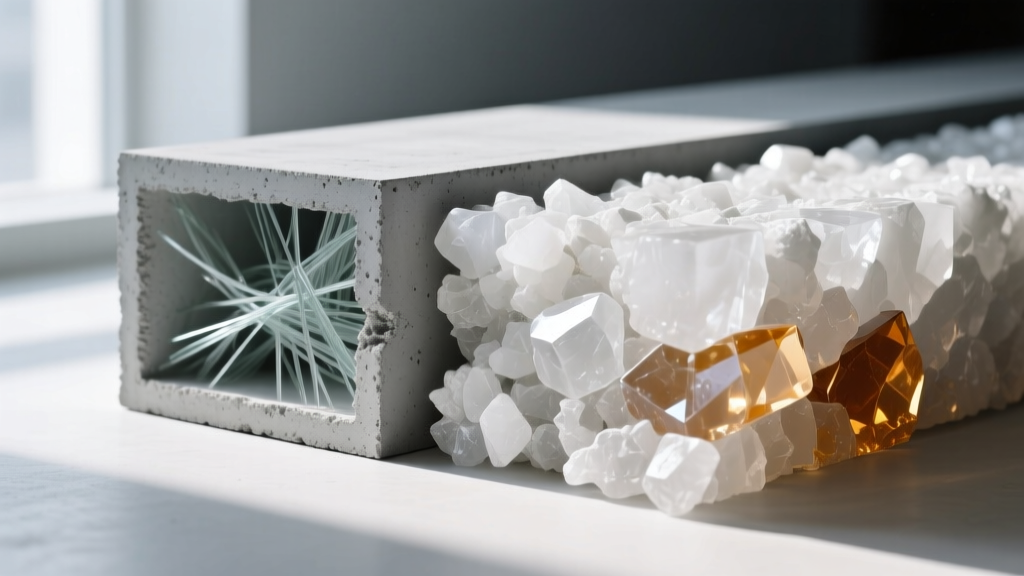
Glass Fiber Reinforced Concrete (GFRC) has largely superseded wet-cast methods for premium fabrications. GFRC utilizes a spray-up or premium pour method incorporating 4% to 6% alkali-resistant (AR) glass fibers by weight. The inclusion of AR glass fibers alters the failure mechanics of the concrete: instead of brittle, catastrophic snapping under tensile stress, the fibers bridge micro-cracks, yielding a flexural strength exceeding 1,500 psi (compared to roughly 600 psi for standard wet-cast). This allows fabricators to reduce the countertop thickness from 1.5 inches down to 0.75 inches, cutting the dead weight by half and eliminating the need for heavy cabinet reinforcement.
When designing concrete mixes, avoid using reactive silica aggregates (like certain river gravels or recycled glass) in high-alkali cement environments. ASR causes the aggregate to absorb moisture and expand, leading to internal 'map cracking' that cannot be repaired post-cure. Always specify non-reactive, washed quartz sands or granite dust for the fine aggregate fraction.
Engineered Quartz: The Vibro-Compression Vacuum Matrix
Engineered quartz is manufactured using the Bretonstone process. The mix design consists of 90% to 93% crushed natural quartz aggregates—graded from fine micron powders to 3mm chips—mixed with 7% to 10% unsaturated polyester resin, pigments, and antimicrobial agents.
The mixture is poured into molds and subjected to a vibro-compression vacuum process. The vacuum extracts all trapped air, while intense vibration and hydraulic pressure (up to 100 tons per square meter) compact the aggregate into the densest possible configuration before the resin is heat-cured. The result is a non-porous surface with a compressive strength often exceeding 10,000 psi. However, fabricators and designers must note the critical limitation of the resin binder: thermal degradation.
Resin Limitations and Thermal Shock
While quartz aggregates can withstand thousands of degrees, the polyester resin matrix begins to soften and discolor at temperatures exceeding 300°F (150°C). Placing a 450°F cast-iron pan directly on a quartz surface will cause localized thermal shock, resulting in permanent yellowing, scorch marks, or delamination of the resin from the aggregate. As noted by the Centers for Disease Control and Prevention (CDC), the high silica content and resin matrix also create specific hazardous dust profiles during fabrication, requiring strict OSHA-compliant wet-cutting and ventilation protocols in the shop.
Technical Comparison Matrix
| Property | GFRC Concrete | Wet-Cast Concrete | Engineered Quartz |
|---|---|---|---|
| Compressive Strength | 6,000 - 8,000 psi | 5,000 - 7,000 psi | 10,000 - 14,000 psi |
| Flexural Strength | 1,500 - 2,000 psi | 500 - 700 psi | 4,000 - 5,000 psi |
| Water Absorption (Porosity) | 3% - 5% (sealed) | 5% - 8% (sealed) | < 0.1% (Non-porous) |
| Maximum Thermal Tolerance | > 1,000°F (537°C) | > 1,000°F (537°C) | 300°F (150°C) |
| Standard Thickness | 0.75 inches | 1.5 inches | 0.75 - 1.25 inches |
| UV Stability (Outdoor Use) | Excellent | Excellent | Poor (Resin yellows) |
Failure Modes and Edge Cases in the Field
Specifying the wrong material for the environment leads to predictable, irreversible failures. Understanding these edge cases is vital for long-term performance.
Concrete: Acid Etching and Micro-Cracking
Even with advanced pozzolan blends and topical polyurethane sealers, concrete remains vulnerable to acidic compounds. Citric acid, vinegar, and wine can penetrate microscopic breaches in the topical sealer and react with residual calcium compounds in the cement paste, leaving permanent 'etch marks' (dull spots where the surface is chemically dissolved). Furthermore, if the concrete is not properly wet-cured for a minimum of 7 days post-cast, plastic shrinkage cracking will manifest as hairline fractures near sink cutouts or integrated drainboards.
Quartz: UV Degradation and Seam Delamination
Engineered quartz is strictly an interior material. When exposed to direct ultraviolet (UV) sunlight, the polyester resins undergo photo-oxidation, causing severe yellowing and brittleness within 12 to 18 months. Additionally, because quartz slabs are fabricated in maximum lengths of roughly 120 inches, large kitchens require seams. If the fabricator uses an incompatible epoxy or fails to perfectly level the substrate, the rigid quartz slab will experience shear stress at the seam, leading to visible delamination or snapping under heavy point-loads.
2026 Cost and Fabrication Realities
Market pricing reflects the labor intensity and material science of each option. As of 2026, the installed costs break down as follows:
- Engineered Quartz: $75 to $140 per square foot installed. Premium brands with complex veining or specialized antimicrobial resins push the upper limit. Fabrication is highly automated via CNC waterjets.
- Wet-Cast Concrete: $85 to $120 per square foot installed. Requires extensive manual labor for forming, casting, wet-grinding, and multi-stage sealing.
- GFRC Concrete: $110 to $160+ per square foot installed. The premium reflects the specialized spray equipment, AR glass fibers, and the high skill level required to achieve a consistent, pinhole-free face coat.
For commercial projects, the Natural Stone Institute and associated trade groups frequently note that while quartz has a higher upfront material cost than basic tile or laminate, its zero-maintenance lifecycle and lack of required annual sealing make it the default ROI winner for high-traffic hospitality environments.
The Decision Framework: When to Specify Which Material
Do not choose based on visual samples alone. Apply this material-science decision framework to your specific project parameters:
- Specify Engineered Quartz if: The application is an indoor, high-traffic kitchen (residential or commercial) where zero porosity, NSF-certified food safety, stain resistance, and minimal maintenance are the primary directives. Accept the thermal limitations and mandate the use of trivets.
- Specify GFRC Concrete if: The design requires complex, monolithic 3D shapes (integrated sinks, custom curved islands, waterfall edges with return grains), or if the countertop will be installed in an outdoor kitchen or patio where UV exposure and freezing temperatures would destroy resin-based alternatives.
- Specify Wet-Cast Concrete if: The project demands a heavy, brutalist aesthetic with large, exposed aggregate profiles or integral embedded elements (like brass inlays or embedded stone) that require deep, traditional vibration casting methods.
By aligning the chemical and structural realities of the mix design with the physical demands of the space, designers can eliminate premature material failure and ensure the countertop performs flawlessly over its lifespan.
Written by
David NakamuraDavid Nakamura is a licensed architect (AIA) and construction technology writer focused on sustainable building methods, mass timber engineering, and high-performance building envelopes. He holds a Master of Architecture from the University of Washington and is a certified Passive House Consultant (CPHC). David spent eight years at the Seattle firm Mithun, where he led the design of three LEED Platinum projects, before founding his own practice specializing in net-zero residential design. He serves on the editorial advisory board of GreenBuilder Magazine and has authored peer-reviewed papers on cross-laminated timber (CLT) connections for the Journal of Structural Engineering. In his spare time, David teaches woodworking at Pratt Fine Arts Center and kayaks the Puget Sound.
More from David Nakamura
View all
Construction Cost
Labor Cost to Build a Deck Per Sq Ft: 2026 Installation Guide
Discover the exact labor cost to build a deck per sq ft in 2026. This installation guide breaks down contractor rates, complexity factors, and hidden fees.
Aug 4, 2026

Construction Cost
How Much Does It Cost to Build a 3 Bedroom House? Financing Guide
Learn exactly how much it costs to build a 3 bedroom house and explore 2026 financing options, construction loan types, and budget frameworks for your build.
Aug 4, 2026

Construction Cost
Cost to Build a Tennis Court: 2026 Guide
How much does it cost to build a tennis court in 2026? Breakdowns for asphalt, concrete, and synthetic surfaces plus fencing and lighting.
Jul 30, 2026