Cost of Blacktop vs Concrete: 2026 Paving Price Guide
Compare the true cost of blacktop vs concrete in 2026. Analyze upfront pricing, 30-year lifecycle expenses, load capacities, and climate impacts.

Upfront Installation Costs: Blacktop vs. Concrete
When evaluating the cost of blacktop vs concrete for driveway and paving projects in 2026, the initial capital outlay remains the primary differentiator. Blacktop (asphalt) is fundamentally a petroleum-based product, meaning its price fluctuates with global crude oil markets and regional bitumen availability. Concrete, conversely, is tied to limestone quarrying, Portland cement production, and increasingly, carbon-capture surcharges at the plant level.
For a standard 600-square-foot residential driveway, the national average installation costs break down as follows:
| Cost Factor | Blacktop (Asphalt) | Concrete (Broom Finish) | Concrete (Stamped/Exposed) |
|---|---|---|---|
| Subbase Preparation (4-6" aggregate) | $1.50 - $2.50 / sq ft | $1.50 - $2.50 / sq ft | $2.00 - $3.50 / sq ft |
| Material Costs | $3.00 - $5.00 / sq ft | $6.00 - $9.00 / sq ft | $9.00 - $14.00 / sq ft |
| Labor & Formwork | $2.50 - $5.50 / sq ft | $4.50 - $12.50 / sq ft | $10.00 - $18.00 / sq ft |
| Total Installed Cost | $7.00 - $13.00 / sq ft | $12.00 - $24.00 / sq ft | $21.00 - $35.50 / sq ft |
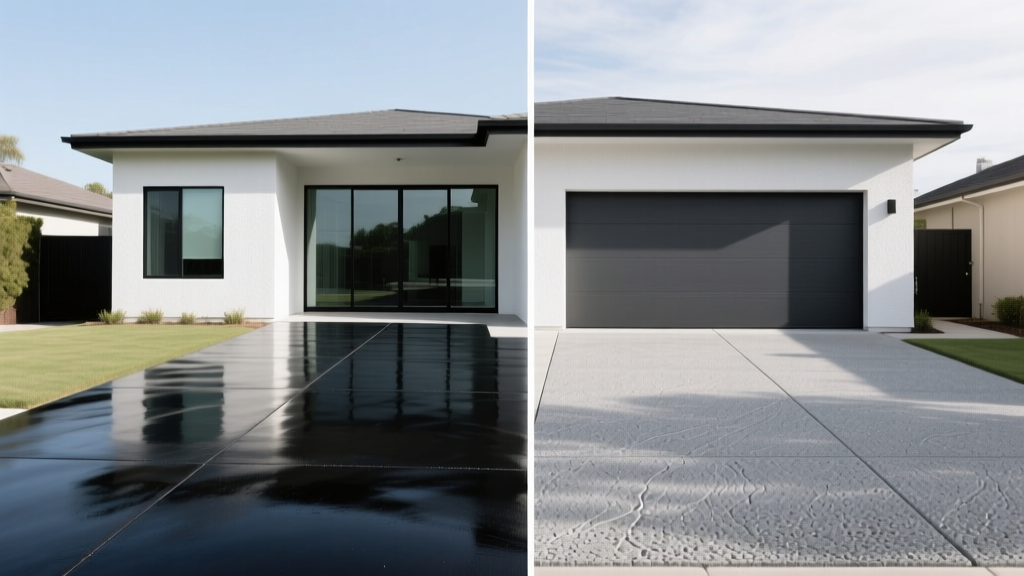
Lifecycle and Long-Term Maintenance Expenses
Upfront pricing only tells half the story. A true material guide must analyze the 30-year lifecycle cost, which accounts for maintenance, repairs, and eventual replacement.
Blacktop Maintenance Realities
Asphalt is a flexible pavement. While this allows it to withstand minor ground heaving without cracking, it also means the surface is susceptible to oxidation, UV degradation, and petroleum spills.
- Sealcoating: Required every 3 to 5 years. Costs $0.15 to $0.25 per square foot. Over 30 years, expect to pay $2,700 to $4,500 in sealcoating for a standard driveway.
- Crack Filling: Annual maintenance. Hot-pour rubberized crack filler costs about $0.05 per linear foot.
- Overlay/Replacement: Asphalt typically requires a 2-inch mill-and-overlay at year 15, or full-depth replacement by year 20 to 25.
Concrete Maintenance Realities
Concrete is a rigid pavement. It does not require sealcoating to prevent oxidation, but it is highly vulnerable to water intrusion at the joints and de-icing chemical scaling.
- Joint Sealing: Control joints must be cleaned and re-caulked with polyurethane self-leveling sealant every 5 to 7 years ($0.10 per linear foot).
- Pressure Washing: Recommended bi-annually to prevent moss and freeze-thaw spalling.
- Lifespan: A properly poured 4,000 PSI concrete driveway with a 6-inch compacted subbase will easily last 30 to 50 years with zero structural overlays required.
"When calculating the cost of blacktop vs concrete over a 30-year horizon, concrete often achieves cost-parity with asphalt around year 18, assuming the concrete was finished with a proper air-entrainment mix and the asphalt was sealed on schedule."
— Federal Highway Administration (FHWA) Pavement Lifecycle Reports
Structural Integrity and Load-Bearing Capacities
The structural engineering behind these two materials dictates where they should be used. If you plan to park heavy vehicles, RVs, or boat trailers, the material choice is non-negotiable.
Asphalt Structural Limits
Asphalt relies entirely on its subbase for load distribution. The asphalt layer itself (typically 2 to 3 inches thick) is merely a waterproof wearing course. If the underlying crushed stone base is compromised by water, the asphalt will rut and sink under point loads. According to the National Asphalt Pavement Association (NAPA), residential driveways should utilize a PG 64-22 binder grade to resist rutting in summer heat while remaining flexible in winter.
Concrete Structural Advantages
Concrete possesses inherent structural rigidity. A standard 4-inch thick slab of 4,000 PSI concrete distributes point loads across a wider area of the subgrade. For driveways expecting heavy RVs or dump trucks, increasing the slab thickness to 5 or 6 inches and utilizing #4 rebar on a 2-foot grid eliminates the risk of point-load punching. The Portland Cement Association (PCA) emphasizes that incorporating 5% to 7% air-entrainment into the mix is critical for creating microscopic voids that allow freezing water to expand without spalling the surface.
Climate Considerations: Freeze-Thaw vs. Extreme Heat
Geography heavily influences the cost-effectiveness and longevity of paving materials. Use this decision matrix to align your material choice with your local climate.
| Climate Profile | Optimal Material | Technical Justification |
|---|---|---|
| Deep Freeze-Thaw Cycles (Midwest/Northeast) | Concrete (Air-Entrained) | Asphalt becomes brittle below 10°F and cracks. Concrete with 6% air-entrainment survives expansion. |
| Extreme Heat (Southwest/Desert) | Concrete | Asphalt softens at surface temps above 140°F, leading to severe tire rutting and tracking into garages. |
| Mild, Stable Climates (Pacific Northwest/Coastal) | Blacktop | Asphalt's flexibility handles minor soil shifting without cracking; lower upfront cost yields faster ROI. |
| Heavy Tree Canopy / Shade | Concrete | Asphalt in constant shade retains moisture, leading to base failure and accelerated moss/lichen degradation. |
The 5-Point Decision Framework
Bypass the generic advice and use this specific framework to finalize your paving decision:
- Evaluate the Subgrade Soil: If your soil is expansive clay that shifts significantly with moisture changes, choose blacktop. Concrete will crack along fault lines in expansive soils unless you invest $3,000+ in deep helical piers or a post-tensioned slab.
- Calculate the 20-Year Budget: If your immediate budget is capped at $8,000 for a 1,000 sq ft driveway, blacktop is your only viable option. If you can finance $16,000 upfront, concrete eliminates the $3,000+ in sealcoating costs you would pay over the next two decades.
- Assess Heavy Load Requirements: If the driveway will support a 15,000 lb RV or frequent commercial delivery trucks, mandate a 6-inch, 4,000 PSI concrete slab with dowel bars at all transverse joints.
- Factor in Snow Removal: If you use a steel-blade snowplow, choose concrete. Steel blades will gouge and tear the aggregate surface of older asphalt, whereas a properly cured concrete slab will withstand steel scraping indefinitely.
- Consider HOA and Resale Value: Real estate appraisals in 2026 continue to show that pristine concrete driveways yield a 1.5% to 2% higher home valuation compared to asphalt, primarily due to buyer perception of lower immediate maintenance liabilities.
Frequently Asked Questions
Can I pave blacktop directly over an existing cracked concrete driveway?
No. This is known as a "blacktop overlay" and is a frequent contractor shortcut that leads to failure. The existing cracks in the concrete are active joints; within 12 to 18 months, those exact same cracks will reflect through the new asphalt surface (a phenomenon called reflective cracking). The concrete must be demolished and removed, or a specialized paving interlayer fabric must be installed between the concrete and asphalt, adding $1.50 to $2.00 per square foot to the project.
Does the color of the material affect snow melting?
Yes. Blacktop has a low albedo, meaning it absorbs up to 90% of solar radiation, which can accelerate snow and ice melting on sunny winter days. Concrete reflects solar radiation. However, this thermal advantage for asphalt comes with a trade-off: the absorbed heat accelerates the oxidation of the bitumen binder, which is why asphalt turns gray and brittle over time if not sealcoated.
What is the curing time difference before I can drive on it?
Blacktop can typically handle passenger vehicle traffic within 48 to 72 hours after the final roller pass, as it relies on thermal cooling to set. Concrete requires a chemical hydration process. While you can walk on concrete after 24 hours, it requires a minimum of 7 days of curing to reach 70% of its compressive strength, and a full 28 days before heavy vehicles or RVs should be parked on it.
Written by
James ThorntonJames Thornton is a construction industry veteran with 25 years of hands-on experience in wood framing, lumber grading, and residential building codes. He started as a framing carpenter in rural Oregon, earned his ICC Residential Building Inspector certification, and eventually became a senior plan reviewer for the City of Portland Bureau of Development Services. James holds a B.S. in Wood Science & Technology from Oregon State University and is a certified lumber grader through the West Coast Lumber Inspection Bureau (WCLIB). He has inspected over 3,000 residential construction sites and authored the city's internal guide on advanced framing techniques (2x6 at 24" O.C.). James lives in Bend, OR, where he builds custom timber-frame cabins and competes in lumberjack sports.
More from James Thornton
View all
Insulation
Best Home Insulation Materials: Complete 2026 Guide
Compare top home insulation materials for 2026. Find R-values, installed costs per square foot, and best uses for fiberglass, spray foam, and mineral wool.
Aug 4, 2026

Sustainable Building
Certify Your Green Building Material for LEED and WELL
Step-by-step guide to certifying a green building material for LEED v5 and WELL v2. Master EPDs, HPDs, and VOC limits for 2026 project specifications.
Aug 4, 2026

Stone & Masonry
Veneer Stacked Stone Panels: Interior Design & Style Showcase
Discover how veneer stacked stone panels transform interiors. Explore modern design profiles, material pairings, and technical installation specs.
Aug 4, 2026