Concrete vs Mortar Mix: Key Differences and Best Uses
Discover the critical differences in concrete vs mortar mix. Learn compressive strengths, ASTM types, mix ratios, and exact use cases for your projects.

The Fundamental Divide: Aggregate Size and Purpose
When planning a masonry or structural project, confusing concrete vs mortar mix is one of the most costly mistakes a builder can make. While both materials share a common base—Portland cement and water—their structural behaviors, curing mechanics, and load-bearing capacities are fundamentally different. The divergence comes down to a single critical variable: aggregate size.
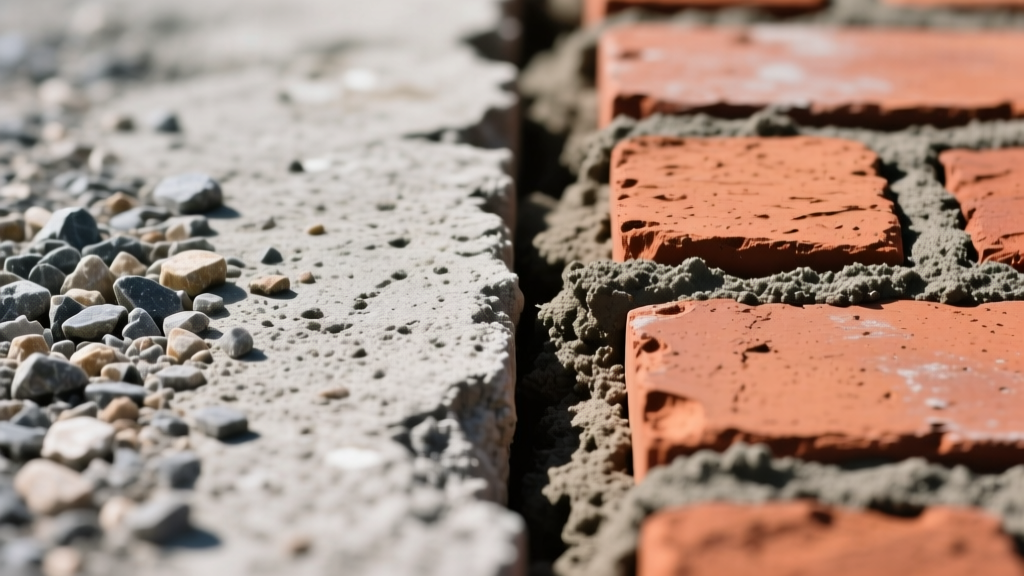
Concrete is a structural composite designed to bear massive compressive loads. It relies on coarse aggregate (gravel or crushed stone ranging from 3/8 inch to 1 inch) to create an interlocking matrix that resists cracking under heavy weight. Mortar, conversely, is a binding agent. It uses only fine aggregate (masonry sand) to create a smooth, workable paste that adheres to masonry units (brick, block, stone) and accommodates slight structural movements without fracturing the units themselves.
Concrete Mix: Structural Load-Bearing Mechanics
Concrete is engineered for high compressive strength, typically measured in Pounds per Square Inch (PSI). The standard volumetric ratio for a general-purpose concrete mix is 1:2:3 (one part cement, two parts sand, three parts coarse gravel). The water-cement (w/c) ratio is strictly controlled, usually between 0.40 and 0.50, to ensure maximum density and strength upon hydration.
Common Concrete PSI Ratings and Applications
- 2,500 - 3,000 PSI: Standard residential slabs, sidewalks, and non-structural footings. This is the most common mix found in big-box retail stores.
- 4,000 PSI: Driveways, garage floors, and patio slabs that will endure vehicular traffic or heavy point loads.
- 5,000+ PSI: Structural columns, suspended decks, and commercial foundations. Often requires air-entrainment admixtures for freeze-thaw durability in northern climates.
As of 2026, a standard 80 lb bag of 4,000 PSI concrete mix (such as Quikrete High-Strength or Sakrete Max Pro) costs between $6.50 and $8.50, yielding approximately 0.6 cubic feet of mixed material.
Mortar Mix: The Binding Agent and ASTM C270 Standards
Mortar is governed by ASTM C270 Standard Specification for Mortar for Unit Masonry. Unlike concrete, mortar is classified by 'Types' rather than strict PSI ratings, though each type has a minimum compressive strength requirement. Mortar must possess high bond strength and workability, requiring a higher water-cement ratio (typically 0.50 to 0.60) and the inclusion of hydrated lime or masonry cement to retain water and prevent premature drying.
The Four Primary Mortar Types
| Mortar Type | Ratio (Cement:Lime:Sand) | Min. PSI | Primary Application |
|---|---|---|---|
| Type N | 1 : 1 : 6 | 750 | General above-grade masonry, veneer, and soft brick. |
| Type S | 1 : 0.5 : 4.5 | 1,800 | Below-grade foundations, retaining walls, and high-load brick. |
| Type M | 1 : 0.25 : 3.5 | 2,500 | Heavy stone masonry, load-bearing walls, and below-grade stone. |
| Type O | 1 : 2 : 9 | 350 | Historic restoration, tuckpointing, and non-load-bearing interior walls. |
An 80 lb bag of pre-blended Type S or Type N mortar typically ranges from $7.50 to $11.00 in 2026. While more expensive per pound than concrete, mortar is applied in thin 3/8-inch joints, meaning a single bag covers a significantly larger surface area of masonry than a bag of concrete covers in slab volume.
Head-to-Head Comparison Matrix
To quickly determine which material fits your project parameters, reference this direct comparison of physical and economic properties.
| Property | Standard Concrete Mix | Type S Mortar Mix |
|---|---|---|
| Coarse Aggregate | Yes (Gravel up to 3/4') | No (Fine sand only) |
| Compressive Strength | 3,000 - 5,000+ PSI | 1,800 PSI (Type S) |
| Joint Thickness | N/A (Poured in bulk forms) | 3/8 inch standard |
| Flexural/Bond Strength | Low (Requires rebar for tension) | High (Adheres to masonry units) |
| Workability Time | 45 - 60 minutes | 90 - 120 minutes (lime retains water) |
| Avg. Cost (80lb Bag) | $6.50 - $8.50 | $7.50 - $11.00 |
Critical Failure Modes: What Happens When You Swap Them?
Substituting one material for the other does not just result in a subpar finish; it leads to catastrophic structural failure. According to guidelines from the American Concrete Institute (ACI) and the Portland Cement Association (PCA), understanding these failure modes is critical for structural integrity.
The coarse gravel in concrete prevents you from achieving a uniform 3/8-inch joint. More importantly, concrete cures into a highly rigid, high-PSI matrix. When a masonry wall experiences thermal expansion or slight foundation settling, the rigid concrete joint will not flex. Instead, the stress transfers to the masonry units, causing the bricks or blocks to crack and spall.
The Danger of Using Mortar for Footings
Conversely, using mortar to pour a structural footing or slab is equally destructive. Mortar lacks the coarse aggregate interlock required to distribute point loads. Without gravel to act as a structural skeleton, a mortar footing will crumble and shear under the weight of a structural wall. Mortar's high lime content also makes it highly susceptible to shrinkage cracking when poured in thick, bulk volumes.
Project-Specific Decision Framework
Use this rapid decision matrix to select the correct material for your specific application. If your project falls into the 'Structural Base' category, you need concrete. If it falls into the 'Masonry Bonding' category, you need mortar.
- Pouring a new sidewalk, patio, or driveway? Use 4,000 PSI Concrete with air-entrainment. Finish with a broom finish for slip resistance.
- Setting fence posts or mailbox posts? Use Fast-Setting Concrete Mix. Do not use mortar; the post will pull out under wind loads due to mortar's lack of shear strength.
- Building a brick or cinder block retaining wall? Use Type S Mortar. The high bond strength and 1,800 PSI rating will resist lateral soil pressure and moisture.
- Installing natural stone veneer on a prepared scratch coat? Use Type N or Type S Mortar. Add a latex bonding admixture to the mix to increase adhesion to vertical surfaces.
- Repairing crumbling joints on a 100-year-old historic brick home? Use Type O Mortar. Modern high-PSI mortars (like Type S or M) are too hard for soft historic bricks and will cause the brick faces to spall during freeze-thaw cycles.
Best Practices for Mixing and Curing
Regardless of whether you are mixing concrete or mortar, the hydration process requires precise water management. The most common error among DIYers and novice masons is 're-tempering'—adding extra water to a mix that has begun to stiffen in the wheelbarrow. Every additional cup of water added beyond the manufacturer's specification dilutes the cement paste, increasing the capillary pore structure and reducing the final compressive strength by up to 10% per extra inch of slump.
For concrete, maintain a damp curing environment for a minimum of 7 days using wet burlap or a liquid curing compound to prevent plastic shrinkage cracking. For mortar, mist the masonry joints lightly with water for 48 to 72 hours after tooling to ensure the lime fully carbonates and achieves maximum bond strength.
Written by
Sarah WhitfieldSarah Whitfield is a chartered quantity surveyor (MRICS) and construction cost analyst with 15 years of experience in material pricing, procurement strategy, and project budgeting. She earned her degree in Construction Management from the University of Reading (UK) and has worked on projects ranging from $2M custom homes to $180M mixed-use developments across North America and Europe. Sarah currently leads cost estimating for BuildMat Insight, maintaining a proprietary database of 4,000+ material price points updated quarterly. She is a frequent contributor to RSMeans cost data panels and has presented at the International Cost Engineering Council (ICEC) congress. Based in Denver, CO, Sarah is an avid trail runner and volunteer mentor for Women in Construction.
More from Sarah Whitfield
View all
Wood & Lumber
What Are the Different Types of Wood? A Builder's Guide
Compare structural softwoods, finish hardwoods, and engineered lumber. Analyze Janka ratings, MOE values, and 2026 pricing for construction.
Aug 4, 2026

Walls & Panels
Steel Framing vs Wood Framing: Corrosion and Moisture Defense
Compare steel framing vs wood framing for moisture resistance. Learn about galvanized coatings, condensation risks, and corrosion protection strategies.
Jul 21, 2026

Stone & Masonry
How to Cut Stone Veneer: Wet Saw vs Grinder Comparison
Compare the best tools for cutting stone veneer. We review wet saws, angle grinders, and chop saws to help you achieve clean, chip-free cuts.
Jul 21, 2026