What Type of Drill Bit for Concrete? SDS vs Masonry Guide
Discover what type of drill bit for concrete you need. Compare SDS-plus, SDS-max, and standard masonry bits for slabs, walls, and reinforced pours.

The Short Answer: Matching the Bit to the Hammer
Determining what type of drill bit for concrete you need depends entirely on the tool you are using and the compressive strength (PSI) of the substrate. While a standard masonry bit can technically pierce low-strength cinder block, modern structural concrete (typically 3,000 to 5,000 PSI) requires specialized metallurgy and shank designs to transfer impact energy without shattering the bit or burning out the tool motor.
The fundamental rule of concrete drilling is that the bit must match the chuck mechanism. Standard straight-shank masonry bits are designed for mechanical cam-action hammer drills. Slotted Drive System (SDS) bits are engineered for pneumatic rotary hammers. Using the wrong combination results in catastrophic tool failure, spalled concrete, and severe safety hazards.
Bit Type Selection Matrix
| Bit Type | Required Tool | Max Practical Diameter | Best Application | Avg. Cost (2026) |
|---|---|---|---|---|
| Standard Masonry (Straight/Hex) | Standard Hammer Drill | 1/2 inch | Brick, CMU block, light anchor holes | $3 - $8 |
| SDS-Plus (10mm Shank) | SDS-Plus Rotary Hammer | 1-1/8 inches | Slabs, foundation walls, wedge anchors | $10 - $25 |
| SDS-Max (18mm Shank) | SDS-Max Rotary Hammer | 2 inches (up to 4' with cores) | Deep foundations, thick reinforced piers | $45 - $95 |
| Diamond Core (Wet/Dry) | Core Drill / High-Torque Hammer | 6+ inches | HVAC penetrations, plumbing, electrical | $80 - $250 |
Standard Masonry Bits: When to Use (and When to Avoid)
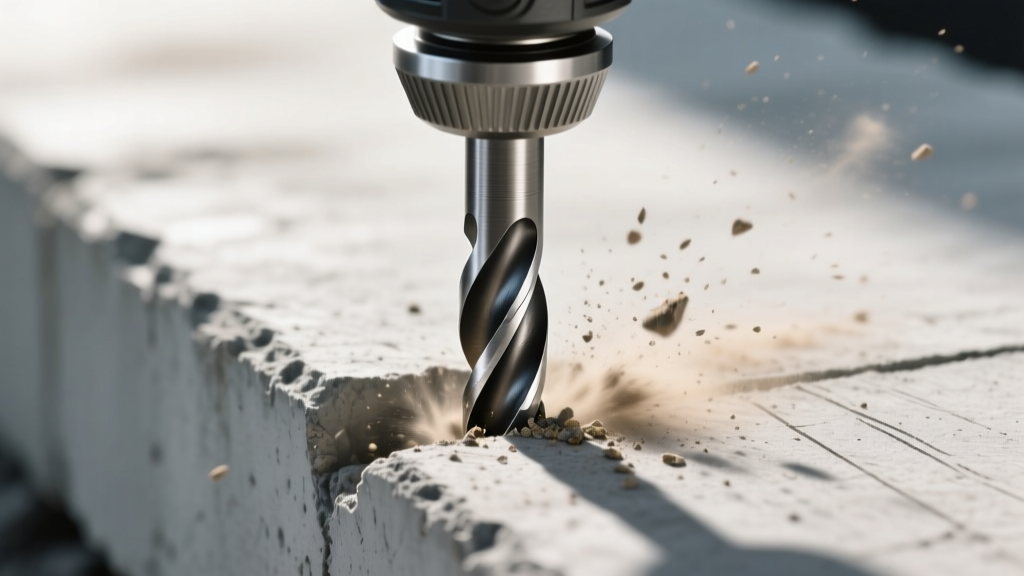
Standard masonry bits feature a straight or hex shank and a tungsten carbide tip brazed onto a fluted steel body. They rely on the mechanical hammering action of a standard hammer drill, which typically delivers between 0.5 and 1.5 Joules of impact energy.
The Anatomy and Limitations
The carbide tip is shaped like a wide spade. As the drill rotates, the carbide scrapes and crushes the concrete, while the hammering action pulverizes the aggregate. However, standard hammer drills suffer from 'cam-action' limitations: the mechanical clutch creates high vibration but low actual impact force.
- Where they excel: Drilling 1/4-inch to 3/8-inch holes into brick mortar joints, lightweight cinder block, or older, poorly cured concrete for plastic wall anchors.
- Where they fail: High-PSI structural slabs, exposed quartz aggregate, and reinforced concrete. The spade tip will deflect off hard aggregate, and the straight shank will slip in the drill chuck under high torque, stripping the shank and destroying the chuck jaws.
SDS-Plus and SDS-Max: The Professional Standard
If you are drilling into a modern concrete slab, foundation wall, or retaining pier, you must use an SDS bit in a rotary hammer. The Slotted Drive System (SDS) allows the bit to slide back and forth within the chuck without spinning freely. This design transfers the pneumatic hammer blow (often 2.0 to 8.0+ Joules) directly to the back of the bit, rather than relying on the user's physical downward pressure.
Carbide Head Geometry: 2-Cutter vs. 4-Cutter
When selecting an SDS bit, the geometry of the carbide head dictates its performance in reinforced concrete.
A standard 2-cutter (spade-style) SDS bit will deflect, bind, or snap if it strikes a piece of #4 or #5 steel rebar. If your drilling zone is not scanned with a ground-penetrating radar (GPR) or rebar locator, you must use a 4-cutter (cross-tip) or full-carbide head bit (such as the Bosch HCFC2000 or Hilti TE-CX). These bits feature a symmetrical cross geometry that chews through rebar without binding, preventing the rotary hammer from violently twisting out of your hands.
SDS-Plus vs. SDS-Max: Sizing the Shank
The primary difference lies in the shank diameter and the tool's impact energy capacity:
- SDS-Plus (10mm shank): The industry standard for general contracting. Handles holes from 3/16-inch up to 1-1/8 inches. Ideal for setting wedge anchors, sleeve anchors, and Tapcon screws.
- SDS-Max (18mm shank): Designed for heavy civil and commercial work. The larger shank absorbs the massive impact energy of an SDS-Max hammer (up to 15+ Joules) without snapping. Used for large-diameter through-bolts, core drilling adapters, and deep foundation doweling.
Diamond Core Bits for Precision Penetrations
When drilling holes larger than 2 inches for plumbing stacks, HVAC ductwork, or electrical conduit, rotary hammering is no longer viable. The percussive force will spall the back side of the concrete (blowout) and compromise structural integrity. Instead, professionals use diamond-tipped core bits.
Wet vs. Dry Core Drilling
Wet Core Drilling: Uses a continuous water feed to cool the diamond segments and flush out the concrete slurry. Wet drilling is mandatory for heavily reinforced concrete, as the water prevents the steel rebar from overheating and glazing the diamond matrix. It also entirely suppresses silica dust.
Dry Core Drilling: Relies on specialized laser-welded diamond segments designed to withstand high heat. Dry bits must be used with high-capacity HEPA vacuum shrouds. They are generally limited to non-reinforced or lightly reinforced concrete, as hitting rebar without water cooling will rapidly destroy the diamond segments.
Troubleshooting Common Drilling Failures
Even with the correct bit type, concrete presents unique metallurgical challenges. Here is how to diagnose and fix the most common field failures.
1. The Bit Burns, Glazes, or Stops Cutting
The Cause: Concrete contains quartz and silicate aggregates that are harder than the carbide tip. If the user applies too much downward pressure and the RPM is too low, the friction melts the braze holding the carbide, or 'glazes' the tip smooth.
The Fix: Reduce downward pressure. Let the tool's weight and the pneumatic impact do the work. Increase the RPM slightly and pull the bit out of the hole every 5 to 10 seconds to clear the dust from the flutes. Clogged flutes cause friction heat, which anneals (softens) the steel shaft.
2. The Bit Wanders or Deflects on Hard Aggregate
The Cause: Hitting a piece of flint or quartz aggregate with a worn 2-cutter bit. The asymmetric spade tip will follow the path of least resistance, causing the hole to drift off-center, which ruins the holding value of structural anchors.
The Fix: Switch to a 4-cutter (cross-tip) bit. The symmetrical geometry ensures the bit stays centered even when transitioning between soft cement paste and hard aggregate. For critical structural anchors, always drill a pilot hole with a smaller, shorter bit to establish the trajectory before stepping up to the final diameter.
OSHA Silica Compliance and Dust Extraction
Drilling concrete generates respirable crystalline silica (RCS), a known carcinogen that causes silicosis and lung cancer. Compliance with OSHA's Respirable Crystalline Silica standard is not optional for commercial job sites.
According to NIOSH guidelines on silica dust exposure, dry drilling concrete without engineering controls can generate silica levels hundreds of times above the permissible exposure limit (PEL). To comply with OSHA Table 1 when using handheld rotary hammers, you must utilize one of the following methods:
- Water Delivery System: A continuous water feed applied directly to the drill bit at the point of impact. (Often impractical for interior overhead drilling).
- Dust Collection System (DCS): A shroud attached to the drill chuck, connected to a HEPA-filtered vacuum. The vacuum must provide at least 25 cubic feet per minute (CFM) of airflow per inch of bit diameter, and the filter must be cleaned automatically or manually to prevent suction loss.
Expert Insight: Never rely on standard shop vacuums for concrete dust. Standard filters will clog with fine silica powder in seconds, and the exhaust will blow the microscopic RCS particles directly back into the breathing zone. Only use vacuums equipped with certified HEPA filters and automatic reverse-pulse filter cleaning mechanisms.
Final Selection Framework
To summarize your purchasing decision: If you are hanging a 50 lb shelf on a basement cinder block wall, a $5 standard masonry bit and a consumer hammer drill will suffice. If you are installing structural wedge anchors into a 4,000 PSI reinforced slab, invest in an SDS-Plus rotary hammer and a 4-cutter full-carbide SDS bit. For plumbing penetrations, rent a wet core drill rig. Matching the bit geometry, shank type, and cutting head to the specific concrete substrate ensures anchor integrity, tool longevity, and operator safety.
For further reading on general masonry fastening techniques and substrate preparation, refer to The Family Handyman's concrete drilling protocols, which provide excellent visual guides for DIY anchor installations.
Written by
Priya KapoorPriya Kapoor is a real estate market analyst and construction economics researcher with expertise in housing affordability, development feasibility, and infrastructure investment. She holds a Master of Regional Planning from Cornell University and previously worked as a senior analyst at CBRE's Investment Properties group, where she modeled returns for $4B in mixed-use development pipelines. Priya now runs an independent research practice advising developers, municipalities, and REITs on construction cost forecasting and market timing. She publishes the quarterly "BuildMat Market Pulse" report tracking material price indices across 12 commodity categories. Based in Austin, TX, Priya serves on the board of Habitat for Humanity Austin and is a marathon runner.
More from Priya Kapoor
View all
Construction Cost
Cost to Build a 1600 Sq Ft Home in 2026: Full Breakdown
Accurate 2026 cost to build a 1600 sq ft home—material, labor, and regional pricing breakdowns included. Plan your budget with real-time estimates.
Aug 11, 2026

Wood & Lumber
Name the Types of Wood for Pressure Treatment and Preservation
Learn how to name the types of wood best suited for pressure treatment. Compare species treatability, chemical retention levels, and 2026 preservation costs.
Aug 4, 2026

Stone & Masonry
Stone Veneer Suppliers Lindenhurst: 2026 Cost Analysis
Analyze 2026 stone veneer costs in Lindenhurst, NY. Compare local supplier pricing, delivery fees, and Suffolk County installation labor rates.
Aug 4, 2026