Concrete vs Asphalt Driveways: Technical Specs & Load Ratings
Compare concrete vs asphalt driveways through technical specs, including PSI ratings, base requirements, thermal limits, and lifecycle degradation.

Engineering Divergence: Rigid vs. Flexible Pavement Systems
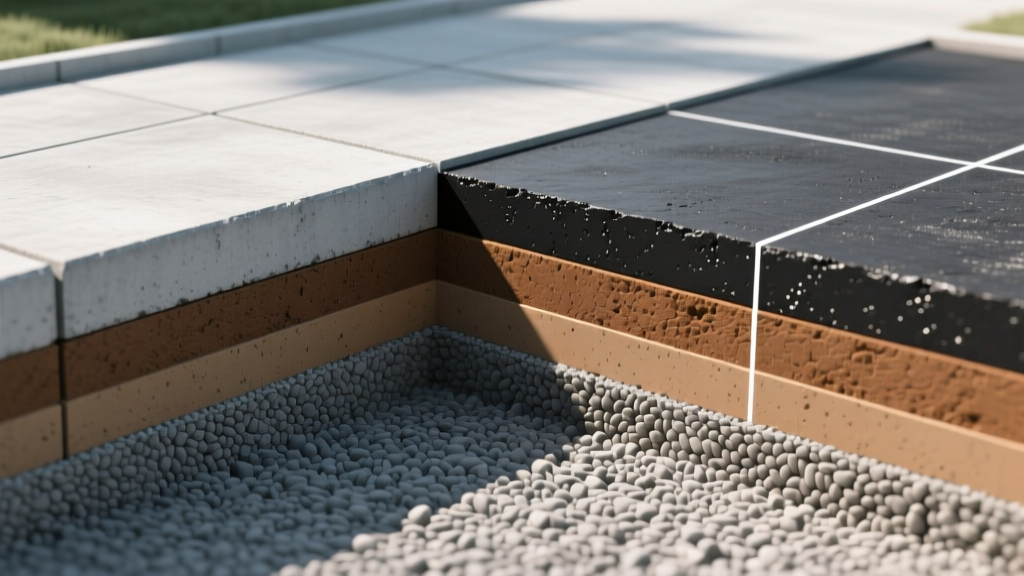
When evaluating concrete vs asphalt driveways from a structural engineering perspective, the fundamental distinction lies in their load-distribution mechanics. Concrete operates as a rigid pavement system, relying on the flexural strength of the slab to bridge over minor subgrade inconsistencies. Asphalt functions as a flexible pavement system, requiring a highly compacted, load-bearing aggregate base to distribute point loads downward through the pavement layers. Understanding the technical specifications of both materials is critical for specifying the correct driveway system based on soil California Bearing Ratio (CBR), climate zone, and anticipated axle loads.
Material Composition and Mix Design Standards
The longevity of either driveway system is dictated by its initial mix design and adherence to industry standards.
Concrete Mix Specifications
Residential and light-commercial concrete driveways require a minimum compressive strength of 4,000 psi at 28 days, governed by American Concrete Institute (ACI) standards. The mix design typically utilizes ASTM C150 Type I or Type II Portland cement with a maximum water-to-cement (w/c) ratio of 0.45 to ensure low permeability. For regions experiencing freeze-thaw cycles, air entrainment between 5% and 7% is mandatory to provide microscopic relief valves for expanding ice crystals. The aggregate gradation should peak at 3/4-inch crushed stone, and the slump must be strictly maintained between 4 and 5 inches to prevent segregation during placement.
Asphalt Binder and Aggregate Specifications
Hot Mix Asphalt (HMA) for driveways is specified using the Superpave (Superior Performing Asphalt Pavements) system under AASHTO M 320. The binder grade is selected based on local thermal extremes; a PG 64-22 (Performance Graded) binder is standard for most of the continental United States, indicating the asphalt will resist rutting up to 64°C (147°F) and thermal cracking down to -22°C (-8°F). The aggregate matrix requires angular, crushed rock with a high percentage of fractured faces to ensure stone-on-stone interlock, preventing premature raveling under turning vehicle tires.
Structural Base and Subgrade Requirements
The most common cause of premature driveway failure is inadequate subgrade preparation. Because asphalt is flexible, it will telegraph any underlying settlement, whereas concrete's rigidity can mask minor subgrade voids until the tensile limit is exceeded.
| Specification Metric | Concrete Driveway (Rigid) | Asphalt Driveway (Flexible) |
|---|---|---|
| Minimum Slab/Surface Thickness | 4 inches (5 inches for RVs/Trucks) | 2 to 3 inches (HMA surface course) |
| Aggregate Base Thickness | 4 inches of compacted crushed stone | 6 to 8 inches of compacted aggregate base |
| Subgrade Compaction Requirement | 90% Standard Proctor Density | 95% Modified Proctor Density |
| Minimum Soil CBR Value | CBR > 3 (Slab bridges soft spots) | CBR > 5 (Requires stiff support) |
| Reinforcement | 6x6 W1.4xW1.4 WWF or macro-synthetic fibers | None (Relies on aggregate interlock and tack coat) |
Thermal Dynamics and Environmental Stressors
Thermal expansion and contraction dictate the jointing and maintenance protocols for both materials. Concrete has a coefficient of thermal expansion of approximately 5.5 x 10^-6 in/in/°F. To prevent uncontrolled random cracking, control joints must be saw-cut within 4 to 12 hours of placement (depending on ambient temperature) at a depth of 25% of the slab thickness. These joints should be spaced in feet no more than 2 to 3 times the slab thickness in inches (e.g., a 4-inch slab requires joints every 8 to 12 feet).
According to the Portland Cement Association, the application of magnesium chloride and calcium chloride de-icers during the first winter of a concrete driveway's life can cause severe surface scaling. Asphalt is immune to chloride-induced scaling but becomes highly brittle at sub-zero temperatures, making it susceptible to thermal cracking if the PG binder grade is not correctly matched to the local climate zone.
Asphalt, conversely, does not require control joints but is highly susceptible to temperature-induced viscosity changes. At surface temperatures exceeding 120°F, standard PG 64 binders can soften, leading to permanent deformation (rutting) under stationary point loads, such as car tires parked in the same spot during peak summer heat or the tongue jacks of heavy travel trailers.
Load-Bearing Capacity and Point Load Deflection
When specifying a driveway for heavy recreational vehicles (RVs), concrete mixer trucks, or delivery vehicles, point load capacity is the governing metric.
- Concrete Flexural Strength: A standard 4,000 psi concrete mix yields a modulus of rupture (flexural strength) of approximately 500 to 600 psi. This allows the slab to span minor voids and resist the concentrated point loads of an 8,000 lb RV axle without deflection.
- Asphalt Structural Number (SN): Asphalt load capacity is calculated using the AASHTO structural number equation. A standard residential asphalt driveway (SN ≈ 3.0) will experience permanent subgrade deformation if subjected to repeated loads exceeding 10,000 lbs on a single axle, particularly when the pavement temperature is above 80°F.
For properties requiring frequent heavy truck access, engineering specifications dictate increasing the concrete thickness to 6 inches with a 5,000 psi mix design, or increasing the asphalt aggregate base to 12 inches of crushed rock stabilized with a geogrid.
Lifecycle Degradation and Maintenance Intervals
The degradation mechanisms of concrete and asphalt are fundamentally different, dictating their respective lifecycle costs and maintenance schedules.
Asphalt Oxidation and Raveling
Asphalt degradation is primarily driven by UV oxidation, which causes the bitumen binder to lose its volatile maltenes, becoming brittle over time. This leads to micro-cracking and eventual raveling (loss of surface aggregate). To mitigate this, a coal tar or asphalt-based emulsion sealcoat must be applied every 3 to 5 years. According to the Federal Highway Administration (FHWA), timely sealcoating and crack filling can extend the functional life of a flexible pavement by 40% to 50%. In 2026, the average lifecycle cost of asphalt, factoring in bi-annual sealcoating, ranges from $5.50 to $9.00 per square foot installed.
Concrete Carbonation and Joint Failure
Concrete does not oxidize, but it is subject to carbonation (which lowers the pH and can corrode embedded steel if present) and joint sealant failure. The primary maintenance requirement for a concrete driveway is the removal and replacement of polyurethane or silicone joint sealants every 10 to 15 years to prevent incompressible materials (sand, gravel) from entering the joints, which causes spalling at the joint edges during thermal expansion. Properly specified and placed concrete driveways carry a higher initial capital cost ($9.00 to $15.00+ per square foot in 2026) but require near-zero structural maintenance over a 30- to 40-year design life.
Technical Decision Matrix: Specifying the Correct System
Use the following engineering parameters to determine the optimal driveway material for specific site conditions:
| Site Condition / Requirement | Optimal Specification | Technical Rationale |
|---|---|---|
| Poor Soil Conditions (CBR < 4) | Concrete (5-inch, 4000 psi) | Rigid slab bridges soft subgrade spots; asphalt would require expensive deep excavation and base replacement. |
| Heavy Tree Root Encroachment | Asphalt (Flexible base) | Asphalt can be milled and overlaid easily when roots heave the base; concrete slabs will crack irreparably. |
| Steep Gradient (> 12% slope) | Concrete (Tined finish) | Concrete provides superior, permanent skid resistance; asphalt can become slick when wet and is prone to downhill creep. |
| Frequent Heavy Point Loads (RVs) | Concrete (6-inch, 5000 psi) | Prevents asphalt rutting under stationary tongue jacks and stabilizing jacks during high summer temperatures. |
Technical FAQs
What are the exact curing vs. cooling timelines for traffic loading?
Concrete requires a minimum of 7 days of wet curing or membrane curing to reach 70% of its design strength before passenger vehicle traffic is permitted, and 28 days for heavy trucks. Asphalt, being a thermoplastic material, relies on cooling rather than chemical curing. Passenger vehicles can typically drive on a newly compacted asphalt driveway within 24 to 48 hours, provided the internal mat temperature has dropped below 120°F. However, sharp turning of steering wheels on stationary vehicles should be avoided for the first 14 days to prevent surface scuffing.
How does subgrade moisture affect the structural integrity of both systems?
Hydrostatic pressure and trapped moisture are detrimental to both. In concrete, a capillary break (typically a 6-mil polyethylene vapor barrier) is often placed beneath the slab to prevent moisture vapor transmission, which can cause flooring adhesive failures if the driveway extends into a garage. In asphalt, trapped moisture in the base course leads to stripping (separation of the asphalt binder from the aggregate) and the formation of potholes. Both systems require positive surface drainage with a minimum cross-slope of 2% (1/4 inch per foot) to shed water away from the pavement structure.
Written by
Elena RodriguezElena Rodriguez is a civil engineer and technical writer specializing in concrete technology, masonry systems, and ASTM/ACI compliance. She earned her B.S. in Civil Engineering from Texas A&M University and spent a decade at a materials testing laboratory, performing over 2,000 concrete compressive strength tests and masonry prism evaluations. Elena is an ACI-certified Field Testing Technician (Grade I) and a member of ASTM Committee C12 on Natural Building Stone. She currently consults on forensic engineering cases involving concrete failures and moisture intrusion. Based in San Antonio, TX, Elena is a proud member of the Society of Women Engineers (SWE) and coaches her daughter's FIRST Robotics team.
More from Elena Rodriguez
View all
Walls & Panels
Cost Analysis: Light Gauge Steel Framing Advantages and Disadvantages
Evaluate light gauge steel framing advantages and disadvantages through a strict cost analysis lens, comparing material, labor, and lifecycle expenses.
Aug 4, 2026

Walls & Panels
Gypsum Board Types: Exact Specifications, Thickness & Dimensions
Compare standard, Type X, and moisture-resistant gypsum board types. Get exact specifications, thicknesses, dimensions, and ASTM standards for your project.
Aug 4, 2026

Fire Resistance
Best Fire-Resistant Outdoor Decking Materials: 2026 Buyer Guide
Discover the best fire-resistant outdoor decking materials for 2026. Compare Class A PVC, aluminum, and hardwood options for WUI compliance and safety.
Aug 4, 2026