Cement vs Concrete Driveway: Material Facts and Top Alternatives
Discover the truth behind the cement vs concrete driveway debate, compare 2026 installation costs, and evaluate top alternatives like asphalt and pavers.

The Great Misnomer: Cement vs. Concrete Explained
When homeowners begin researching driveway materials, the phrase 'cement vs concrete driveway' dominates search results. However, from a materials science perspective, this is a false dichotomy. Cement is not an alternative to concrete; it is a primary ingredient within it. According to the Portland Cement Association, cement (specifically Portland cement, governed by ASTM C150) is the fine gray powder that acts as the binder. Concrete is the final composite material created when cement is mixed with water, fine aggregates (sand), and coarse aggregates (crushed stone or gravel).
Why a Pure 'Cement Driveway' Fails Under Vehicular Loads
To understand why concrete is the standard, we must examine what happens when the coarse aggregate is omitted. A pure cement-and-sand mixture (mortar) lacks the stone interlock required to distribute dynamic vehicular loads.
- Excessive Shrinkage: Cement paste and fine sand experience significantly higher volumetric shrinkage during the hydration process than mixes containing 3/4-inch coarse aggregate. A pure cement slab will develop severe map-cracking within weeks of curing.
- Tensile Weakness: Without the mechanical interlock of crushed stone, the flexural strength of the slab drops drastically. A standard 4,000 PSI concrete driveway achieves a flexural strength of roughly 600 PSI. A cement-sand mortar mix may only achieve 200 to 300 PSI, leading to immediate snapping under the weight of a standard 4,000-pound passenger vehicle.
- Surface Spalling: Pure cement surfaces are highly susceptible to freeze-thaw scaling. Without proper air-entrainment and aggregate density, water penetrates the surface, freezes, and pops the cement paste off the slab.
Standard 2026 Concrete Driveway Specifications
For a durable residential driveway in 2026, the American Concrete Institute (ACI 332) mandates specific parameters that separate professional installations from substandard work. When evaluating quotes, ensure your contractor specifies the following:
The Ideal Mix Design
A standard residential driveway requires a 4,000 PSI compressive strength mix with a maximum water-cement (w/c) ratio of 0.45. In climates with freezing winters, the mix must include 5% to 7% air-entrainment to create microscopic bubbles that give expanding ice room to move without fracturing the slab. The aggregate should be a 3/4-inch maximum size crushed stone.
Structural Reinforcement and Thickness
The minimum slab thickness is 4 inches, but 5 inches is strongly recommended for driveways that will support heavy RVs, boats, or commercial delivery trucks. Reinforcement should consist of either #4 (1/2-inch) steel rebar placed on a 24-inch grid, or macro-synthetic fibers (such as polypropylene fiber mesh) dosed at 3 to 5 lbs per cubic yard to control plastic shrinkage cracking.
Concrete vs. True Driveway Alternatives
Since cement is an ingredient rather than an alternative, the real comparison lies between standard concrete and other viable driveway paving systems. Below is a 2026 cost and performance matrix for the most common driveway materials.
| Material | 2026 Installed Cost (per sq. ft.) | Expected Lifespan | Maintenance Interval | Load Bearing Capacity |
|---|---|---|---|---|
| Poured Concrete | $9.00 - $15.00 | 30 - 50 Years | Seal every 3-5 years | Excellent (4,000+ PSI) |
| Asphalt | $6.00 - $10.00 | 15 - 25 Years | Sealcoat every 2-3 years | Good (Flexible) |
| Permeable Pavers | $18.00 - $30.00 | 40+ Years | Vacuum joints every 2 years | Excellent (8,000 PSI units) |
| Gravel / Crushed Stone | $2.50 - $5.00 | Indefinite (with upkeep) | Regrade and top-dress annually | Poor (Ruts under heavy loads) |
Asphalt: The Flexible Competitor
Asphalt is the most direct alternative to concrete. It utilizes a bitumen binder rather than Portland cement. Asphalt's primary advantage is its flexibility; it can withstand minor subgrade settling and extreme freeze-thaw cycles without cracking, making it highly popular in northern climates. However, asphalt softens in extreme summer heat and requires strict biennial sealcoating to prevent oxidation and raveling. According to the Federal Highway Administration, proper asphalt pavement design requires a well-compacted aggregate base to prevent alligator cracking under heavy loads.
Permeable Pavers: The Eco-Friendly Alternative
For homeowners facing strict municipal stormwater runoff regulations, permeable pavers are the premier alternative. As noted by the Environmental Protection Agency (EPA), permeable pavement systems significantly reduce localized flooding and filter pollutants. These systems use high-strength concrete units (ASTM C936) spaced apart, with joints filled with clean, open-graded crushed stone. While the upfront cost is double that of poured concrete, the 40-year lifecycle cost is often lower because individual pavers can be lifted and replaced if the subgrade shifts, eliminating the need to demolish and repour an entire slab.
Site-Specific Decision Framework
Choosing between concrete and its alternatives should not be based solely on initial price. Use this decision framework to match the material to your specific site conditions:
Choose Poured Concrete If:
- Your driveway features a steep incline (concrete provides superior traction compared to smooth asphalt when textured with a broom finish).
- You live in a hot, southern climate where asphalt would soften and track into your garage.
- You want aesthetic options, such as stamped patterns, exposed aggregate, or integral color.
Choose Asphalt If:
- You are on a strict initial budget but need a solid, paved surface.
- Your region experiences severe, prolonged freezing temperatures and your soil is prone to frost heave.
- You need a driveway installed quickly and ready for use within 48 to 72 hours (concrete requires 7 days to cure before vehicular traffic).
Choose Permeable Pavers If:
- Your local municipality mandates on-site stormwater retention.
- Your property has mature tree roots that would easily crack a rigid concrete slab.
- You anticipate needing to access underground utilities in the future.
The Hidden Variable: Subgrade Preparation
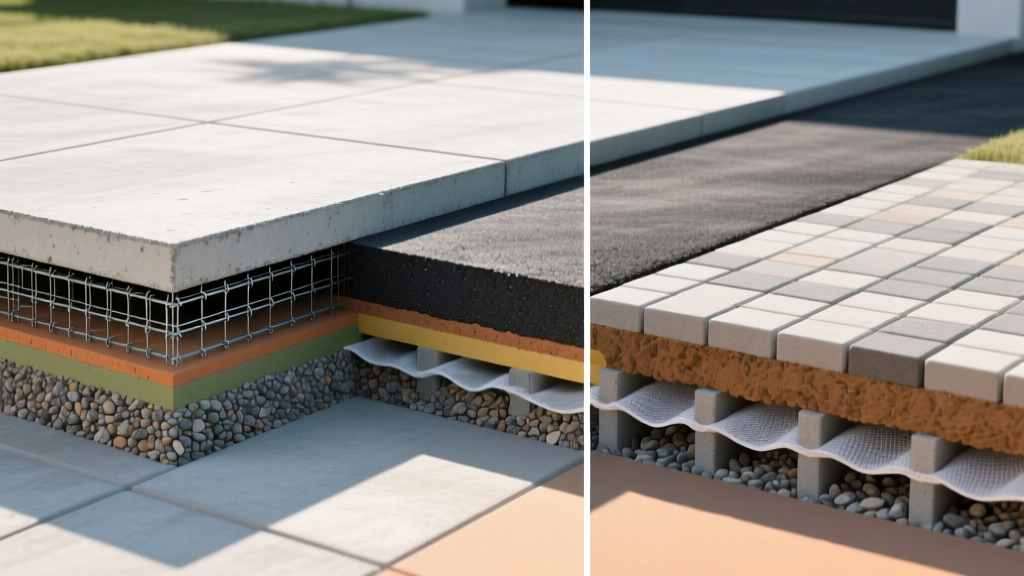
Regardless of whether you choose concrete, asphalt, or pavers, the lifespan of your driveway is dictated by the dirt beneath it. A common failure point in residential driveways is inadequate subgrade compaction. The native soil must be excavated to a depth of 8 to 12 inches and replaced with a compacted base of crushed angular gravel (typically 3/4-inch minus). This base must be mechanically compacted to 95% Standard Proctor density. Furthermore, a 10-mil polyethylene vapor barrier should be placed beneath concrete slabs to prevent moisture migration from the soil, which can cause floor covering failures if the driveway connects to an interior garage slab. Skipping subgrade preparation to save $1,500 on a 1,000-square-foot project will inevitably result in catastrophic differential settling within the first five years.
Written by
David NakamuraDavid Nakamura is a licensed architect (AIA) and construction technology writer focused on sustainable building methods, mass timber engineering, and high-performance building envelopes. He holds a Master of Architecture from the University of Washington and is a certified Passive House Consultant (CPHC). David spent eight years at the Seattle firm Mithun, where he led the design of three LEED Platinum projects, before founding his own practice specializing in net-zero residential design. He serves on the editorial advisory board of GreenBuilder Magazine and has authored peer-reviewed papers on cross-laminated timber (CLT) connections for the Journal of Structural Engineering. In his spare time, David teaches woodworking at Pratt Fine Arts Center and kayaks the Puget Sound.
More from David Nakamura
View all
Construction Cost
Labor Cost to Build a Deck Per Sq Ft: 2026 Installation Guide
Discover the exact labor cost to build a deck per sq ft in 2026. This installation guide breaks down contractor rates, complexity factors, and hidden fees.
Aug 4, 2026

Construction Cost
How Much Does It Cost to Build a 3 Bedroom House? Financing Guide
Learn exactly how much it costs to build a 3 bedroom house and explore 2026 financing options, construction loan types, and budget frameworks for your build.
Aug 4, 2026

Construction Cost
Cost to Build a Tennis Court: 2026 Guide
How much does it cost to build a tennis court in 2026? Breakdowns for asphalt, concrete, and synthetic surfaces plus fencing and lighting.
Jul 30, 2026