Grind and Seal vs Polished Concrete: 2026 Cost Breakdown
Compare the 2026 costs of grind and seal vs polished concrete. Detailed pricing, material breakdowns, and long-term ROI analysis for commercial floors.

The Fundamental Process Divergence
When evaluating decorative concrete flooring for commercial or high-traffic residential spaces, the distinction between a grind and seal finish and mechanically polished concrete dictates not only the initial capital expenditure but the decade-long maintenance budget. While both processes begin with heavy-duty planetary grinders equipped with metal-bonded diamonds to cut the surface, the divergence occurs at the 200-grit mark. Understanding this mechanical and chemical divergence is the only way to accurately forecast your 2026 flooring costs.
A grind and seal process halts mechanical refinement early, relying on a topical film-forming sealer (typically polyurethane or acrylic) to provide the sheen and protection. Polished concrete, conversely, abandons topical films entirely after the densification stage, relying on mechanical burnishing up to 3,000 grit to achieve reflectivity. This fundamental difference in material science drives a massive wedge between the two pricing models.
Grind and Seal: 2026 Cost and Material Analysis
The grind and seal method is fundamentally a surface-coating system applied to a mechanically prepared substrate. The concrete is ground to a 100 or 200 metal-bond grit to remove laitance and open the pores, followed by the application of a penetrating primer and two coats of a high-solids topical sealer.
Labor and Material Pricing
For a standard 5,000 square foot commercial space, the national average cost for a professional grind and seal ranges from $3.50 to $6.50 per square foot in 2026. The lower end assumes a slab in excellent condition requiring minimal patching, while the upper end accounts for extensive joint filling and the use of premium aliphatic polyurethanes.
- Preparation & Grinding (30% of cost): $1.00 - $1.50/sq ft. Includes shot-blasting or coarse diamond grinding.
- Patching & Joint Filling (15% of cost): $0.50 - $1.00/sq ft. Utilizing polyurea or epoxy semi-rigid fillers like Metzger/McGuire Spal-Pro.
- Sealer Materials (25% of cost): $0.80 - $1.50/sq ft. Water-based aliphatic polyurethanes (e.g., Euclid Chemical EverClear WB) offer UV stability and non-yellowing properties, costing roughly 30% more than solvent-based acrylics but providing double the abrasion resistance.
- Application Labor (30% of cost): $1.20 - $2.50/sq ft. Rolling or spraying two coats with strict recoat windows.
Topical sealers trap moisture. If your slab emits moisture vapor exceeding 3 lbs per 1,000 sq ft per 24 hours (per ASTM F1869 calcium chloride testing) or 75% Relative Humidity (per ASTM F2170 in-situ probes), the sealer will blister and delaminate within months. Mitigating this requires an epoxy moisture vapor barrier (MVB) primer, adding $2.50 to $4.00 per square foot to your baseline budget.
Polished Concrete: The Grit Progression Premium
Mechanically polished concrete is a multi-step abrasive refinement process. The concrete is densified using a chemical hardener—typically a lithium or potassium silicate solution such as PROSOCO Consolideck LS—which reacts with the free lime in the concrete to form calcium silicate hydrate (C-S-H). This permanently hardens the surface, allowing it to be burnished to a glass-like finish without topical coatings.
Pricing by Aggregate Exposure and Grit Level
Because polishing requires passing over the floor multiple times with progressively finer resin-bonded diamonds, labor scales linearly with the desired grit level. According to industry benchmarks tracked by Concrete Network, a basic polish (400 grit) starts around $5.00 per square foot, while a high-gloss salt-and-pepper finish (1,500+ grit) pushes past $12.00 per square foot.
| Polish Level | Final Grit | Reflectivity / Sheen | 2026 Avg Cost (per sq ft) |
|---|---|---|---|
| Level 1 (Flat) | 100 - 200 Resin | Matte / Low Sheen | $4.50 - $6.00 |
| Level 2 (Satin) | 400 Resin | Satin / Semi-Gloss | $6.00 - $8.50 |
| Level 3 (Polished) | 800 Resin | High Sheen / Reflective | $8.50 - $11.00 |
| Level 4 (Highly Polished) | 1,500 - 3,000 Resin | Mirror / Glass-like | $11.00 - $15.00+ |
Head-to-Head Cost Comparison Matrix
Choosing between these two systems requires looking past the day-one invoice. The following matrix breaks down the financial and operational realities of both finishes over a 10-year lifecycle.
| Financial Metric | Grind and Seal | Mechanically Polished |
|---|---|---|
| Initial Installation Cost | $3.50 - $6.50 / sq ft | $6.00 - $15.00 / sq ft |
| Expected Lifespan (High Traffic) | 2 to 4 years before recoat | 10 to 20+ years |
| Routine Maintenance Cost | Moderate (Requires specific pH-neutral cleaners to protect film) | Low (Auto-scrubbing with water or mild conditioner) |
| 10-Year Recoat / Refurbishment | $2.00 - $4.00 / sq ft (Requires full re-grind and reseal every 3 years) | $0.50 - $1.50 / sq ft (Burnishing with diamond-impregnated pads) |
| Slip Resistance (Wet) | Low to Moderate (Depends on anti-slip additives in sealer) | High (Meets OSHA/ADA standards even when wet, if properly maintained) |
Long-Term ROI and Maintenance Economics
The initial cost savings of a grind and seal system are rapidly eroded in high-traffic environments such as retail showrooms, restaurants, or busy warehouse aisles. Topical sealers are sacrificial layers; they scratch, scuff, and degrade under UV exposure and foot traffic. When a polyurethane sealer fails, you cannot simply apply a new coat over the old one. The floor must be chemically stripped or mechanically re-ground to remove the failing film, re-prepped, and resealed. According to facility management data summarized by Angi, the 10-year cost of ownership for a topical sealed floor often exceeds that of a Level 3 polished floor due to these mandatory refurbishment cycles.
The Break-Even Point
For spaces with low foot traffic (e.g., private residential garages, low-use storage rooms, or boutique retail with strict shoe policies), the grind and seal system remains the most economically sound choice. The break-even point where polished concrete becomes the cheaper long-term investment typically occurs around year four or five, coinciding with the second mandatory recoat of a topical sealer.
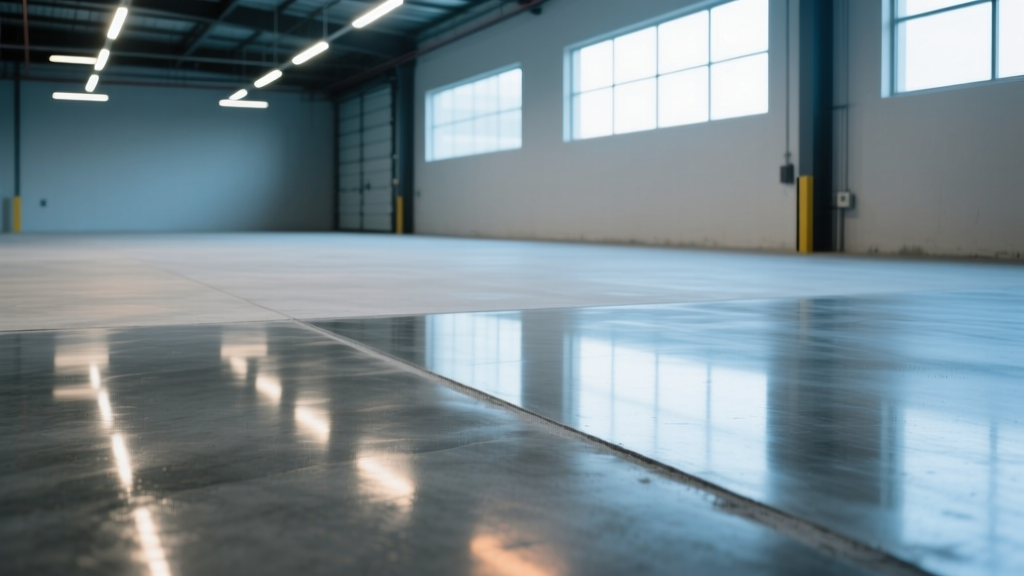
Edge Cases That Destroy Your Budget
Both systems are highly vulnerable to specific slab conditions. Failing to identify these during the initial site walk will result in massive change orders.
- Existing Mastics and Coatings: If the slab previously had VCT tile or epoxy, removing the residual mastic requires aggressive scarification or shot-blasting before polishing can begin. This adds $1.50 to $3.00 per square foot. Grind and seal is slightly more forgiving, as the topical sealer can mask minor staining, but heavy mastic shadows will still bleed through light-colored sealers.
- Soft or Crazed Concrete: Concrete with a low compressive strength (below 3,000 PSI) or surface crazing will not take a mechanical polish. The diamonds will tear the aggregate out, leaving a pitted, ugly surface. In these cases, a grind and seal is mandatory, but it requires a heavy-bodied, high-solids epoxy primer to fill the micro-voids before the polyurethane topcoat is applied.
- Control Joint Widths: Polished concrete looks best with tight, clean control joints. If your slab has spalled or widened joints (greater than 1/4 inch), filling them with polyurea and polishing flush is incredibly labor-intensive. Many contractors will charge a premium linear foot rate for joint prep on polished jobs, whereas grind and seal contractors often leave joints un-filled or simply brush sealer into them.
Choose Grind and Seal if your budget is strictly capped under $5.00/sq ft, the space experiences low-to-moderate traffic, and you have a planned capital expenditure for floor refurbishment every 36 months.
Choose Polished Concrete if you are building a high-traffic commercial facility, require ADA-compliant slip resistance, want to eliminate volatile organic compounds (VOCs) from topical film-forming chemicals, and view the floor as a 15-year capital asset rather than a recurring maintenance line item.
Written by
David NakamuraDavid Nakamura is a licensed architect (AIA) and construction technology writer focused on sustainable building methods, mass timber engineering, and high-performance building envelopes. He holds a Master of Architecture from the University of Washington and is a certified Passive House Consultant (CPHC). David spent eight years at the Seattle firm Mithun, where he led the design of three LEED Platinum projects, before founding his own practice specializing in net-zero residential design. He serves on the editorial advisory board of GreenBuilder Magazine and has authored peer-reviewed papers on cross-laminated timber (CLT) connections for the Journal of Structural Engineering. In his spare time, David teaches woodworking at Pratt Fine Arts Center and kayaks the Puget Sound.
More from David Nakamura
View all
Construction Cost
Labor Cost to Build a Deck Per Sq Ft: 2026 Installation Guide
Discover the exact labor cost to build a deck per sq ft in 2026. This installation guide breaks down contractor rates, complexity factors, and hidden fees.
Aug 4, 2026

Construction Cost
How Much Does It Cost to Build a 3 Bedroom House? Financing Guide
Learn exactly how much it costs to build a 3 bedroom house and explore 2026 financing options, construction loan types, and budget frameworks for your build.
Aug 4, 2026

Construction Cost
Cost to Build a Tennis Court: 2026 Guide
How much does it cost to build a tennis court in 2026? Breakdowns for asphalt, concrete, and synthetic surfaces plus fencing and lighting.
Jul 30, 2026