What Type of Mixture Is Concrete? Composite vs. Modern Alternatives
Discover what type of mixture concrete is, how its heterogeneous composite structure works, and how it compares to asphalt, geopolymer, and ECC alternatives.
The Chemistry and Physics: What Type of Mixture Is Concrete Really?
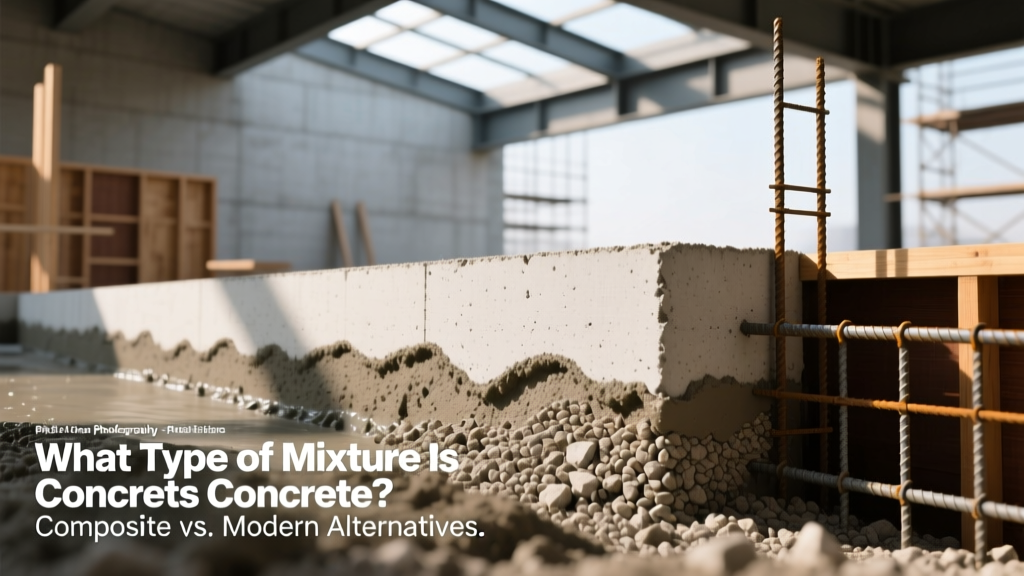
To answer the fundamental question—what type of mixture is concrete—we must look at materials science. Concrete is a heterogeneous composite mixture. It is neither a pure chemical compound nor a homogeneous solution. Instead, it consists of two distinct phases: a continuous binding matrix (the cement paste) and a dispersed particulate phase (the aggregates).
Unlike a simple suspension where particles might settle out, the cement paste in concrete undergoes an irreversible chemical reaction called hydration. When Portland cement (conforming to ASTM C150 standards) meets water, it forms calcium silicate hydrate (C-S-H) gel and calcium hydroxide. This C-S-H gel acts as the microscopic glue that locks the sand and coarse aggregates (conforming to ASTM C33) into a rigid, stone-like mass.
Concrete does not 'dry' to achieve strength. It cures through hydration. If a concrete mixture dries out prematurely (loses moisture to evaporation), the hydration reaction halts, resulting in a weak, dusty surface prone to scaling. This is why wet-curing or applying membrane-forming curing compounds is mandatory for structural integrity.
Mixture Comparison Matrix: Concrete vs. Alternatives
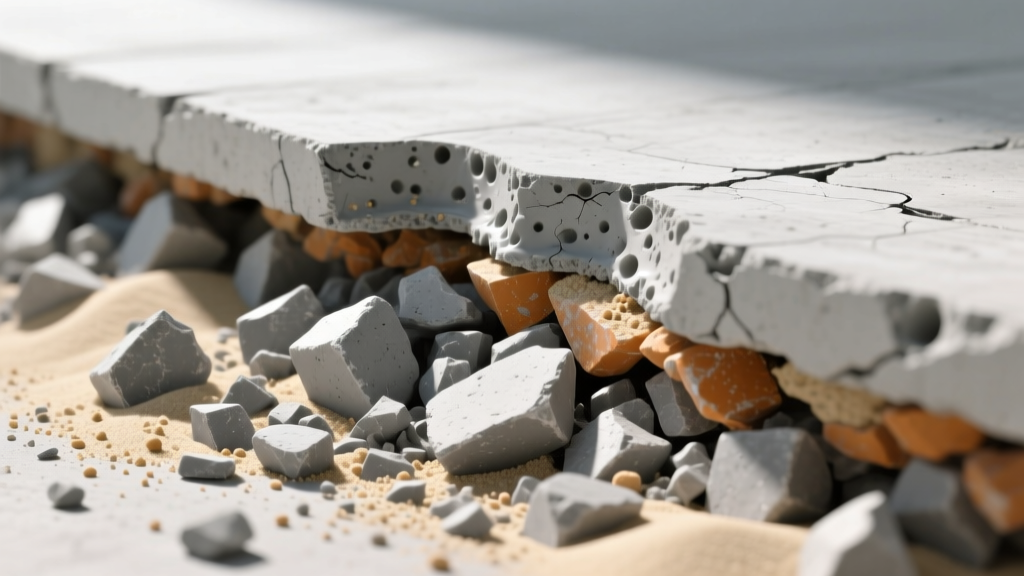
Understanding the heterogeneous nature of standard Portland cement concrete allows engineers to select alternative mixtures when specific performance criteria—such as flexibility, carbon footprint, or tensile ductility—outweigh raw compressive strength.
| Material | Mixture Classification | Binder Type | 28-Day Compressive Strength | Primary Failure Mode |
|---|---|---|---|---|
| Standard Concrete | Heterogeneous Composite | Portland Cement (Hydraulic) | 3,000 - 6,000 psi | Brittle cracking under tension |
| Asphalt Concrete | Viscoelastic Granular Mix | Bitumen (Petroleum-based) | N/A (Measured in Stability) | Rutting and thermal cracking |
| Geopolymer Concrete | Alkali-Activated Composite | Fly Ash/Slag + Alkaline Activator | 4,000 - 8,000 psi | Efflorescence and shrinkage |
| ECC (Bendable Concrete) | Fiber-Reinforced Micromechanical | Cement + PVA Microfibers | 4,000 - 7,000 psi | Fiber pull-out (highly ductile) |
Evaluating Alternative Mixtures for Specific Applications
While standard concrete remains the default for foundations and structural frames due to its predictable cost and widespread availability via ready-mix trucks, alternative mixtures solve specific engineering problems that traditional heterogeneous composites cannot.
Asphalt Concrete (Bituminous Mixtures)
Asphalt concrete replaces the hydraulic cement binder with bitumen, a viscoelastic hydrocarbon. Because bitumen does not undergo a chemical hydration reaction, asphalt remains a thermoplastic mixture. It softens in high heat and stiffens in freezing temperatures.
When to choose it: Asphalt is superior for horizontal paving applications subjected to heavy dynamic loads and freeze-thaw cycles. Its flexibility allows it to absorb minor subgrade settlements without catastrophic cracking, a scenario where rigid Portland cement concrete would snap. However, it lacks the compressive strength required for vertical structural loads.
Geopolymer Concrete (Alkali-Activated Mixtures)
Geopolymer concrete eliminates Portland cement entirely, addressing the massive carbon footprint associated with clinker production. Instead, it utilizes industrial byproducts like Class F fly ash or ground granulated blast-furnace slag (GGBFS), activated by a highly alkaline solution (typically sodium silicate and sodium hydroxide).
When to choose it: Specify geopolymer mixtures for marine environments, wastewater treatment plants, or chemical storage facilities. The resulting aluminosilicate gel is highly resistant to sulfate attack and chloride ion penetration, significantly outperforming standard concrete in corrosive environments. The trade-off is a more complex curing process, often requiring heat curing or strict ambient temperature controls during placement.
Engineered Cementitious Composites (ECC)
Often marketed as 'bendable concrete,' ECC alters the mixture design at the micromechanical level. By incorporating 2% polyvinyl alcohol (PVA) microfibers and deliberately omitting coarse aggregates, ECC achieves a tensile strain capacity of 3% to 5%—roughly 300 to 500 times greater than standard concrete. Under tension, it forms tight, self-healing microcracks (less than 60 micrometers wide) rather than wide, structural fissures.
When to choose it: Use ECC for seismic retrofitting, bridge deck link slabs, and infrastructure subjected to high tensile stress. It eliminates the need for heavy steel rebar in specific thin-shell applications, reducing overall dead load.
2026 Cost and Procurement Realities
Material selection is heavily dictated by project economics. Below are the baseline material costs for commercial procurement in North America as of early 2026. Note that these figures represent the raw material cost per cubic yard (or equivalent volume) and exclude site preparation, forming, and labor.
- Standard Ready-Mix Concrete (4,000 psi): $135 – $165 per cubic yard. Highly commoditized; available within a 60-minute transit radius of most batch plants.
- Geopolymer Concrete: $185 – $240 per cubic yard. The premium reflects the specialized chemical activators and the limited number of batch plants equipped to handle highly alkaline solutions safely.
- Engineered Cementitious Composites (ECC): $1,100 – $1,500+ per cubic yard. Due to the high cost of PVA fibers and proprietary admixtures, ECC is rarely used for mass pours. It is typically purchased in pre-bagged, dry-mix form for targeted repair work or specialized precast elements.
- Hot Mix Asphalt (HMA): $110 – $140 per ton. (Pricing is calculated by weight, not volume, and varies heavily based on regional liquid asphalt binder indices).
Troubleshooting Mixture Design Failures
Even when the correct heterogeneous mixture is specified, on-site errors can compromise the structural matrix. Avoid these critical field mistakes:
- Re-tempering with Water: Adding water to the transit mixer on-site to improve workability increases the water-to-cement (w/c) ratio. Every 0.05 increase in the w/c ratio above the design target (usually 0.45) can reduce compressive strength by up to 10% and increase permeability. Fix: Use high-range water reducers (HRWR / superplasticizers) to restore slump without adding water.
- Confusing Cement Types for Cold Weather: Pouring standard Type I cement in near-freezing temperatures delays hydration, risking frost damage before the concrete reaches 500 psi. Fix: Specify Type III (High Early Strength) cement or use accelerating admixtures (non-chloride based to protect embedded steel) to generate rapid heat of hydration.
- Over-Vibration: While mechanical vibration is necessary to consolidate the mixture and eliminate honeycombing, excessive vibration causes aggregate segregation. The heavier coarse aggregates sink to the bottom, leaving a weak, cement-rich layer at the surface that will craze and scale. Fix: Limit vibration to 5–15 seconds per insertion point, withdrawing the vibrator slowly to close the void.
Expert Insight: The fundamental rule of concrete mixture design is that water is the enemy of strength. The absolute minimum amount of water required to fully hydrate Portland cement is a w/c ratio of roughly 0.22 to 0.25. Any water added beyond this threshold solely for workability will eventually evaporate, leaving behind a network of capillary pores that dictate the concrete's ultimate permeability and vulnerability to freeze-thaw spalling.
Written by
Marcus ChenMarcus Chen is a licensed structural engineer (PE) and building materials analyst with over 12 years of experience across residential, commercial, and industrial construction. He holds a Master of Science in Civil Engineering from UC Berkeley and spent six years at Thornton Tomasetti before transitioning to independent consulting and technical writing. Marcus specializes in material selection for seismic-prone regions, concrete reinforcement strategies, and lifecycle cost analysis. His work has been cited by the American Concrete Institute (ACI) and the Structural Engineers Association of California (SEAOC). When he is not on a job site or at his desk, you will find him hiking the Sierra Nevada or restoring a 1920s craftsman bungalow in Oakland, CA.
More from Marcus Chen
View all
Construction Cost
How Much Did the Eiffel Tower Cost to Build?
How much did the Eiffel Tower cost to build in 1889? We adjust for inflation and compare its budget to modern skyscraper construction.
Aug 4, 2026

Fire Resistance
What Is a Fire Resistant Material? Testing & Certification Guide
Discover what is a fire resistant material through ASTM and UL testing. Learn how fire ratings, certifications, and assemblies work in construction.
Aug 4, 2026

Construction Cost
How Much Did the Burj Khalifa Cost to Build?
How much did the Burj Khalifa cost to build? We break down the $1.5B project and extract 5 money-saving strategies for your next build.
Jul 30, 2026