Gravel vs Concrete Driveway Cost: Mix Design & Lifecycle Value
Compare gravel vs concrete driveway cost through the lens of mix design, aggregate engineering, and 20-year lifecycle value to choose the right surface.

The Core Material Breakdown: What Are You Actually Paying For?
When evaluating the gravel vs concrete driveway cost, most homeowners focus exclusively on the day-one installation price. However, from a materials engineering perspective, you are paying for two entirely different structural systems. Concrete is a rigid, chemically cured composite relying on precise mix designs and tensile reinforcement. Gravel is a flexible, unbound aggregate system relying on mechanical interlock, particle angularity, and subsurface drainage.
Understanding the material science behind both options shifts the conversation from a simple price-per-square-foot metric to a comprehensive lifecycle cost analysis. The upfront cost of a concrete driveway typically ranges from $8.50 to $14.00 per square foot in 2026, while a properly engineered gravel driveway costs between $2.25 and $4.50 per square foot. But to understand why these prices exist—and how they hold up over 20 years—we must examine the specific mix designs and aggregate profiles that dictate their performance.
Concrete Driveway Mix Designs: How PSI and Additives Drive Cost
The cost of a concrete driveway is directly tied to its mix design. A standard residential driveway requires a minimum compressive strength of 4,000 PSI (pounds per square inch) to withstand vehicular loads without micro-fracturing. Upgrading from a basic 3,000 PSI mix to a 4,000 PSI mix adds approximately $15 to $25 per cubic yard to the ready-mix batch price, but it increases the surface lifespan by decades.
Critical Mix Parameters for Driveways
- Water-Cement (w/c) Ratio: Must be kept at or below 0.45. Higher water content increases workability for the finishing crew but drastically reduces final compressive strength and increases permeability.
- Aggregate Sizing: A 3/4-inch maximum nominal aggregate size is standard. This provides optimal interlock for load-bearing capacity while remaining small enough to navigate around rebar or wire mesh.
- Air Entrainment: Microscopic air bubbles (5-7% of total volume) act as pressure relief valves when trapped water freezes and expands. According to the Portland Cement Association, proper air entrainment is the single most critical factor for concrete durability in northern climates.
- Slump: Target a 4-inch to 5-inch slump. If the truck arrives with a 7-inch slump, the batch has too much water and should be rejected or dosed with a mid-range water reducer (plasticizer) on-site.
Beyond the base mix, reinforcement strategies alter the final cost. Synthetic macro-fibers (added directly to the ready-mix truck at the batch plant) cost about $8 to $12 per cubic yard and provide excellent secondary shrinkage crack control. Traditional 6x6 W1.4xW1.4 welded wire mesh (WWM) requires manual placement on chairs, adding $0.40 to $0.60 per square foot in labor and materials, but offers superior structural load distribution across soft subgrades.
Gravel Driveway Profiles: Aggregate Engineering and Base Design
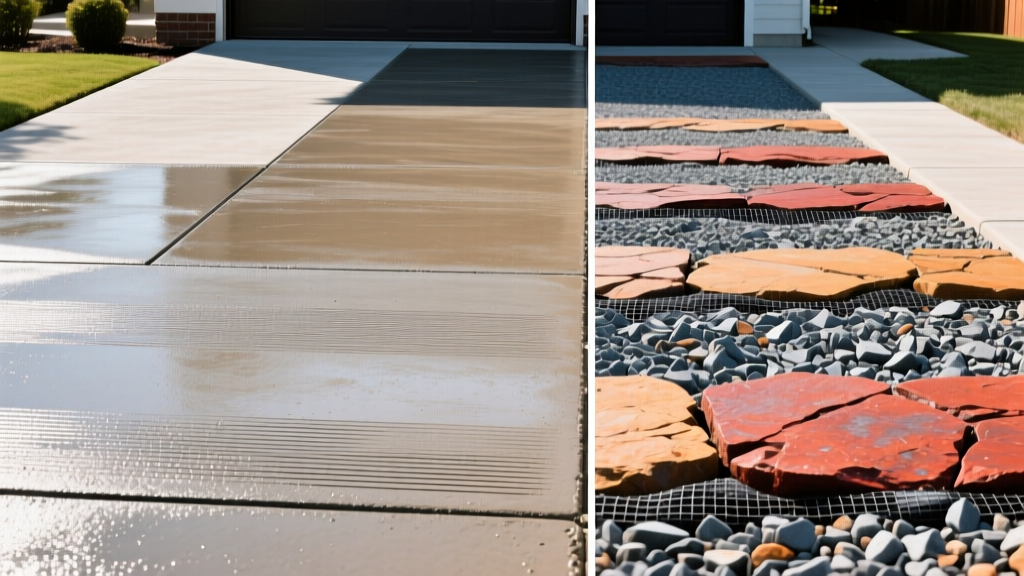
The phrase "gravel driveway" is a misnomer that leads to premature failure. A high-performance gravel driveway is actually a three-layer flexible pavement system. If a contractor simply dumps rounded river rock or pea gravel on top of native topsoil, the surface will rut and wash out within a single season. The cost of a gravel driveway is driven by the depth of excavation, the use of geotextiles, and the specific gradation of crushed stone.
The Three-Layer Aggregate System
- Subgrade Preparation & Geotextile Fabric: Native soil must be stripped of topsoil and compacted. A non-woven geotextile fabric (costing $0.30 to $0.55 per square foot) is laid over the subgrade. This fabric separates the aggregate from the native clay/silt, preventing the gravel from sinking into the mud while allowing water to permeate downward.
- Base Course (2 to 4 inches): This layer utilizes large, angular crushed stone, typically designated as #3 or #4 stone (ranging from 1.5 to 2.5 inches in diameter). The angular faces mechanically interlock under compaction, creating a rigid foundation that distributes vehicular weight across the subgrade.
- Surface Course (2 to 3 inches): The driving surface requires #57 crushed stone (roughly 3/4-inch angular gravel) mixed with stone dust (often called "crusher run" or "dense-graded aggregate"). The stone dust fills the voids between the larger 3/4-inch stones, allowing the layer to compact into a nearly impermeable, concrete-like surface that still retains flexibility.
"The success of an unbound aggregate driveway relies entirely on particle angularity. Rounded aggregates like pea gravel lack internal friction and will displace laterally under tire shear forces, regardless of how deeply they are installed."
— Guidelines derived from the American Concrete Institute and aggregate base specification standards.
Cost Comparison Matrix: Upfront vs. 20-Year Lifecycle
To accurately compare the gravel vs concrete driveway cost, we must project maintenance, repair, and replacement intervals over a standard 20-year ownership period. The data below assumes a standard 600-square-foot residential driveway (12x50 feet) in a temperate climate with moderate freeze-thaw cycles.
| Cost Metric | 4,000 PSI Concrete (Broom Finish) | Engineered Crushed Gravel (3-Layer) |
|---|---|---|
| Initial Installation (600 sq ft) | $6,300 - $8,400 | $1,500 - $2,400 |
| Annual Maintenance Cost | $0 - $50 (Sealing every 3 years) | $150 - $250 (Annual re-grading/top-dressing) |
| Weed/Erosion Control | Minimal (Joint sand stabilization) | Moderate (Herbicide or manual pulling) |
| Snow Removal Impact | Excellent (Plow-safe with proper curing) | Poor (Plows displace surface gravel) |
| Estimated 20-Year Total Cost | $6,800 - $9,400 | $4,500 - $7,400 |
Climate and Soil Decision Framework: When to Choose Which
The final decision between gravel and concrete should not be based on budget alone, but on the geotechnical properties of your site and your local climate. Use the following framework to determine the optimal material for your specific environment.
Choose 4,000 PSI Air-Entrained Concrete When:
- Heavy Snowfall Regions: If you rely on commercial snow plows, gravel is virtually impossible to maintain. Plow blades will routinely scrape and displace the surface course, requiring massive annual top-dressing.
- Expansive Clay Soils: Soils with high plasticity indices swell dramatically when wet. A rigid concrete slab, properly reinforced with thickened edges or post-tensioning, can bridge minor subgrade variations that would cause a flexible gravel driveway to rut and washboard.
- Steep Gradients (>12% slope): Water runoff on steep driveways will continuously wash away the stone dust binder in a gravel surface, exposing the larger #57 stone and creating severe erosion channels.
Choose Engineered Crushed Gravel When:
- High Water Tables & Poor Drainage: If your property suffers from standing water or a high seasonal water table, concrete slabs are prone to hydrostatic pressure cracking and mud-jacking failures. Gravel's inherent permeability allows surface water to infiltrate and disperse naturally.
- Rural or Heavy Timber Environments: In heavily wooded areas, tree roots will inevitably heave and crack rigid concrete. A flexible gravel surface can be easily re-graded and repaired with a box blade and a fresh load of crusher run, avoiding the $2,000+ cost of concrete slab replacement.
- Low California Bearing Ratio (CBR) Subgrades: If soil testing reveals a CBR value below 5, the cost to excavate and import structural fill to support a concrete slab becomes prohibitive. A thick, geotextile-separated gravel base can accommodate softer subgrades more economically.
Ultimately, mastering the gravel vs concrete driveway cost analysis requires looking past the initial contractor quote. By specifying a 4,000 PSI air-entrained mix with a 0.45 w/c ratio for concrete, or a three-layer crushed angular system with geotextile separation for gravel, you ensure that whichever material you choose is engineered to survive the specific environmental stresses of your property.
Written by
David NakamuraDavid Nakamura is a licensed architect (AIA) and construction technology writer focused on sustainable building methods, mass timber engineering, and high-performance building envelopes. He holds a Master of Architecture from the University of Washington and is a certified Passive House Consultant (CPHC). David spent eight years at the Seattle firm Mithun, where he led the design of three LEED Platinum projects, before founding his own practice specializing in net-zero residential design. He serves on the editorial advisory board of GreenBuilder Magazine and has authored peer-reviewed papers on cross-laminated timber (CLT) connections for the Journal of Structural Engineering. In his spare time, David teaches woodworking at Pratt Fine Arts Center and kayaks the Puget Sound.
More from David Nakamura
View all
Construction Cost
Labor Cost to Build a Deck Per Sq Ft: 2026 Installation Guide
Discover the exact labor cost to build a deck per sq ft in 2026. This installation guide breaks down contractor rates, complexity factors, and hidden fees.
Aug 4, 2026

Construction Cost
How Much Does It Cost to Build a 3 Bedroom House? Financing Guide
Learn exactly how much it costs to build a 3 bedroom house and explore 2026 financing options, construction loan types, and budget frameworks for your build.
Aug 4, 2026

Construction Cost
Cost to Build a Tennis Court: 2026 Guide
How much does it cost to build a tennis court in 2026? Breakdowns for asphalt, concrete, and synthetic surfaces plus fencing and lighting.
Jul 30, 2026