Clay Pavers vs Concrete Pavers: Technical Specs & ASTM Standards
Compare clay pavers vs concrete pavers using ASTM C902 and C936 technical specs, compressive strength, absorption rates, and freeze-thaw data.

Core Material Composition and Manufacturing Standards
The fundamental divergence between clay pavers and concrete pavers begins at the molecular level and is codified by two distinct ASTM International standards. Clay pavers are governed by ASTM C902 (Standard Specification for Vehicular and Pedestrian Brick), while concrete pavers fall under ASTM C936 (Standard Specification for Solid Concrete Interlocking Paving Units).
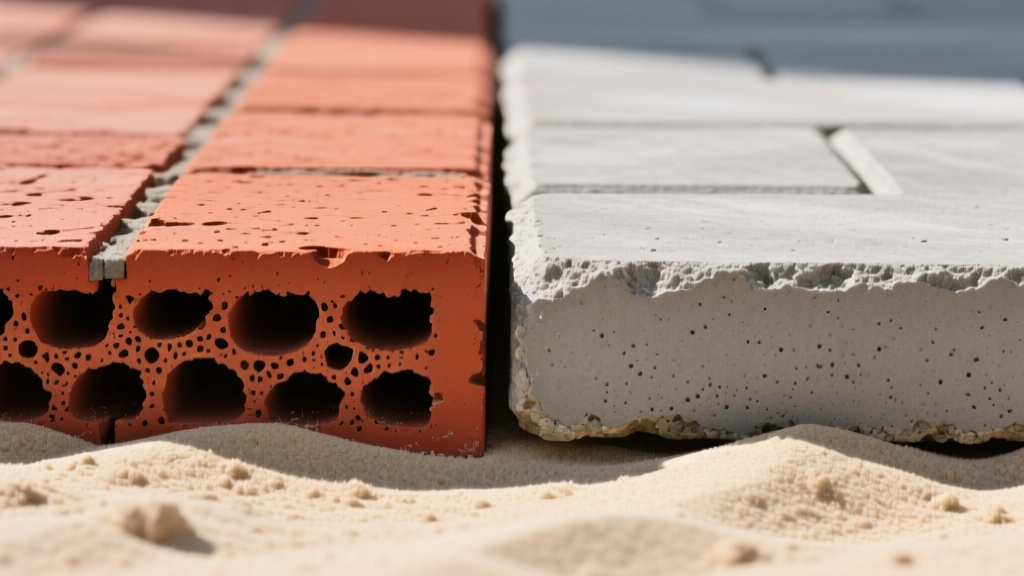
Clay pavers are manufactured from natural shale and clay, extruded or molded, and fired in kilns at temperatures exceeding 2,000°F (1,093°C). This vitrification process fuses the silica and alumina into a dense, ceramic matrix. Concrete pavers, conversely, are formed from a zero-slump mixture of Portland cement, fine aggregates, and pigments. They are vibro-compacted under high pressure in steel molds and air-cured, relying on the hydration of cement for structural integrity rather than thermal fusion.
Compressive Strength and Load-Bearing Capacities
When evaluating clay pavers vs concrete pavers for vehicular applications, compressive strength is the primary engineering metric. Both materials easily exceed the requirements for residential driveways and commercial parking lots, but their failure modes differ.
- Clay Pavers (ASTM C902 Type I): Minimum average compressive strength of 10,000 psi, with no individual unit below 8,800 psi. High-density clay pavers routinely achieve 12,000 to 14,000 psi in independent lab testing.
- Concrete Pavers (ASTM C936): Minimum average compressive strength of 8,000 psi, with no individual unit below 7,200 psi. Premium commercial-grade concrete pavers can reach 9,500 psi.
While clay boasts a higher raw PSI, concrete pavers utilize geometric interlocking shapes (e.g., I-shapes, hexagons) to distribute dynamic vehicular loads laterally across the paving matrix. Clay pavers are typically rectangular and rely on dense herringbone or basketweave laying patterns, combined with rigid edge restraints, to achieve structural interlock. According to the Brick Industry Association (BIA), clay pavers in a 90-degree herringbone pattern distribute loads so effectively that they are routinely specified for heavy-duty industrial ports and fire lanes.
Water Absorption, Freeze-Thaw Durability, and Efflorescence
Moisture management is where the material science of clay and concrete diverges most drastically, directly impacting long-term maintenance and aesthetics in cold climates.
| Technical Metric | Clay Pavers (ASTM C902 SX) | Concrete Pavers (ASTM C936) |
|---|---|---|
| Max Water Absorption | 6.0% (Severe Weathering) | 5.0% (Severe Weathering) |
| Freeze-Thaw Cycles | 50 cycles (max 0.5% weight loss) | 50 cycles (max 1.0% weight loss) |
| Efflorescence Potential | Virtually None | High (Requires chemical mitigation) |
| Modulus of Rupture (Flexural) | ~1,500 - 2,000 psi | ~600 - 900 psi |
The Efflorescence Factor
Efflorescence—the unsightly white, powdery residue that appears on paving surfaces—is a chemical reaction inherent to Portland cement. As water moves through concrete pavers, it dissolves calcium hydroxide (a byproduct of cement hydration) and carries it to the surface. Upon contact with atmospheric carbon dioxide, it crystallizes into calcium carbonate.
Because clay pavers are fired and contain zero Portland cement, they lack the free lime required to produce primary efflorescence. Any white residue on clay is typically secondary efflorescence from the cementitious base layer or jointing sand, which washes away naturally with rain.
The Interlocking Concrete Pavement Institute (ICPI) recommends using efflorescence-inhibiting admixtures during manufacturing and applying specialized silane/siloxane sealers post-installation to mitigate this issue in concrete pavers, adding to the lifecycle maintenance cost.
Dimensional Tolerances and Installation Mechanics
Precision in manufacturing dictates the speed of installation and the type of jointing sand required. Concrete pavers are machine-molded with extreme precision, while clay pavers exhibit slight organic variations due to the firing process.
- Concrete Paver Tolerances: Typically ±1/16 inch (1.5 mm) in length and width. This uniformity allows for tight, 1/16-inch joints and the use of fine, standard masonry sand.
- Clay Paver Tolerances: Typically ±3/32 inch (2.4 mm). To accommodate this, clay pavers are often manufactured with chamfered (beveled) edges, which visually mask size discrepancies and create a natural V-joint that holds coarse, sharp concrete sand securely.
For large-scale commercial projects, the dimensional consistency of concrete pavers allows for mechanical installation using vacuum lifters and hydraulic clamps, drastically reducing labor costs. Clay pavers, due to their slight size variations and heavier density, are predominantly laid by hand, increasing the initial installation timeline and labor expense.
Colorfastness and Abrasion Resistance Over Time
The longevity of the paver's aesthetic profile under heavy foot and vehicular traffic is governed by how the color is integrated into the unit.
Furthermore, concrete pigments are susceptible to UV degradation. Over a 15-to-20-year period, intense sunlight will cause the iron oxide pigments in concrete pavers to fade, shifting vibrant terracottas and charcoals into washed-out pastels. The ceramic glaze and natural mineral colors of fired clay are entirely UV-stable and will not fade over a 100-year lifespan.
Cost Analysis and Lifecycle ROI
While initial material costs heavily favor concrete, a 50-year lifecycle analysis narrows the gap significantly when factoring in maintenance, cleaning, and replacement.
- Material Cost (2026 Estimates): Standard concrete pavers range from $2.50 to $4.50 per square foot. Premium architectural clay pavers range from $4.50 to $8.00 per square foot.
- Installation Labor: Concrete (mechanical assist) averages $7.00 to $10.00 per square foot. Clay (hand-laid) averages $10.00 to $14.00 per square foot.
- Maintenance: Concrete requires periodic sealing ($0.50/sq ft every 3-5 years) and chemical efflorescence removal. Clay requires only occasional re-sanding of joints and basic pressure washing.
Decision Framework: When to Specify Which Material
Choosing between clay pavers vs concrete pavers should not be based on aesthetics alone. Use this technical decision matrix to align the material with the project's engineering demands:
- Specify Clay Pavers When: The project is in a historic district requiring authentic materials; the client demands zero efflorescence and UV-stable colors; the application involves heavy de-icing salt usage (clay is highly resistant to salt spalling); or the design relies on traditional rectangular laying patterns.
- Specify Concrete Pavers When: The project requires complex geometric interlocking shapes for heavy dynamic shear loads (e.g., port terminals, steep gradients); the budget is strictly constrained; mechanical installation is necessary to meet a tight construction schedule; or the design requires large-format slabs (e.g., 24x24 inches) which are structurally unfeasible in fired clay.
Written by
Sarah WhitfieldSarah Whitfield is a chartered quantity surveyor (MRICS) and construction cost analyst with 15 years of experience in material pricing, procurement strategy, and project budgeting. She earned her degree in Construction Management from the University of Reading (UK) and has worked on projects ranging from $2M custom homes to $180M mixed-use developments across North America and Europe. Sarah currently leads cost estimating for BuildMat Insight, maintaining a proprietary database of 4,000+ material price points updated quarterly. She is a frequent contributor to RSMeans cost data panels and has presented at the International Cost Engineering Council (ICEC) congress. Based in Denver, CO, Sarah is an avid trail runner and volunteer mentor for Women in Construction.
More from Sarah Whitfield
View all
Wood & Lumber
What Are the Different Types of Wood? A Builder's Guide
Compare structural softwoods, finish hardwoods, and engineered lumber. Analyze Janka ratings, MOE values, and 2026 pricing for construction.
Aug 4, 2026

Walls & Panels
Steel Framing vs Wood Framing: Corrosion and Moisture Defense
Compare steel framing vs wood framing for moisture resistance. Learn about galvanized coatings, condensation risks, and corrosion protection strategies.
Jul 21, 2026

Stone & Masonry
How to Cut Stone Veneer: Wet Saw vs Grinder Comparison
Compare the best tools for cutting stone veneer. We review wet saws, angle grinders, and chop saws to help you achieve clean, chip-free cuts.
Jul 21, 2026