Concrete vs Wood Railroad Ties: Technical Specs & Load Data
Compare concrete vs wood railroad ties with AREMA technical specs, load-bearing data, fastening systems, and failure modes for heavy-haul transit.

Material Properties and Dimensional Tolerances
The engineering divergence between timber and prestressed concrete sleepers fundamentally alters track geometry, load distribution, and maintenance cycles. While wood railroad ties rely on the natural flexibility and damping characteristics of cellular biomass, concrete ties utilize high-strength, pre-tensioned composite mechanics to resist heavy-haul axle loads. The American Railway Engineering and Maintenance-of-Way Association (AREMA) Chapter 30 establishes the baseline dimensional and material tolerances for both systems in North American transit and freight networks.
| Technical Specification | Wood Tie (Southern Yellow Pine) | Prestressed Concrete Tie |
|---|---|---|
| Standard Dimensions (W x H x L) | 7" x 9" x 102" (178 x 229 x 2591 mm) | 7" x 10" x 102" (178 x 254 x 2591 mm) |
| Average Unit Weight | 150 – 200 lbs (68 – 90 kg) | 650 – 800 lbs (295 – 363 kg) |
| Compressive Strength (Parallel to Grain / Concrete) | 7,000 – 8,500 psi | 8,000 – 10,000 psi (at 28 days) |
| Modulus of Elasticity (MOE) | 1.5 x 10^6 – 1.9 x 10^6 psi | 4.0 x 10^6 – 5.0 x 10^6 psi |
| Internal Reinforcement | N/A (Cellular lignin/cellulose matrix) | 6 to 8 strands of 0.2" low-relaxation prestressing steel |
| Preservative / Treatment | Creosote or Copper Naphthenate (AWPA U1) | N/A (Inherently rot/insect resistant) |
Track Modulus and Dynamic Load Distribution
Track modulus (u), measured in pounds per inch per inch (lb/in/in), dictates how a track structure distributes dynamic wheel loads into the underlying ballast and subgrade. This is the most critical differentiator when specifying concrete vs wood railroad ties for high-speed or heavy-haul corridors.
The Stiffness Differential
Wood ties yield a track modulus typically ranging from 1,500 to 3,000 lb/in/in. This relative flexibility allows the track to absorb high-frequency vibrations and minor subgrade inconsistencies without transferring destructive point-loads to the ballast. Conversely, prestressed concrete ties generate a track modulus between 4,000 and 8,000 lb/in/in. While this stiffness maintains superior gauge and alignment under 36-ton axle loads, it demands a deeper, highly angular crushed rock ballast profile. If concrete ties are installed on rounded gravel or fouled ballast, the rigid sleepers will "center-bind," leading to catastrophic negative bending moments.
Fastening System Mechanics and Gauge Retention
The interface between the rail base and the tie dictates longitudinal rail restraint and lateral gauge stability. The fastening mechanics differ radically between the two materials.
- Wood Tie Fastening: Relies on friction and the shear strength of the wood fibers. Standard configurations use 7.5" cut spikes or 6" screw spikes driven through a 14" or 16" steel tie plate. The gauge-holding capacity is directly proportional to the withdrawal resistance of the wood, which degrades as moisture content fluctuates and spike holes enlarge over time.
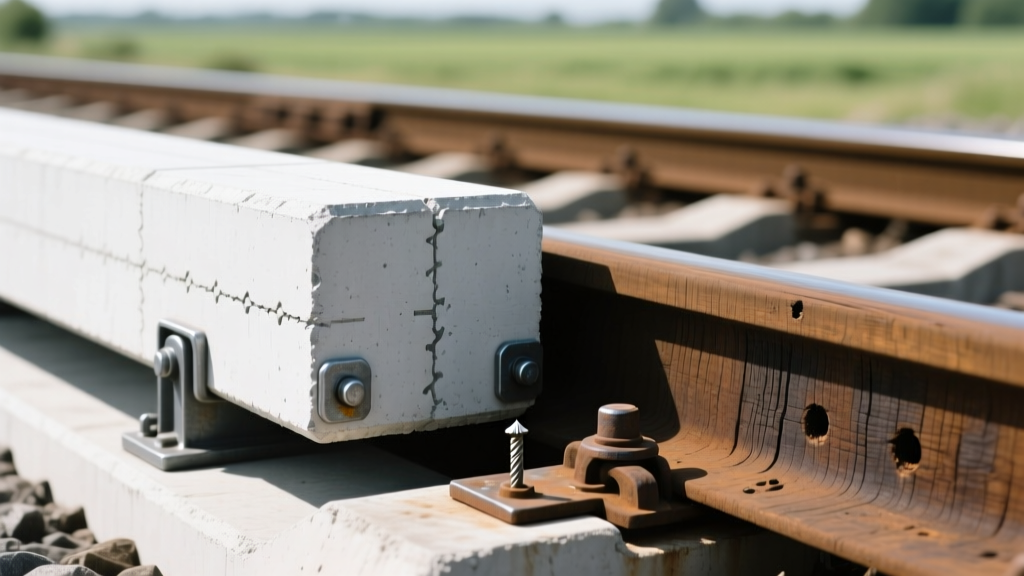
- Concrete Tie Fastening: Utilizes cast-in steel shoulders or glued-in plastic dowels to anchor elastic fasteners (e.g., Pandrol e2055 or Vossloh SKL clips). These elastic clips apply a continuous downward toe load of 2,000 to 3,000 lbs per clip. This constant clamping force maintains the rail seat even under severe thermal expansion and high-speed lateral forces, eliminating the need for mechanical spike friction.
Degradation Mechanics and Failure Modes
Understanding the specific failure modes of each material is essential for lifecycle cost modeling and predictive maintenance scheduling. The Federal Railroad Administration (FRA) tracks these degradation metrics to enforce track safety standards across Class I and shortline railroads.
Wood Tie Primary Failure Modes
- Plate Cutting: Dynamic impact loads cause the steel tie plate to embed into the timber, destroying the cant (tilt) of the rail and accelerating head fatigue on the rail steel.
- Spike Kill: Repeated tamping and lateral rail shift elongates the spike holes, resulting in a total loss of gauge retention. This is the leading cause of derailments on timber-track curves.
- Biological Decay: Fungal attack at the spike holes or tie ends, particularly in high-moisture environments where creosote leaching occurs.
Concrete Tie Primary Failure Modes
- Center Negative Cracking: Occurs when ballast fouling creates rigid support at the tie ends while the center is unsupported. The prestressing strands cannot resist the resulting negative bending moment, causing transverse snapping.
- Rail Seat Abrasion: If the polyurethane or rubber tie pad fails, the steel rail base grinds directly against the concrete, creating a slurry that accelerates wear and alters the rail cant.
- Longitudinal Splitting: Typically caused by improper handling (dropping ties) or excessive dynamic impact from wheel flats, propagating cracks along the prestressing strands.
Lifecycle Cost and Heavy-Haul Suitability
While the initial capital expenditure for concrete ties is 30% to 50% higher than timber, the lifecycle economics shift dramatically based on Million Gross Tons (MGT) traffic. According to durability frameworks outlined by the Portland Cement Association, prestressed concrete structures maintain structural integrity far beyond organic materials when subjected to continuous mechanical stress.
| Economic & Operational Metric | Wood Ties (Creosote Treated) | Prestressed Concrete Ties |
|---|---|---|
| Initial Unit Cost (Material Only) | $45 – $65 | $85 – $120 |
| Expected Service Life (Straight Track) | 15 – 25 years (approx. 300 MGT) | 40 – 50 years (approx. 800+ MGT) |
| Expected Service Life (Sharp Curves) | 5 – 10 years (due to gauge widening) | 30 – 40 years (elastic clip retention) |
| Ballast Degradation Rate | Moderate (flexibility absorbs impact) | High (stiffness transfers impact to rock) |
| Automated Inspection Compatibility | Low (irregular geometry confounds lasers) | High (uniform geometry enables high-speed scanning) |
Engineering Decision Matrix: Specification Guidelines
Use the following technical parameters to determine the optimal tie specification for new construction or full-depth relay projects.
Specify Prestressed Concrete Ties When:
- Axle loads routinely exceed 33 tons (heavy-haul coal, grain, or intermodal corridors).
- Operating speeds exceed 79 mph (high-speed passenger or express freight).
- Track geometry must be maintained to tight tolerances for automated track inspection vehicles.
- The curve radius is less than 1,000 feet, where wood ties would suffer rapid spike kill and gauge widening.
Specify Wood Ties When:
- Track is situated on weak, compressible subgrades (e.g., peat, soft clay) where the damping effect of timber is required to prevent ballast pulverization.
- The corridor is a low-speed, light-density branch line (less than 5 MGT annually) where the higher capital cost of concrete cannot be justified by maintenance savings.
- Frequent track geometry changes, switches, and crossings are required, as timber can be easily field-drilled and modified for custom frog and switch layouts.
- Extreme cold climates where concrete is susceptible to freeze-thaw spalling if air-entrainment specifications are not strictly maintained during manufacturing.
Written by
David NakamuraDavid Nakamura is a licensed architect (AIA) and construction technology writer focused on sustainable building methods, mass timber engineering, and high-performance building envelopes. He holds a Master of Architecture from the University of Washington and is a certified Passive House Consultant (CPHC). David spent eight years at the Seattle firm Mithun, where he led the design of three LEED Platinum projects, before founding his own practice specializing in net-zero residential design. He serves on the editorial advisory board of GreenBuilder Magazine and has authored peer-reviewed papers on cross-laminated timber (CLT) connections for the Journal of Structural Engineering. In his spare time, David teaches woodworking at Pratt Fine Arts Center and kayaks the Puget Sound.
More from David Nakamura
View all
Construction Cost
Labor Cost to Build a Deck Per Sq Ft: 2026 Installation Guide
Discover the exact labor cost to build a deck per sq ft in 2026. This installation guide breaks down contractor rates, complexity factors, and hidden fees.
Aug 4, 2026

Construction Cost
How Much Does It Cost to Build a 3 Bedroom House? Financing Guide
Learn exactly how much it costs to build a 3 bedroom house and explore 2026 financing options, construction loan types, and budget frameworks for your build.
Aug 4, 2026

Construction Cost
Cost to Build a Tennis Court: 2026 Guide
How much does it cost to build a tennis court in 2026? Breakdowns for asphalt, concrete, and synthetic surfaces plus fencing and lighting.
Jul 30, 2026